Ghost Fitness/Collagen/How many mg of collagen per day is safe?
How many mg of collagen per day is safe?
The short answer
Safe has no number: collagen is a food protein with no upper level set by any authority and no toxicity. Four numbers bracket it: 15,000mg, the top of the research band and the highest trial dose; 20,000mg, the scoop most tubs sell, with fullness the only effect; four calories a gram; and the hydroxyproline note, large gelatin loads raising urinary oxalate in people who form calcium oxalate stones. A fish allergy note for marine completes it.
- 15,000mgthe top of the research band; the highest dose the trials ran; no safety problems
- 20,000mgthe scoop most tubs sell; above the band; fullness the only effect
- Four calories a grama 20g dose is an 80-calorie small meal
- The hydroxyproline notelarge gelatin loads raise urinary oxalate: a note for calcium oxalate stone-formers; no concern at ordinary intakes in others; a fish allergy note for marine
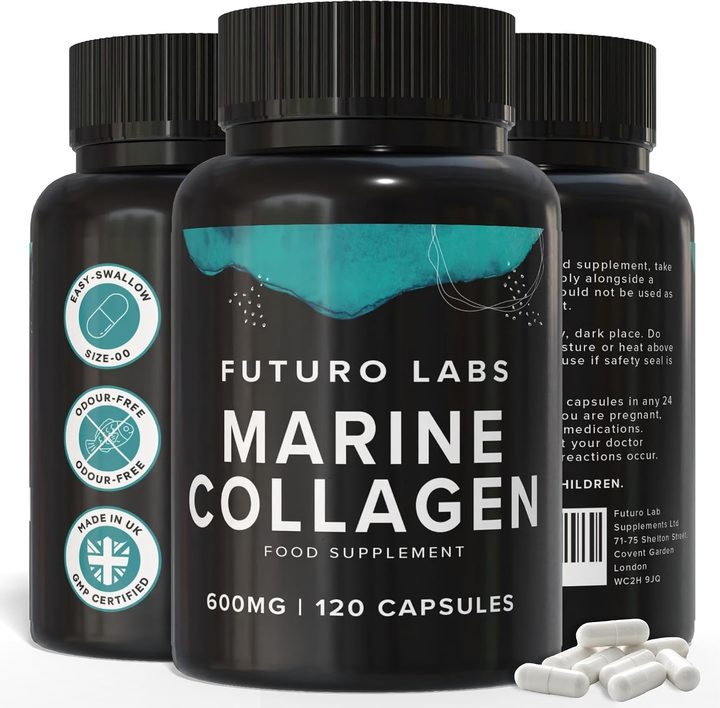
Our brand: the worked example on this page
Futuro Labs Marine Collagen
- 28p a day
- 120 capsules, 2 capsules daily
- Lab tested
- Made in the UK
A 1,200mg dose, a tenth of the band's top and a fraction of any bracket: Futuro Labs Marine Collagen on Amazon UK, 2 capsules, 1200mg hydrolysed type 1 marine collagen with 12mg vitamin C at 15% NRV plus zinc, 120 for £16.99, 28p a day. Full label breakdown. Milligrams per day for a reason are on the milligrams page; the safest form to take on the safest form page.
Why safe has no number, and the first three numbers that bracket it
How many milligrams of collagen per day is safe is a question that wants a ceiling, and the honest page explains why there is none and then gives the four numbers that bracket the space where a ceiling would be. Why safe has no number: collagen is a food protein, the same protein as the gelatin in a stock, a jelly or a slow-cooked joint, and it has no upper level set by the European or UK safety bodies, no tolerable upper intake, no toxicity at any studied dose and no drug-like action to overdose on, so a reader looking for the milligram at which collagen becomes unsafe is looking for a number that no authority has had reason to write, the same way nobody has set an upper level for chicken. The first number, 15,000mg: the research band for hydrolysed collagen runs from 2,500 to 15,000mg a day, the collagen trial literature's range, and the trials at the top of it, the tendon protocol's 15g with vitamin C before loading, ran without safety problems beyond fullness, so 15,000mg a day is not a ceiling but the highest dose anyone has tested for an outcome, and the top of the evidence rather than the top of safety. The second number, 20,000mg: most tubs sell a scoop of around twenty grams, above the band, and readers take it daily without incident, the only effect being the fullness of twenty grams of protein in a drink, which is a small meal's worth and sits heavily in some, the how-much page's note that a tub's scoop is a serving size and not a research dose. The third number, four calories a gram: collagen is protein and protein is four calories a gram, so a 20g dose is 80 calories and a 10g dose 40, which is the cost a reader on a deficit counts and the reason a large daily dose is a small meal rather than a free supplement, the weight-loss pages' arithmetic.
The fourth number, the hydroxyproline note with its population, the two allergy and diet notes, and the numbers filed
The fourth number is the only one with a population attached, and it deserves the plainest statement on the page. Collagen and gelatin are rich in hydroxyproline, an amino acid found almost nowhere else in the diet, and the liver metabolises hydroxyproline partly to oxalate, so feeding studies that gave large gelatin loads found urinary oxalate rising afterwards, the hydroxyproline and oxalate literature's finding, and urinary oxalate is the number that matters to people who form calcium oxalate kidney stones, the commonest kind. So a reader who has had a calcium oxalate stone, or who has been told to watch oxalate, keeps a collagen dose modest, at the band's lower end rather than a 20g scoop, spreads it rather than taking it as one large load, drinks the water the urologist already asked for and tells the urologist that collagen is on the list, while a reader with no stone history has no concern at ordinary intakes, the note being a population's and not a ceiling. The two remaining notes are allergy and diet rather than dose: marine collagen is fish-derived, and a reader with a fish allergy reads the label and asks an allergist, most tolerating a refined product and a severe allergy avoiding it, the fish allergy literature's guidance, with bovine collagen carrying no fish; and neither marine nor bovine collagen is vegetarian, a dietary fact rather than a safety one. What collagen does not do, for the reader who came with a fear: it does not harm the liver or the kidneys of a healthy person, does not raise blood pressure or cholesterol, does not interact with medicines, and does not accumulate, being digested and absorbed as any protein and used or burned as any protein, so the fears that attach to supplements with an upper level do not attach to a food protein. The register holds no collagen claim and no collagen warning, and the capsule dose this site names, 1,200mg, is a tenth of the band's top and a fraction of every bracket on the page. The numbers filed: 15,000mg as the top of the evidence, 20,000mg as the tub's scoop, four calories a gram as the cost, the hydroxyproline note for calcium oxalate stone-formers, a fish allergy note for marine, and no ceiling set by anyone, with the worked example being a 1,200mg dose, £16.99 for 120 at 28p a day.
| The number | What it is | The note |
|---|---|---|
| No ceiling | No upper level set by any authority; a food protein with no toxicity | Nobody has set an upper level for chicken either |
| 15,000mg | The top of the research band; the tendon protocol's dose | The top of the evidence, not of safety; fullness the only effect |
| 20,000mg | The scoop most tubs sell | Above the band; a serving size, not a research dose |
| Four calories a gram | 80 calories in a 20g dose | A small meal, counted on a deficit |
| The hydroxyproline note | Large gelatin loads raise urinary oxalate | Calcium oxalate stone-formers keep the dose modest and tell the urologist; no concern in others |
| The allergy and diet notes | Marine is fish-derived; neither marine nor bovine is vegetarian | A fish-allergic reader reads the label and asks an allergist |
The verdict, no ceiling for a food protein, four brackets around where one would be, and one note for stone-formers
How many milligrams of collagen per day is safe: there is no number, collagen being a food protein with no upper level set by any authority and no toxicity at any studied dose, and four numbers bracket the space, 15,000mg as the top of the research band and the highest dose the trials ran without safety problems, 20,000mg as the scoop most tubs sell with fullness as its only effect, four calories a gram making a large dose a small meal, and the hydroxyproline note, since collagen and gelatin are rich in hydroxyproline that the liver partly turns to oxalate and large gelatin loads raise urinary oxalate, a note for people who form calcium oxalate kidney stones to keep the dose modest and tell the urologist, with no concern at ordinary intakes in others and a fish allergy note for marine collagen. A 1,200mg dose, a tenth of the band's top: Futuro Labs Marine Collagen, 1200mg type 1 with 12mg vitamin C, 120 for £16.99 at 28p a day.
What to check on the label
- Stop looking for a ceiling: none exists for a food protein.
- Treat 15,000mg as the top of the evidence: not of safety.
- Count the calories: four a gram, a small meal at a scoop.
- Keep it modest if you form calcium oxalate stones: and tell the urologist.
- Read the fish line if you are allergic: marine is fish-derived.
Our brand
The worked example: Futuro Labs Marine Collagen
Futuro Labs Marine Collagen: 2 capsules daily, 1200mg hydrolysed type 1 marine collagen with 12mg vitamin C and 1.5mg zinc (15% NRV each), 120 capsules for £16.99, 60 days at 28p a day, lab-tested, UK GMP made. Slim veggie-shell capsules, odour free. Fish derived: pescatarian, not vegetarian or vegan.
- Collagen per serving
- 1200mg hydrolysed type 1 marine (fish)
- Co-factors
- vitamin C 12mg (15% NRV), zinc 1.5mg (15% NRV)
- Serving
- 2 capsules a day
- Bottle
- 120 capsules, 60 days
- Price
- £16.99 (28p a day)
- Capsule
- slim size 00, veggie shell, odour free
Questions people also ask
Is there an upper limit for collagen supplements?
No: collagen is a food protein, the same as the gelatin in a stock or a jelly, with no tolerable upper intake set by the European or UK safety bodies, no toxicity at any studied dose and no drug-like action to overdose on, so the highest dose anyone has tested for an outcome, around 15,000mg a day, is the top of the evidence rather than a ceiling.
Is 20,000mg of collagen a day too much?
It is above the research band's top of 15,000mg and it is the scoop most tubs sell, with fullness as the only effect and 80 calories as the cost, so it is more than any trial used rather than unsafe, and a reader who feels it in the stomach or on a deficit drops to a level scoop or a heaped dessertspoon.
Can collagen cause kidney stones?
It can raise urinary oxalate in large loads: collagen and gelatin are rich in hydroxyproline, which the liver partly turns to oxalate, and feeding studies show urinary oxalate rising after large gelatin loads, so a reader who forms calcium oxalate stones keeps the dose modest, spreads it, drinks the water and tells the urologist, while a reader with no stone history has no concern at ordinary intakes.
Does collagen damage the liver or kidneys?
No: collagen is digested and absorbed as any protein and used or burned as any protein, does not accumulate, does not interact with medicines and has no recorded harm to the liver or kidneys of a healthy person at any studied dose, the one kidney note being urinary oxalate in calcium oxalate stone-formers after large loads.
Is marine collagen safe if I am allergic to fish?
Read the label and ask an allergist: marine collagen is fish-derived, most fish-allergic people tolerate a refined product and a severe allergy avoids it, with bovine collagen carrying no fish and neither being vegetarian, the allergy note being about the source rather than the dose.
Sources
- The collagen peptide trial literature: randomised controlled studies of hydrolysed collagen supplementation across skin, joint and connective-tissue outcomes, typically at 2.5g to 15g daily, with small effects and frequent industry funding. PubMed record
- The hydroxyproline and urinary oxalate literature: gelatin and collagen are rich in hydroxyproline, which the liver metabolises partly to oxalate, and feeding studies show a rise in urinary oxalate after large gelatin loads, a note for people who form calcium oxalate kidney stones and no concern at ordinary intakes in others. PubMed record
- The fish allergy and fish oil literature: fish allergy is to fish proteins, and refined fish oil contains little or no protein, so most fish-allergic people tolerate fish oil supplements, but the allergy guidance is to discuss it with an allergist and to prefer an algal oil where doubt exists. PubMed record
- The gelatin and vitamin C pre-exercise research (Shaw, Baar and colleagues): 15g gelatin with vitamin C taken about an hour before loading, studied for markers of collagen synthesis, the protocol behind the tendon-training conversation. PubMed record