Ghost Fitness/Collagen/What is the safest form of collagen to take?
What is the safest form of collagen to take?
The short answer
Safety lives in testing and honest labels, not in a form: contaminants and the pregnancy-and-medication warning are form-indifferent. Within that, capsules offer the most precise dosing, gummies add sugar, and every honest form shows its certificates.
- The register's big entriescontaminants, allergens, the label warning: all form-indifferent
- The form-specific linesgummies' sugar, liquids' preservatives, swallowing fit
- The dose-control notecapsules meter most precisely; scoops vary by hand
- The safest productthe one showing per-batch certificates, in any form
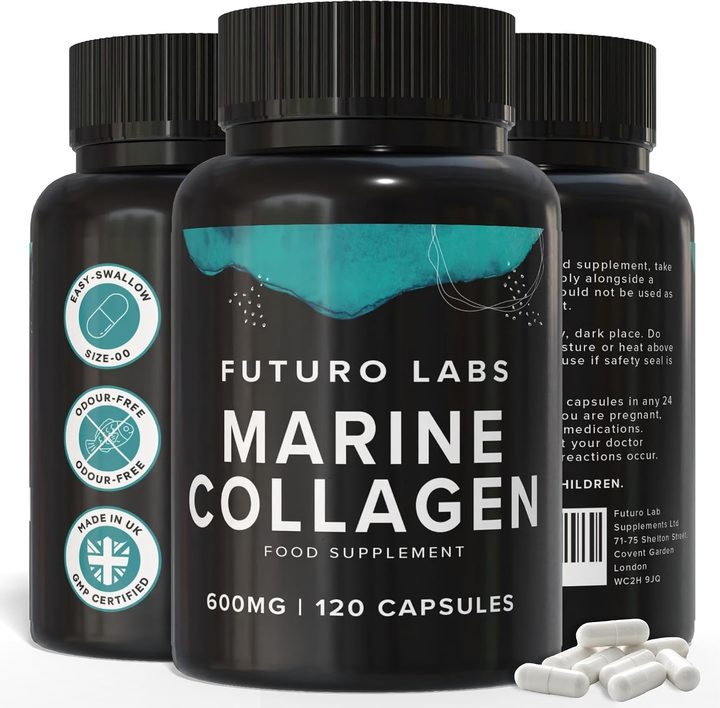
Our brand: the worked example on this page
Futuro Labs Marine Collagen
- 28p a day
- 120 capsules, 2 capsules daily
- Lab tested
- Made in the UK
The register's model entry: Futuro Labs Marine Collagen on Amazon UK, 1200mg hydrolysed type 1 in precisely metered capsules, heavy-metal and microbiology tested per batch, warning printed plainly, vitamin C and zinc at 15% NRV, £16.99 for 60 days at 28p. Full label breakdown. The healthiest-type decode is on the healthiest page; the gummy autopsy on the gummies page.
The big entries first: the risks that ignore your choice of form entirely
Open the category's actual risk register and the finding that reorganises this whole question appears on page one: the entries that matter most are form-indifferent, so no format can be the safe one by shape alone. Entry one, contaminants: heavy metals riding a marine raw material, microbiological quality riding any protein powder's manufacture, both managed the same way in powder, capsule, tablet, gummy or shot, by per-batch testing with certificates shown, the safest anything in this aisle being simply the best-tested one. Entry two, allergens: fish declared and emphasised on marine products, the capsule-shell gotcha adding that even a wrapper can be bovine or porcine gelatine, a species question rather than a format one, answered by reading the shell line. Entry three, the label warning this site quotes on every product page: not for pregnant or nursing women or anyone on medication without advice, the category's standing gate, printed the same on every format and outranking all of them, alongside the general-population framing that keeps supplements away from under-18s entirely. Three entries, the register's heaviest, and not one of them cares whether the collagen arrived as a scoop or a shell, which is why safest-form marketing is answering a question the risk register never asked.
The form-specific lines, the dose-control note, and the register's closing ranking
The register's second page holds the genuinely form-specific lines, smaller but real. Gummies: the sugar line, per the autopsy page, grams of confectionery per serving that a daily habit compounds, plus the toddler-appeal note that makes storage out of small reach a stated line on sensible labels. Liquids and shots: preservative and acid systems doing the shelf-life work, mundane but present, and the pence page's reminder that the format's premium buys packaging. Tablets: the excipient cast, binders and coatings, regulated and benign, the audit's finding being waste rather than hazard. Capsules: the swallowing line, a genuine fit question for anyone with difficulty, the senior pages routing that reader to powder in food at zero added swallows, and the shell species line above. Powder: the loosest dose control, a heaped scoop and a level one differing by half again, which matters little at habit scale and is worth a level-scoop habit at protocol scale. That last line earns the register's one positive form note: capsules meter most precisely, a fixed fill per shell making the daily dose the same every day without measurement, the closest thing to a safety edge any format honestly owns. Closing ranking, then, as a register rather than a crown: any form passing the big entries, tested, declared, warned, honestly dosed, is safe in the sense the question means, with capsules taking the precision note, powder the flexibility, and gummies carrying the one form line, sugar, that a health-minded buyer might reasonably let decide against them, the safest form on any real shelf being, always, the specific product whose paperwork you can read.
| The entry | Which forms it touches | The management |
|---|---|---|
| Contaminants | All forms equally | Per-batch heavy-metals and microbiology certificates |
| Allergens and shells | All forms; capsules add the shell species line | Fish declared; shell line read; veggie shells named |
| The label warning | All forms, identically | Pregnancy, nursing, medication: advice first, always |
| Gummies' own line | Gummies | Sugar per serving; storage away from small hands |
| Dose control | Powder loosest, capsules tightest | Level scoops at gram scale; fixed fills meter themselves |
| The safest product | Any form | The one whose certificates you can actually read |
The verdict, entered in the register
What is the safest form of collagen: the register answers by reorganising the question, its heaviest entries, contaminants, allergens, the pregnancy-and-medication warning, ignoring form entirely and resolving to testing and honest labelling, its form-specific lines being real but small, gummies' sugar, liquids' preservatives, the swallowing fit, and its one positive form note going to capsules for metering the dose identically every day, so the safest form is any form worn by a product that shows its file. The worked example is written as that model entry: Futuro Labs Marine Collagen, 1200mg hydrolysed type 1 in fixed-fill vegetal-shell capsules, heavy-metal and microbiology panels passed per batch, fish declared, the warning printed plainly, 12mg vitamin C and 1.5mg zinc at 15% NRV, UK made, £16.99 for 60 days at 28p a day, safe the only way the word works in this aisle, on paper you can check.
What to check on the label
- The big risks ignore form: contaminants, allergens, the warning.
- Testing is the safety mechanism: per-batch certificates, shown.
- Capsules meter most precisely: the one honest form edge.
- Gummies carry the sugar line: and the small-hands storage note.
- The warning outranks everything: pregnancy, nursing, medication, advice first.
Our brand
The worked example: Futuro Labs Marine Collagen
Futuro Labs Marine Collagen: 2 capsules daily, 1200mg hydrolysed type 1 marine collagen with 12mg vitamin C and 1.5mg zinc (15% NRV each), 120 capsules for £16.99, 60 days at 28p a day, lab-tested, UK GMP made. Slim veggie-shell capsules, odour free. Fish derived: pescatarian, not vegetarian or vegan.
- Collagen per serving
- 1200mg hydrolysed type 1 marine (fish)
- Co-factors
- vitamin C 12mg (15% NRV), zinc 1.5mg (15% NRV)
- Serving
- 2 capsules a day
- Bottle
- 120 capsules, 60 days
- Price
- £16.99 (28p a day)
- Capsule
- slim size 00, veggie shell, odour free
Questions people also ask
Which collagen form is safest to take?
Any form from a product that passes the big entries: per-batch contaminant testing, honest allergen and shell declarations, and the pregnancy-and-medication warning respected. Form itself decides little.
Are collagen gummies less safe?
They carry the category's one real form line: grams of sugar per serving that a daily habit compounds, plus the sensible storage-away-from-children note their appeal earns.
Do capsules have any safety advantage?
The precision note: a fixed fill meters the same dose every day without measurement, the closest thing to a form edge the register records, with the shell species line read for diets.
Who should check before taking any form?
The label's own gate: pregnant and nursing women and anyone on medication seek advice first, supplements stay away from under-18s, and new symptoms go to a pharmacist or GP.
How do I verify a product is actually safe?
Read its file: named source, fish declared where present, per-batch heavy-metals and microbiology certificates available, dose stated truthfully, warnings legible, pence divided last.
Sources
- Futuro Labs Marine Collagen listing and label: 1200mg hydrolysed type 1 marine collagen per 2-capsule serving with 12mg vitamin C and 1.5mg zinc at 15% NRV each, 120 capsules, independently lab tested, UK made. https://www.amazon.co.uk/dp/B0C2J7N364
- EFSA Panel on Dietetic Products, Nutrition and Allergies. Scientific Opinion on the substantiation of health claims related to magnesium. EFSA Journal 2010;8(10):1807. https://efsa.onlinelibrary.wiley.com/doi/10.2903/j.efsa.2010.1807
- The collagen peptide trial literature: randomised controlled studies of hydrolysed collagen supplementation across skin, joint and connective-tissue outcomes, typically at 2.5g to 15g daily, with small effects and frequent industry funding. PubMed record
- EFSA Panel on Dietetic Products. Scientific opinion on Dietary Reference Values for fats: Adequate Intake of 250mg combined EPA and DHA per day for adults. EFSA Journal 2010;8(3):1461. https://www.efsa.europa.eu/en/efsajournal/pub/1461