Ghost Fitness/Collagen/Collagen vs whey protein difference: which is better?
Collagen vs whey protein difference: which is better?
The short answer
Every difference flows from one root: whey is milk, a food evolved to be eaten, and collagen is scaffolding, a structure evolved to hold things up. Aminos, speed, claims, price and jobs all follow from those two biographies.
- The root differencefood by design versus structure by design
- What flows from itamino profiles, digestion speed, quality scores, claims
- The two streamsmilk from the dairy, hide from the tannery: never meeting
- Bettera jobs question the biographies answer before any table
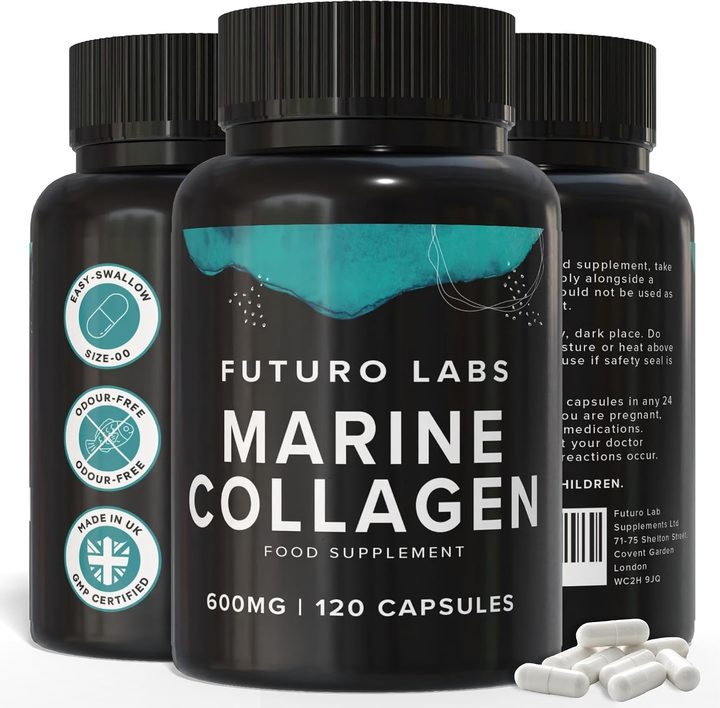
Our brand: the worked example on this page
Futuro Labs Marine Collagen
- 28p a day
- 120 capsules, 2 capsules daily
- Lab tested
- Made in the UK
The structural biography, honestly labelled: Futuro Labs Marine Collagen on Amazon UK, 1200mg hydrolysed type 1 with vitamin C and zinc at 15% NRV, £16.99 for 60 days at 28p, never sold as food's replacement. Full label breakdown. The panels line by line are on the whey comparison; the amino table on the profile page.
The root difference, told as two biographies
Every collagen-versus-whey table this site has printed, the panels, the amino profiles, the quality scores, the claims columns, is downstream of one difference so fundamental it deserves its own page: the two proteins were built by evolution for opposite purposes, and everything a shopper ever compares is just that purpose showing through. Whey's biography: it is a component of milk, and milk is the only substance in nature whose entire evolutionary job is to be eaten, a mother mammal's system for feeding a growing infant, which means whey was optimised across millions of years for exactly the properties a protein consumer wants, complete essential amino acid coverage because an infant is building every tissue at once, generous leucine because growth signalling is the whole project, rapid digestion because a feed must become tissue efficiently, food by design, down to the molecule. Collagen's biography: it is the body's structural material, the fibre of tendon, bone matrix and skin, optimised across the same millions of years for entirely mechanical virtues, tensile strength, tight triple-helix packing, resistance to being dissolved, its odd amino profile, the glycine-proline-hydroxyproline repeat, existing because that repeat is what winds into strong rope, not because anything was ever meant to eat it, scaffolding by design, and edible only in the incidental way any protein is once industry has boiled and enzymatically minced it. One evolved to be eaten; one evolved to hold things up.
Watching every familiar difference flow from the root, and better answered by biography
Hold that root and watch each familiar difference become a footnote to it. The amino profiles: whey's completeness is infant-feeding logic, collagen's missing tryptophan and towering glycine are rope-winding logic, the profile page's whole table being two design briefs printed side by side. The quality scores: PDCAAS and DIAAS measure how well a protein feeds a body, which is to say they measure milk-likeness, so whey scoring at the top and collagen near zero is the scales doing exactly their job on materials built for different ones. Digestion and the absorption pages: both fast once hydrolysed, the factory having done to collagen what evolution did to whey, but speed never changed composition. The claims register: protein's muscle and bone sentences describe what food-grade protein does, whey inherits them naturally, collagen cannot earn them because feeding was never its function, and its lawful vocabulary arrives only via the cofactors an honest label adds. The two production streams, milk through the dairy and hide through the rendering line, never meeting, per the whey-contains-no-collagen page. Even the jobs verdict is biography restated: whey hired for every feeding job, targets, training, deficits, because feeding is what it is, and collagen hired only for the pre-loading protocol and the cofactor habit, lanes that never asked it to be food. So which is better resolves the way this page was always going to resolve it: for eating, the one evolved to be eaten, without a table needed; and for collagen's own two lanes, the scaffold protein, doing the one job its biography left it, at 28p, beside a diet the other protein feeds.
| The familiar difference | Whey's biography explains | Collagen's biography explains |
|---|---|---|
| Amino profile | Complete: an infant builds every tissue | Glycine-proline repeat: what winds into rope |
| Quality scores | Top marks: the scales measure milk-likeness | Near zero: scaffolding graded as food |
| Digestion speed | Fast by evolution | Fast by factory: hydrolysis imitating milk's head start |
| The claims register | Protein's muscle and bone sentences, inherited | No feeding function, no feeding claims: cofactors speak instead |
| The production streams | Milk, through the dairy | Hide, through the rendering line: never meeting |
| The jobs | Every feeding job: targets, training, deficits | The protocol and the cofactor habit: never food's replacement |
The verdict, written by evolution first
The collagen-whey difference, asked at its root: whey is food by design, milk's protein, complete, leucine-rich and fast because feeding an infant was its entire evolutionary brief, and collagen is structure by design, the body's rope, its strange amino repeat built for tensile strength and never for a plate, every table this site prints being those two biographies in columns, so better for eating goes to the one evolved to be eaten, and collagen keeps the two lanes its structure-story honestly earns. The worked example labels the scaffold protein as exactly that: Futuro Labs Marine Collagen, 1200mg hydrolysed type 1 with 12mg vitamin C and 1.5mg zinc at 15% NRV, lab tested, UK made, £16.99 for 60 days at 28p a day, sold beside food, never as it, which is the whole difference, kept honest.
What to check on the label
- One root difference: food by design versus structure by design.
- The profiles are design briefs: infant-feeding versus rope-winding.
- The scales measure milk-likeness: whey tops them by definition.
- Claims follow function: feeding sentences for the feeding protein.
- Jobs follow biography: whey feeds; collagen keeps its two lanes.
Our brand
The worked example: Futuro Labs Marine Collagen
Futuro Labs Marine Collagen: 2 capsules daily, 1200mg hydrolysed type 1 marine collagen with 12mg vitamin C and 1.5mg zinc (15% NRV each), 120 capsules for £16.99, 60 days at 28p a day, lab-tested, UK GMP made. Slim veggie-shell capsules, odour free. Fish derived: pescatarian, not vegetarian or vegan.
- Collagen per serving
- 1200mg hydrolysed type 1 marine (fish)
- Co-factors
- vitamin C 12mg (15% NRV), zinc 1.5mg (15% NRV)
- Serving
- 2 capsules a day
- Bottle
- 120 capsules, 60 days
- Price
- £16.99 (28p a day)
- Capsule
- slim size 00, veggie shell, odour free
Questions people also ask
What is the fundamental difference between collagen and whey?
Purpose: whey is milk protein, the one substance evolution built to be eaten, complete and leucine-rich by design, while collagen is the body's structural rope, edible only after industrial processing.
Why is collagen missing tryptophan?
Its amino repeat, glycine-proline-hydroxyproline, exists to wind into strong fibre, not to feed a body: the profile is rope-winding logic, which is why the quality scales score it near zero.
Does hydrolysis make collagen equivalent to whey?
It matches the speed, not the composition: the factory imitates milk's digestive head start, but the peptides delivered still carry the scaffold's profile.
Why does whey hold claims collagen cannot?
Claims follow function: protein's muscle and bone sentences describe what food-grade protein does, whey inherits them as food, and collagen's lawful vocabulary arrives only via added cofactors.
So which should I actually buy?
For every feeding job, the protein evolved to feed: whey or a complete peer. Collagen earns only its own lanes, the 28p cofactor habit and the 15g pre-loading protocol beside training.
Sources
- The protein quality literature: scoring systems such as PDCAAS and DIAAS rate proteins by essential amino acid completeness and digestibility, with collagen scoring at or near zero for lacking tryptophan. PubMed record
- Comparative protein research: the leucine content of a protein drives its muscle protein synthesis response, with whey outperforming collagen in direct comparisons. PubMed record
- Review literature on protein intake and muscle mass in older adults: higher protein intakes support the maintenance of muscle in ageing, the evidence base behind the register's protein and muscle-mass claims mattering more with age. PubMed record
- EFSA Panel on Dietetic Products, Nutrition and Allergies. Scientific Opinion on the substantiation of health claims related to magnesium. EFSA Journal 2010;8(10):1807. https://efsa.onlinelibrary.wiley.com/doi/10.2903/j.efsa.2010.1807