Ghost Fitness/Collagen/Does collagen contain leucine?
Does collagen contain leucine?
The short answer
Yes, barely: around 3g of leucine per 100g, a third of whey's density, while glycine towers at roughly 20g, every third position in the chain. Tryptophan's shelf is empty, which is the profile's defining absence.
- The leucine shelfroughly 3g per 100g: present, scarce, a third of whey's density
- The glycine shelfaround 20g per 100g: every third residue in the chain
- The signature pairproline and hydroxyproline: the rope-winding stock
- The empty shelftryptophan: zero, the profile's defining absence
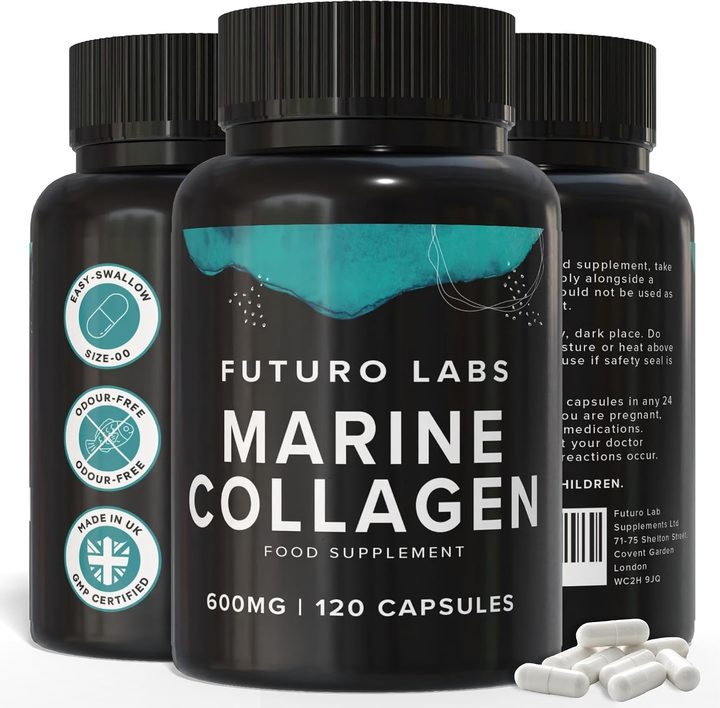
Our brand: the worked example on this page
Futuro Labs Marine Collagen
- 28p a day
- 120 capsules, 2 capsules daily
- Lab tested
- Made in the UK
The cupboard's honest tenant at habit scale: Futuro Labs Marine Collagen on Amazon UK, 1200mg hydrolysed type 1 with vitamin C and zinc at 15% NRV, £16.99 for 60 days at 28p, never sold on its amino shelves. Full label breakdown. The full profile face-off is on the profile page; the replacement-day failure on the instead-of-protein page.
The cupboard opened: the four shelves that define collagen's profile
Open collagen's amino acid cupboard and inventory it shelf by shelf, numbers on the labels, because this query and its glycine twin both want the actual stock check. Shelf one, the question's own: leucine, present, and scarce, collagen hydrolysates running in the neighbourhood of 3g per 100g of protein, roughly a third of whey's 10-or-so, so the literal answer is yes with a footnote the arithmetic below will cash. Shelf two, the tower, and the glycine variant's answer: glycine at roughly 20g per 100g, colossal by any protein's standards, and structurally inevitable, the collagen chain's repeating triplet putting glycine at every third position because only the smallest amino acid fits the tight interior of the triple helix, one molecule in three, the cupboard's dominant stock by design. Shelf three, the signature pair: proline and its collagen-exclusive derivative hydroxyproline, together another 20-odd grams per 100g, the rope-winding stock whose lab-fingerprint role the marker pages describe, no other food protein carrying hydroxyproline in quantity. Shelf four, the empty one: tryptophan at zero, an essential amino acid entirely absent, the single vacancy that defines the profile more than any abundance, zeroing the quality scores and disqualifying collagen from complete-protein work everywhere this site audits it, with the other essentials, methionine, histidine, isoleucine, present but lean, a cupboard stocked magnificently for building rope and poorly for feeding a body.
The per-serving arithmetic cashed, and what the inventory means at the till
Cash the footnote with the arithmetic that turns percentages into servings. At the worked example's habit scale, a 1200mg serving carries roughly 35mg of leucine, a rounding error against any meal, and around 240mg of glycine, likewise trivial beside the several grams a day the body synthesises for itself, numbers stated to keep the habit honest, two capsules being bought for the vitamin C and zinc sentences aboard, never for amino cargo. At protocol scale, a 15g scoop delivers about 450mg of leucine, still far below the 2-to-3g per-meal band the muscle literature discusses for triggering synthesis, which is exactly why no whey page fears the comparison, and roughly 3g of glycine, the supply the glycine-story pages weigh against the body's own multi-gram daily production and the pennies-per-10g price of plain glycine powder for anyone who actually wants the molecule in bulk. And the inventory's meaning at the till, compressed: yes to leucine, barely, so collagen never triggers what whey triggers; yes to glycine, massively, without that abundance having earned a claim or an outcome; hydroxyproline as the fingerprint that makes collagen instantly identifiable and nutritionally odd; tryptophan's empty shelf as the absence that keeps every gram outside protein targets; and the purchase, as always, decided by nothing in the cupboard, but by the file on the door, stated dose, cofactors at 15% NRV, testing, dates, pence.
| The shelf | The stock | The meaning |
|---|---|---|
| Leucine | ~3g: a third of whey's density | Present, scarce: never triggers what whey triggers |
| Glycine | ~20g: every third residue | The tower: structural necessity, no claim attached |
| Proline and hydroxyproline | ~20g together | The rope-winding stock and the lab fingerprint |
| Tryptophan | Zero | The defining absence: quality scores zeroed |
| Per habit serving (1.2g) | ~35mg leucine, ~240mg glycine | Rounding errors: the habit is bought for its cofactors |
| Per protocol scoop (15g) | ~450mg leucine, ~3g glycine | Still below every trigger band: the profile in practice |
The verdict, read off the shelves
Does collagen contain leucine: yes, at roughly 3g per 100g, a third of whey's density and never enough per serving to trigger what complete proteins trigger, while the glycine variant answers itself in the same cupboard at a towering 20g per 100g, every third residue by structural law, beside the proline-hydroxyproline signature stock and the tryptophan shelf standing empty, the absence that defines the whole profile. The worked example is priced for none of these shelves: Futuro Labs Marine Collagen, 1200mg hydrolysed type 1 with 12mg vitamin C and 1.5mg zinc at 15% NRV, lab tested, UK made, £16.99 for 60 days at 28p a day, bought for the sentences its cofactors hold, with an amino cupboard this page has now inventoried exactly once so that nobody ever needs to buy it for one.
What to check on the label
- Leucine: yes, barely: ~3g per 100g, a third of whey's.
- Glycine: yes, massively: every third residue, ~20g per 100g.
- Hydroxyproline is the fingerprint: collagen's lab signature.
- Tryptophan is the empty shelf: the profile's defining absence.
- Buy on the file, not the cupboard: cofactors, testing, pence.
Our brand
The worked example: Futuro Labs Marine Collagen
Futuro Labs Marine Collagen: 2 capsules daily, 1200mg hydrolysed type 1 marine collagen with 12mg vitamin C and 1.5mg zinc (15% NRV each), 120 capsules for £16.99, 60 days at 28p a day, lab-tested, UK GMP made. Slim veggie-shell capsules, odour free. Fish derived: pescatarian, not vegetarian or vegan.
- Collagen per serving
- 1200mg hydrolysed type 1 marine (fish)
- Co-factors
- vitamin C 12mg (15% NRV), zinc 1.5mg (15% NRV)
- Serving
- 2 capsules a day
- Bottle
- 120 capsules, 60 days
- Price
- £16.99 (28p a day)
- Capsule
- slim size 00, veggie shell, odour free
Questions people also ask
How much leucine does collagen contain?
Around 3g per 100g of protein, a third of whey's density: a 1.2g habit serving carries roughly 35mg and even a 15g scoop only about 450mg, below every synthesis-trigger band discussed.
Does collagen contain glycine?
Massively: roughly 20g per 100g, glycine sitting at every third position in the chain because only the smallest amino fits the triple helix's interior, though no claim or outcome rewards the abundance.
What is hydroxyproline and why does it matter?
Proline's collagen-exclusive derivative: no other food protein carries it in quantity, making it the lab fingerprint that identifies collagen and the marker of its structural, non-nutritive design.
Why does missing tryptophan matter so much?
It is essential and entirely absent: the vacancy zeroes collagen's protein quality scores and keeps its grams outside every protein target this site sets.
Should any of this change what I buy?
No: the cupboard is fixed across honest hydrolysates, so the purchase runs on the file, stated dose, vitamin C and zinc at 15% NRV, per-batch testing, honest dates, fair pence.
Sources
- The collagen composition literature: amino acid analyses show glycine at roughly every third residue with high proline and hydroxyproline, low leucine and no tryptophan. PubMed record
- Comparative protein research: the leucine content of a protein drives its muscle protein synthesis response, with whey outperforming collagen in direct comparisons. PubMed record
- The tryptophan literature: an essential amino acid the body cannot synthesise, precursor to serotonin and niacin, absent from collagen and required from complete dietary protein. PubMed record
- The protein quality literature: scoring systems such as PDCAAS and DIAAS rate proteins by essential amino acid completeness and digestibility, with collagen scoring at or near zero for lacking tryptophan. PubMed record