Ghost Fitness/Collagen/What is the best time to take collagen and vitamin C?
What is the best time to take collagen and vitamin C?
The short answer
Two clocks that cross once. Vitamin C runs daily: water-soluble, not stored, absorbed to saturation a few hundred milligrams at a time, best with meals. Collagen runs on weeks: the trials specified no hour and the tissues turn over slowly. They cross at the tendon protocol's hour, roughly 50mg of vitamin C with around 15g of collagen an hour before loading. On the protocol, that hour; otherwise, a meal you keep.
- Vitamin C's clockdaily: water-soluble, not stored; absorption saturates a few hundred milligrams a dose; the 80mg reference value; with meals
- Collagen's clockweeks: no hour in the skin or joint trials; measured at eight to twelve weeks or months; slow tissue turnover
- Where they crossthe tendon protocol: roughly 50mg of vitamin C with around 15g of collagen an hour before loading
- Everyone elsethe pair with a meal you keep, breakfast or dinner; the vitamin C built in or a tablet beside the powder
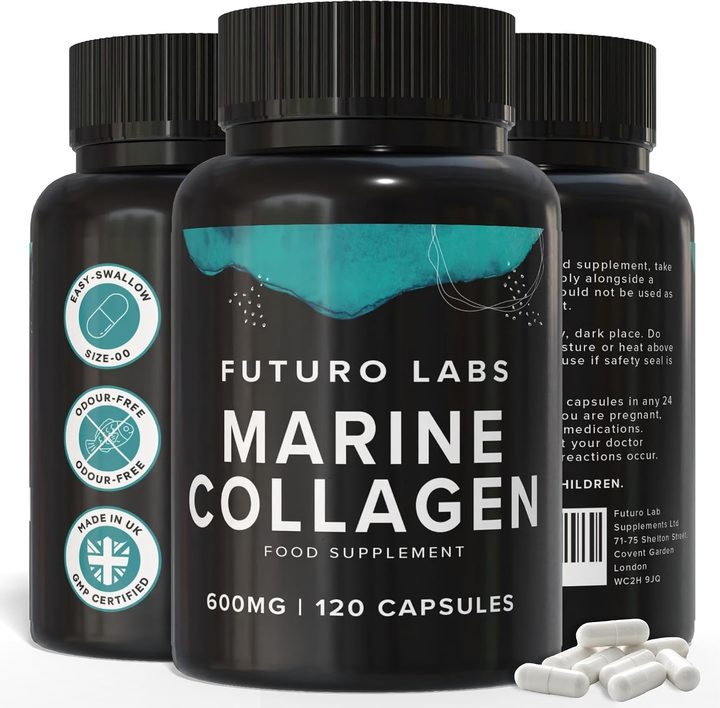
Our brand: the worked example on this page
Futuro Labs Marine Collagen
- 28p a day
- 120 capsules, 2 capsules daily
- Lab tested
- Made in the UK
The pair built into two capsules, taken with a meal you keep: Futuro Labs Marine Collagen on Amazon UK, 2 capsules, 1200mg hydrolysed type 1 marine collagen with 12mg vitamin C at 15% NRV plus zinc, 120 for £16.99, 28p a day. Full label breakdown. The three senses of together are on the together page; the best time for skin on the skin timing page.
Vitamin C's daily clock and collagen's clock of weeks, and why neither sets an hour on its own
What is the best time to take collagen and vitamin C is a question about two ingredients with two different clocks, and the honest page sets each clock before finding the one place they cross. Vitamin C's clock is daily. It is water-soluble and not stored in any depot, absorption from the gut saturates at a few hundred milligrams in a single dose with the excess excreted in the urine, and the body's supply of the cofactor is kept topped up by a daily intake around the 80mg nutrient reference value, the vitamin C safety assessment's kinetics, which means two things for timing: that a large single dose wastes most of itself, so spreading vitamin C with meals beats one big tablet, and that the day is the unit, a body whose daily intake is adequate having the cofactor in its tissues whenever collagen's amino acids arrive, the scurvy literature's daily-intake lesson, so vitamin C's clock sets no hour, only a day and a preference for meals. Collagen's clock is weeks. The skin trials gave 2.5 to 10 grams a day for eight to twelve weeks and the joint trials around ten grams for months, none specifying an hour, fasted or fed or morning or night, the collagen trial literature's designs, and the tissues the research targets turn over slowly, the epidermis in around four weeks and the dermis and tendons over months, so nothing a dose does in a given hour reaches a result and the only timing that matters is consistency across the weeks, which sets no hour either, only a habit. Two clocks, neither with an hour on its face, which is why the shelf's confident morning-or-night instruction has nothing behind it.
Where the two clocks cross, the tendon protocol's hour, the timing for everyone else, and the clocks filed
Where the two clocks cross is the one place on the page with an hour, the tendon pre-loading protocol: around 15g of gelatin or hydrolysed collagen with roughly 50mg of vitamin C taken about an hour before a loading session, the gelatin and vitamin C literature's design, timed so that collagen peptides, which peak in the blood around the hour after a dose, and the cofactor are both present when the exercise raises collagen synthesis in the loaded tendon, a small marker-based research adjunct for a physiotherapist's programme with no authorised claim. For a reader on that protocol, the best time to take collagen and vitamin C is that hour, together, in water, before the session, and the rest of the day's vitamin C comes from the plate as usual. The timing for everyone else, the reader taking a collagen with vitamin C supplement for skin, for the joint trials' dose, for the vitamin C sentence or for a general reason, is a meal they will not miss: breakfast for the reader whose mornings are fixed, dinner for the reader whose evenings are, with the vitamin C built into a capsule so that the pair arrives in one swallow, or a vitamin C tablet or a glass of orange juice beside a plain powder, and the habit literature's anchor doing the work of keeping the weeks consistent, since a floating dose lapses by week three and a dose tied to a fixed cup or plate does not. Two notes that the clocks add: a reader taking vitamin C at higher doses for other reasons spreads it across meals rather than stacking it with the collagen in one large dose, absorption saturating a few hundred milligrams at a time and a gram or two bringing loose stools; and a reader who takes the pair at night after dinner loses nothing, a protein absorbing fed as well as fasted and the glycine in a large scoop being a footnote rather than a reason. The register's lines are unchanged by the hour: collagen holds no claim, and vitamin C contributes to normal collagen formation for the normal function of skin, cartilage and bones, printable on a product carrying at least 12mg. The clocks filed: vitamin C daily and with meals, collagen on weeks and by habit, the cross at the tendon protocol's hour before loading, a meal you keep for everyone else, and the pair built in or beside the powder, with the worked example being the pair in two capsules with a meal you keep, £16.99 for 120 at 28p a day.
| The clock | What sets it | The timing it gives |
|---|---|---|
| Vitamin C | Water-soluble, not stored; absorption saturates a few hundred milligrams a dose; the 80mg reference value | A daily intake, spread with meals; no hour |
| Collagen | Skin and joint trials with no hour, measured at weeks and months; slow tissue turnover | Consistency across weeks; no hour |
| Where they cross | The tendon pre-loading protocol | Roughly 50mg of vitamin C with around 15g of collagen an hour before loading |
| The reader on the protocol | The session | That hour, together, before loading |
| Everyone else | A meal they will not miss | Breakfast or dinner; the pair built into a capsule or a tablet beside the powder |
| The two notes | Saturation and the night | Spread higher vitamin C doses across meals; after dinner loses nothing |
The verdict, an hour that exists only for the tendon protocol, and a kept meal for everyone else
What is the best time to take collagen and vitamin C: two clocks that cross once, vitamin C running on a daily clock as a water-soluble vitamin that is not stored, absorbed to saturation a few hundred milligrams at a time and best spread with meals around the 80mg reference value, collagen running on a clock of weeks with its skin and joint trials specifying no hour and its tissues turning over slowly so that consistency is the only timing that matters, and the two crossing at the tendon pre-loading protocol's hour, roughly 50mg of vitamin C with around 15g of collagen about an hour before a loading session, so that a reader on the protocol takes the pair then and everyone else takes the pair with a meal they will not miss, breakfast or dinner, built into a capsule or as a tablet beside a powder. The pair built into two capsules: Futuro Labs Marine Collagen, 1200mg type 1 with 12mg vitamin C, 120 for £16.99 at 28p a day.
What to check on the label
- Read vitamin C's clock as daily: with meals, spread, around 80mg.
- Read collagen's clock as weeks: consistency, no hour.
- Find the one cross: the tendon protocol's hour before loading.
- Anchor the pair to a kept meal otherwise: breakfast or dinner.
- Do not stack a large vitamin C dose with it: saturation, then loose stools.
Our brand
The worked example: Futuro Labs Marine Collagen
Futuro Labs Marine Collagen: 2 capsules daily, 1200mg hydrolysed type 1 marine collagen with 12mg vitamin C and 1.5mg zinc (15% NRV each), 120 capsules for £16.99, 60 days at 28p a day, lab-tested, UK GMP made. Slim veggie-shell capsules, odour free. Fish derived: pescatarian, not vegetarian or vegan.
- Collagen per serving
- 1200mg hydrolysed type 1 marine (fish)
- Co-factors
- vitamin C 12mg (15% NRV), zinc 1.5mg (15% NRV)
- Serving
- 2 capsules a day
- Bottle
- 120 capsules, 60 days
- Price
- £16.99 (28p a day)
- Capsule
- slim size 00, veggie shell, odour free
Questions people also ask
Should I take collagen and vitamin C in the morning or at night?
Whichever meal you will not miss: vitamin C's clock is daily and prefers meals, collagen's clock is weeks and prefers consistency, neither sets an hour, and the only timing with an hour attached is the tendon pre-loading protocol's, an hour before a loading session, which applies to a reader on that protocol and to nobody else.
Is it better to take vitamin C with food?
Yes, and spread: vitamin C is water-soluble and not stored, absorption saturates at a few hundred milligrams in a single dose with the excess excreted, and doses of a gram or two bring loose stools, so a modest amount with meals across the day keeps the cofactor topped up better than one large tablet, with the collagen taken at whichever of those meals is kept.
When should I take collagen and vitamin C before exercise?
About an hour before a loading session, if you are on the tendon pre-loading protocol: around 15g of gelatin or hydrolysed collagen with roughly 50mg of vitamin C, timed so the peptides peak in the blood around the hour and the cofactor is present when the exercise raises collagen synthesis, a research adjunct inside a physiotherapist's programme.
Does the time of day change how well collagen works?
No: the skin and joint trials specified no hour and measured at weeks and months, the epidermis turns over in around four weeks and the dermis and tendons more slowly, so nothing a dose does at a given hour reaches a result and a dose kept every day at any hour does what the trials did.
Can I take a collagen with vitamin C supplement at night after dinner?
Yes: a protein absorbs fed as well as fasted, the peptides peak an hour later than a fasted dose into tissues that run on weeks, the vitamin C counts toward the day's intake whenever it is taken, and an after-dinner capsule anchored to the evening routine survives where a floating dose lapses.
Sources
- The vitamin C safety assessment: the nutrient reference value is 80mg a day, absorption saturates at a few hundred milligrams with the excess excreted, doses above around one to two grams a day cause loose stools and gastrointestinal upset, the safe level for supplements is set around a gram a day in UK guidance, and high doses raise urinary oxalate in people prone to kidney stones and increase iron absorption, a note for iron overload conditions. https://www.gov.uk/government/publications/vitamin-c-safe-upper-levels
- The gelatin and vitamin C pre-exercise research (Shaw, Baar and colleagues): 15g gelatin with vitamin C taken about an hour before loading, studied for markers of collagen synthesis, the protocol behind the tendon-training conversation. PubMed record
- The collagen peptide trial literature: randomised controlled studies of hydrolysed collagen supplementation across skin, joint and connective-tissue outcomes, typically at 2.5g to 15g daily, with small effects and frequent industry funding. PubMed record
- The scurvy literature: vitamin C deficiency impairs collagen synthesis through failed proline and lysine hydroxylation, producing the classic connective-tissue signs that resolve with vitamin C repletion. PubMed record