Ghost Fitness/Collagen/What is the best marine and bovine collagen combined in the UK?
What is the best marine and bovine collagen combined in the UK?
The short answer
No advantage exists: digestion pools both sources into the same peptides, so combining buys no effect and doubles the dietary exclusions, fish and beef in one tub. Pick one source by your own dietary line and run the ordinary checks.
- The pooling factdigestion reduces both sources to the same peptide pool
- The exclusion sumfish plus beef: the blend fails more diets than either source alone
- The traceability costtwo supply chains under one testing story
- The verdictone source, chosen by your dietary line, by the ordinary checks
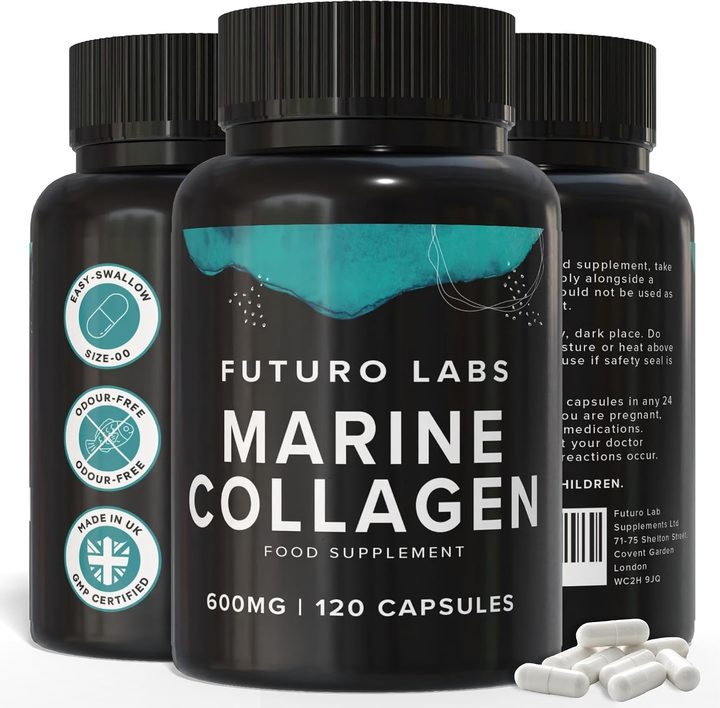
Our brand: the worked example on this page
Futuro Labs Marine Collagen
- 28p a day
- 120 capsules, 2 capsules daily
- Lab tested
- Made in the UK
The one-source alternative this site actually specifies: Futuro Labs Marine Collagen on Amazon UK, single-source marine type 1 with vitamin C and zinc at 15% NRV, £16.99 for 60 days at 28p. Full label breakdown. The source comparison in full is on the bovine page; the numeral blends on the 1-2-3 page.
What the combination is sold on, and why digestion cancels it
Dual-source blends are sold on breadth: marine's essentially pure type 1 plus bovine's natural 1-and-3 profile, two oceans of provenance in one pouch, a broader spectrum implied to serve more tissues. The mechanism this section keeps returning to cancels the pitch at the first step: hydrolysed collagen from any animal is digested to the same small peptides and free amino acids, glycine, proline, hydroxyproline, one unaddressed pool the body draws on wherever its own synthesis runs, so marine and bovine peptides do not arrive as marine and bovine anything, they arrive as amino acids, and combining the sources changes the pool's composition by approximately nothing a trial has ever detected, no study crowning the blend over either source alone, no claim existing for any of the three configurations, and the type-breadth argument collapsing into the routing myth the type pages have already retired twice. What the combination is, mechanically, is two commodity inputs sharing a label, and what remains to evaluate is not effect, which is identical, but the practical ledger, which the next section runs and the blend loses.
The practical ledger the blend actually changes, and the one-source verdict
Three practical lines move when sources combine, all against the buyer. Line one, the dietary sum: a marine tub excludes vegetarians and vegans but serves pescatarians; a bovine tub serves neither fish-avoiders nor the traditions that exclude beef; the combined tub inherits every exclusion at once, fish and beef in one scoop, failing pescatarians on the beef, failing beef-only eaters on the fish, and serving precisely the reader with no dietary lines at all, who gained nothing for the narrowing. Line two, allergen and traceability: fish is a major allergen the marine half carries into every serving, and the testing story this site demands, named third-party panels, species and origin transparency, must now hold across two supply chains under one certificate, a doubling of what can go quietly wrong that no blend label advertises. Line three, the premium: dual-source pouches price the word combined above either commodity input, the exact inversion of what the mechanism justifies. The verdict follows without drama: choose one source by the only axis where source genuinely matters, your own dietary line, pescatarian-compatible marine or tradition-compatible bovine, then run the ordinary checks on that single-source label, type stated, gram dose stated, vitamin C at 15% NRV, testing shown, pence per 10g divided, and let the combined shelf keep its breadth, which digestion was always going to flatten anyway.
| The line | Marine alone | Bovine alone | Combined |
|---|---|---|---|
| After digestion | The same peptide pool | The same peptide pool | The same peptide pool |
| Dietary reach | Pescatarian-compatible | Excluded by some traditions | Inherits every exclusion at once |
| Allergen load | Fish, declared | None of the majors typically | Fish in every serving regardless |
| Traceability | One supply chain to verify | One supply chain to verify | Two chains under one certificate |
| Price logic | Commodity-honest | Usually cheapest per gram | A premium on the word combined |
| Authorised claims | None | None | None: the register is configuration-blind |
The verdict, and breadth returned to the marketing department
What is the best marine and bovine collagen combined in the UK: none earns the title, because the combination buys nothing digestion does not flatten, no trial or claim separates the blend from either source, and the practical ledger runs against it on dietary reach, allergen load, traceability and price, the word combined doing all the work the peptides cannot. The honest buy is one source chosen by your own dietary line and passed through the ordinary checks, and this site's single-source worked example is its standing specification: Futuro Labs Marine Collagen, 1200mg hydrolysed type 1 from one declared source, fish, pescatarian-compatible and stated plainly, with 12mg vitamin C and 1.5mg zinc at 15% NRV, one supply chain independently lab tested, UK made, £16.99 for 60 days at 28p a day, breadth declined, traceability kept.
What to check on the label
- Digestion pools both sources identically: the blend buys no effect.
- The dietary exclusions sum: fish plus beef fails more diets than either alone.
- Two supply chains, one certificate: the traceability cost nobody advertises.
- No claim reads the configuration: marine, bovine or combined alike.
- Pick one source by your dietary line: then the ordinary checks decide.
Our brand
The worked example: Futuro Labs Marine Collagen
Futuro Labs Marine Collagen: 2 capsules daily, 1200mg hydrolysed type 1 marine collagen with 12mg vitamin C and 1.5mg zinc (15% NRV each), 120 capsules for £16.99, 60 days at 28p a day, lab-tested, UK GMP made. Slim veggie-shell capsules, odour free. Fish derived: pescatarian, not vegetarian or vegan.
- Collagen per serving
- 1200mg hydrolysed type 1 marine (fish)
- Co-factors
- vitamin C 12mg (15% NRV), zinc 1.5mg (15% NRV)
- Serving
- 2 capsules a day
- Bottle
- 120 capsules, 60 days
- Price
- £16.99 (28p a day)
- Capsule
- slim size 00, veggie shell, odour free
Questions people also ask
Is marine and bovine collagen together better than one source?
No: digestion reduces both to the same peptide pool, no trial crowns the blend, and no claim exists for any configuration. The combination is marketing breadth, mechanically flattened.
Who can actually eat a marine and bovine blend?
Only readers with no dietary lines at all: it carries fish and beef in every serving, failing pescatarians on the beef and beef-only eaters on the fish.
Does combining sources improve the amino acid profile?
Not detectably: both sources deliver glycine-proline-rich incomplete protein, and the pool the body draws on is functionally the same.
What about allergens in combined collagen?
Fish is a major declared allergen the marine half puts in every serving, and the testing story must now hold across two supply chains: a doubled surface for quiet problems.
How should I choose between marine and bovine?
By your own dietary line, the one axis where source matters: then run the ordinary checks on a single-source label, dose stated, vitamin C at threshold, testing shown, price divided.
Sources
- Futuro Labs Marine Collagen listing and label: 1200mg hydrolysed type 1 marine collagen per 2-capsule serving with 12mg vitamin C and 1.5mg zinc at 15% NRV each, 120 capsules, independently lab tested, UK made. https://www.amazon.co.uk/dp/B0C2J7N364
- The collagen peptide trial literature: randomised controlled studies of hydrolysed collagen supplementation across skin, joint and connective-tissue outcomes, typically at 2.5g to 15g daily, with small effects and frequent industry funding. PubMed record
- EFSA Panel on Dietetic Products, Nutrition and Allergies. Scientific Opinion on the substantiation of health claims related to magnesium. EFSA Journal 2010;8(10):1807. https://efsa.onlinelibrary.wiley.com/doi/10.2903/j.efsa.2010.1807
- EFSA Panel on Dietetic Products. Scientific opinion on Dietary Reference Values for fats: Adequate Intake of 250mg combined EPA and DHA per day for adults. EFSA Journal 2010;8(3):1461. https://www.efsa.europa.eu/en/efsajournal/pub/1461