Ghost Fitness/Omega-3/How long to recover from omega-3 deficiency?
How long to recover from omega-3 deficiency?
The short answer
Define the deficiency first. True essential fatty acid deficiency is rare, seen almost only in fat-free feeding or severe malabsorption, and treated by a clinician. What most readers mean is low status, an omega-3 index below about four percent, common on a low-fish diet and symptomless, and its recovery is the index's clock: three to four months to a plateau at around a gram a day, longer at a standard softgel's 300mg.
- True deficiencyrare: scaly dermatitis, poor healing, growth failure; fat-free feeding or severe malabsorption; a clinician's
- Low statusan omega-3 index below about four percent; common on a low-fish diet; no symptoms
- Recovery at a gram a daythree to four months to a new plateau
- Recovery at 300mg a daylonger, to a lower plateau; a blood test the only proof
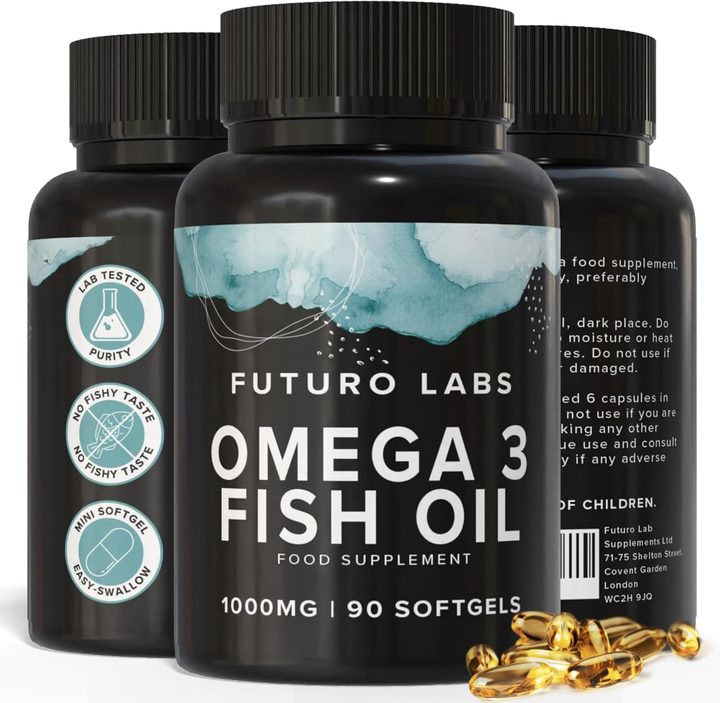
Our brand: the worked example on this page
Futuro Labs Omega 3 Fish Oil
- 17p a day
- 90 softgels, 1 softgel daily
- Lab tested
- Made in the UK
The standard softgel that raises a low status over months: Futuro Labs Omega 3 Fish Oil on Amazon UK, 1 softgel with food, 180mg EPA and 120mg DHA, 90 days a tub, £14.99 at 17p. Full label breakdown. The three pools and their clocks are on the how-long page; the non-fish-eater's arithmetic on the no-fish page.
Deficiency defined first, because the word means two things and only one of them is common
How long to recover from omega-3 deficiency has to define the deficiency first, because the word means two things and they have different answers. True deficiency: essential fatty acid deficiency is a clinical condition, a scaly dermatitis, poor wound healing, hair loss and, in children, growth failure, arising when the diet supplies almost no polyunsaturated fat at all, and it is rare, seen almost only in people fed fat-free intravenous nutrition for weeks, in severe fat malabsorption from gut disease, or in infants on a wrongly formulated feed, the essential fatty acid literature's finding, and it is diagnosed and treated by a clinician with fat given properly rather than by a softgel, with recovery of the skin over weeks once fat is restored. Nobody eating an ordinary diet, however low in fish, has this, because the omega-6 and the small amount of plant omega-3 in any mixed diet prevent it. Low status: what most readers mean by omega-3 deficiency is a low omega-3 index, the share of red-cell membrane fatty acids that is EPA and DHA, which falls below about four percent in people who eat little or no oily fish and take no supplement, a state that is common, the majority of the UK population sitting in it, and symptomless, no twitch, no ache and no tiredness marking it, the depletes page's you-do-not-lose-it-you-stop-building-it, and a state the observational studies associate with higher long-term cardiovascular risk without any symptom to feel. A reader with a low-fish diet and no symptoms is in the second group, and the second group is the one with a recovery clock.
The recovery clock by dose, what is felt on the way, which is nothing, and the deficiency filed
The recovery clock for low status is the omega-3 index's clock, and it runs by dose. At around a gram of EPA and DHA a day, three standard softgels or one concentrate, the index rises over three to four months to a new plateau in the range the observational studies favour, the index kinetics literature's finding, and it sits there for as long as the gram continues. At a standard softgel's 300mg a day, the index rises more slowly and to a lower plateau, adequate for the register's heart claim on day one and building toward a modest improvement in status over four to six months, a reader who wants the higher plateau needing the higher dose or oily fish beside the softgel. At two portions of fish a week with one oily, the UK advice's 450mg a day on average, the plateau sits between the two. What is felt on the way is nothing: no symptom marked the low status and no sensation marks its recovery, the how-long page's three pools filling silently, so a reader who wants proof of recovery has one route, an omega-3 index blood test before and four months after, the number rising from below four percent toward eight being the recovery and the only evidence of it, the same self-experiment the magnesium pages run with a symptom and this page runs with a test because there is no symptom to count. Two honest notes: a high omega-6 diet slows the rise, membranes rebuilt on seed oils leaving less room, so the crowding fix, olive oil for cooking and fewer fried foods, shortens the clock a little; and a reader with true malabsorption, coeliac disease, pancreatic insufficiency or a bariatric history, absorbs a fish oil poorly and has a clinician's conversation, an emulsified oil sometimes helping. The deficiency filed: true deficiency rare and a clinician's, low status common and symptomless, recovery at a gram a day in three to four months and at a standard softgel longer to a lower plateau, nothing felt and a blood test as the only proof, with the worked example being the standard softgel that raises a low status over months, ninety days a tub, £14.99 at 17p.
| The item | The finding | The clock or route |
|---|---|---|
| True essential fatty acid deficiency | Scaly dermatitis, poor healing, growth failure; fat-free feeding or severe malabsorption | Rare; a clinician; skin recovers over weeks once fat is restored |
| Low status | An omega-3 index below about four percent on a low-fish diet | Common; symptomless; the index's clock |
| At a gram a day | Three standard softgels or one concentrate | Three to four months to a plateau in the favoured range |
| At 300mg a day | One standard softgel | Slower, to a lower plateau; the heart claim met on day one |
| What is felt | Nothing on the way | A blood test before and four months after is the only proof |
| What slows the clock | A high omega-6 diet; malabsorption | Olive oil for cooking; a clinician for malabsorption |
The verdict, a rare deficiency that is a clinician's and a common low status that takes a season
How long to recover from omega-3 deficiency: for true essential fatty acid deficiency, rare and seen almost only in fat-free feeding or severe malabsorption, it is a clinician's problem recovering over weeks once fat is restored, and for the low status most readers mean, an omega-3 index below about four percent on a low-fish diet, common and symptomless, recovery runs on the index's clock, three to four months to a plateau in the favoured range at around a gram of EPA and DHA a day and longer to a lower plateau at a standard softgel's 300mg, with nothing felt on the way and a blood test before and after as the only proof. The standard softgel that raises a low status over months: Futuro Labs Omega 3 Fish Oil, one with food, 180mg EPA and 120mg DHA, ninety days a tub, £14.99 at 17p a day.
What to check on the label
- Define the deficiency: true deficiency is rare and a clinician's; low status is common.
- Expect no symptom either way: low status is silent, and so is its recovery.
- Set the clock by dose: three to four months at a gram; longer at 300mg.
- Prove it with a test: an omega-3 index before and four months after.
- Shorten the clock by crowding less: olive oil, fewer fried foods.
Our brand
The worked example: Futuro Labs Omega 3 Fish Oil
Futuro Labs Omega 3 Fish Oil: 1 softgel daily with food, 1000mg fish oil providing 180mg EPA and 120mg DHA (300mg combined), 90 softgels for £14.99, 17p a day, lab-tested purity, UK GMP made. Gelatin shell, so not vegetarian.
- Fish oil per softgel
- 1000mg
- EPA / DHA per softgel
- 180mg / 120mg (300mg combined)
- Serving
- 1 softgel a day
- Bottle
- 90 softgels, 90 days
- Price
- £14.99 (17p a day)
- Softgel
- mini softgel, no fishy taste
Questions people also ask
What are the symptoms of omega-3 deficiency?
For the low status most people mean, none: an omega-3 index below about four percent on a low-fish diet is common and symptomless; true essential fatty acid deficiency, with scaly dermatitis, poor healing and growth failure, is rare and arises almost only in fat-free feeding or severe malabsorption.
How long does it take to fix low omega-3 levels?
Three to four months to a new plateau at around a gram of EPA and DHA a day, three standard softgels or one concentrate, and longer to a lower plateau at a standard softgel's 300mg, the omega-3 index rising silently as red cells turn over.
How do I know if I'm recovering from omega-3 deficiency?
Only by measuring: no symptom marked the low status and none marks its recovery, so an omega-3 index blood test before and four months after, the number rising from below four percent toward eight, is the recovery and the only evidence of it.
Can I recover from omega-3 deficiency with food alone?
Yes: two portions of fish a week with one oily supplies around 450mg of EPA and DHA a day on average and raises the index to a plateau between a standard softgel's and a gram's over the same months, while plant omega-3 from flax and walnuts converts too poorly to do it.
Why is my omega-3 not rising despite supplements?
Usually the dose or the diet: 300mg a day raises the index slowly and to a modest plateau, a high omega-6 diet of seed oils and fried food crowds the omega-3 out of membranes, and true malabsorption from gut disease or bariatric surgery absorbs a fish oil poorly and needs a clinician's conversation.
Sources
- The essential fatty acid deficiency literature: true deficiency, with scaly dermatitis, poor wound healing and growth failure, is rare and seen almost only in fat-free feeding or severe malabsorption, while a low omega-3 status, an omega-3 index below about four percent, is common on a low-fish diet and has no symptoms of its own. PubMed record
- The omega-3 index kinetics literature: red-cell EPA and DHA rise over three to four months of daily intake and fall over a similar period after stopping, the index changing on a clock of months rather than days, with no acute effect of a single dose. PubMed record
- Harris WS, von Schacky C. The omega-3 index: red blood cell EPA and DHA as a measurable marker of omega-3 status, the research standard for judging how effectively intake raises tissue levels. PubMed record
- Scientific Advisory Committee on Nutrition and Committee on Toxicity. Advice on fish consumption: benefits and risks (two portions of fish a week, one oily). TSO, 2004. https://www.gov.uk/government/publications/sacn-advice-on-fish-consumption-benefits-and-risks