Ghost Fitness/Omega-3/How long does omega-3 take to work for eyes?
How long does omega-3 take to work for eyes?
The short answer
There is nothing to wait for, because the claim is maintenance and the treatment trials were null. DHA contributes to the maintenance of normal vision at 250mg a day, a claim with no onset. Three grams a day for a year did no better than placebo for dry eye, and a gram a day for five years added nothing against macular degeneration. The retina's membranes are supplied silently over months.
- The vision claimDHA contributes to the maintenance of normal vision at 250mg of DHA a day: maintenance, no onset
- The dry eye trialthree grams of EPA and DHA a day for a year: no better than placebo on symptoms or signs
- The macular degeneration triala gram a day for five years added to the standard formula: no reduction in progression
- The retina's clockDHA-rich photoreceptor membranes supplied over three to four months; nothing felt or seen
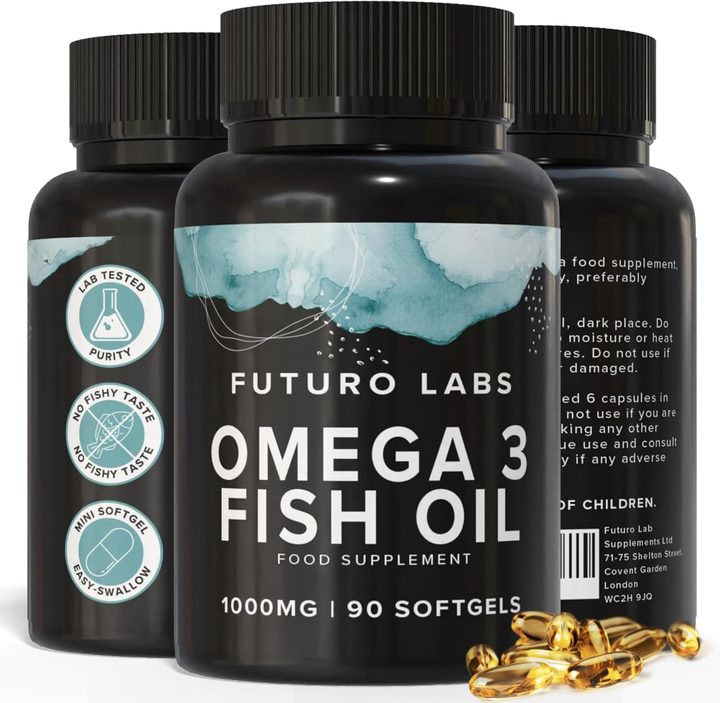
Our brand: the worked example on this page
Futuro Labs Omega 3 Fish Oil
- 17p a day
- 90 softgels, 1 softgel daily
- Lab tested
- Made in the UK
120mg of DHA a softgel, the vision claim at two or three: Futuro Labs Omega 3 Fish Oil on Amazon UK, 1 to 3 softgels with food, 180mg EPA and 120mg DHA each, 90 for £14.99 at 17p. Full label breakdown. DHA's four addresses are on the DHA page; the three pools and their clocks on the how-long page.
Nothing to wait for, because the claim is maintenance, and the retina's own clock
How long omega-3 takes to work for eyes has an honest answer that begins with the claim and ends with two trials, and neither gives the reader a date, because the claim has no onset and the trials found no effect. The claim: DHA contributes to the maintenance of normal vision, authorised at 250mg of DHA a day, a maintenance sentence meaning that a retina with adequate DHA works as it should, DHA being the dominant fatty acid of the photoreceptors' outer segments, the membranes that hold the light-sensing pigment and that need to stay fluid for the pigment to respond, the DHA page's second address, and a maintenance sentence describes adequacy rather than improvement, so a reader with adequate DHA sees as they saw and a reader who was short has a retina supplied over the months it takes DHA to build into its membranes, three to four to a plateau on the index clock, with nothing felt and nothing seen at any point, a maintained retina looking exactly like the one the reader had. What the claim does not promise is an effect on any eye condition, and the shelf's promises, dry eyes relieved and sight protected, are the subject of the two trials that follow, which were designed to test exactly those promises and did.
The two big eye trials, both null, what an eye reader does instead, and the eyes filed
The dry eye trial: a large randomised placebo-controlled trial gave three grams of EPA and DHA a day, ten standard softgels' worth, to people with moderate to severe dry eye disease for a full year, against an olive oil placebo, and found no difference in symptoms or in the clinical signs of dry eye, the best-designed test of the commonest eye reason readers buy fish oil and a null result at a dose and duration far beyond anything a shelf suggests, so a reader with dry eyes waiting for omega-3 to work is waiting for an effect the trial did not find at three grams for a year, and has the eye pharmacist's lubricating drops, the lid hygiene and the optometrist's review instead. The macular degeneration trial: the second age-related eye disease study added a gram of EPA and DHA a day to the standard antioxidant and zinc formula in thousands of people at risk of advanced macular degeneration and followed them for five years, finding no reduction in progression from the omega-3, the second big eye trial and the second null, in the eye's commonest degenerative disease, so a reader taking fish oil to protect their sight against macular degeneration is taking it for a reason the five-year trial did not support, and has the standard formula, smoking cessation and the optometrist's monitoring instead. Two trials, one for the surface of the eye and one for the back of it, both large, both long, both null, and between them the reason this page gives no date. What an eye reader does instead: an optometrist for dry eyes, floaters, blur or any change in sight, since the common eye problems have their own routes and none runs through a softgel; the DHA claim's 250mg by the oily-fish audit for maintenance, two or three standard softgels or a DHA-heavy capsule, taken for what the register says and not for what the shelf does; and no waiting, since a maintenance claim has nothing to wait for. The eyes filed: the vision claim maintenance at 250mg of DHA with no onset, the dry eye trial null at three grams for a year, the macular degeneration trial null at a gram for five years, the retina supplied silently over months, and the honest clock for an eye effect being never, with the worked example being 120mg of DHA a softgel and the vision claim at two or three, £14.99 for 90 at 17p.
| The item | The finding | The clock |
|---|---|---|
| The vision claim | DHA contributes to the maintenance of normal vision at 250mg of DHA a day | No onset; adequacy, not improvement |
| The retina | DHA-rich photoreceptor membranes supplied over three to four months | Nothing felt or seen |
| Dry eye | Three grams a day for a year: no better than placebo | Never; drops, lid hygiene and an optometrist |
| Macular degeneration | A gram a day for five years added to the standard formula: no reduction in progression | Never; the standard formula, no smoking, monitoring |
| Any change in sight | Floaters, blur, pain, loss | An optometrist promptly; not a softgel |
| The worked example | 120mg of DHA a softgel; the claim at two or three | Taken for the register, not the shelf |
The verdict, a claim with no date, two trials with no effect, and an optometrist for the rest
How long does omega-3 take to work for eyes: there is nothing to wait for, the register's sentence being that DHA contributes to the maintenance of normal vision at 250mg of DHA a day, a maintenance claim with no onset that a retina supplied silently over three to four months fulfils without anything felt or seen, and the two big eye trials both being null, three grams of EPA and DHA a day for a year doing no better than placebo for moderate to severe dry eye and a gram a day for five years adding nothing to the standard formula against macular degeneration, so the honest clock for an eye effect is never and an eye reader takes the DHA claim by the oily-fish audit and any change in sight to an optometrist. 120mg of DHA a softgel: Futuro Labs Omega 3 Fish Oil, one to three with food, 180mg EPA and 120mg DHA each, 90 for £14.99 at 17p.
What to check on the label
- Read the vision claim as maintenance: no onset to wait for.
- Know the dry eye trial: three grams for a year, no better than placebo.
- Know the macular degeneration trial: a gram for five years, nothing added.
- Take the DHA claim by the audit: 250mg of DHA at two or three softgels.
- Take the eyes to an optometrist: dry eyes, floaters, blur, any change.
Our brand
The worked example: Futuro Labs Omega 3 Fish Oil
Futuro Labs Omega 3 Fish Oil: 1 softgel daily with food, 1000mg fish oil providing 180mg EPA and 120mg DHA (300mg combined), 90 softgels for £14.99, 17p a day, lab-tested purity, UK GMP made. Gelatin shell, so not vegetarian.
- Fish oil per softgel
- 1000mg
- EPA / DHA per softgel
- 180mg / 120mg (300mg combined)
- Serving
- 1 softgel a day
- Bottle
- 90 softgels, 90 days
- Price
- £14.99 (17p a day)
- Softgel
- mini softgel, no fishy taste
Questions people also ask
Does omega-3 help dry eyes?
Not on the best evidence: a large randomised placebo-controlled trial gave three grams of EPA and DHA a day for a year to people with moderate to severe dry eye and found no difference from an olive oil placebo in symptoms or signs, so dry eyes are treated with lubricating drops, lid hygiene and an optometrist's review rather than a softgel.
Does fish oil protect against macular degeneration?
Not on the five-year trial: adding a gram of EPA and DHA a day to the standard antioxidant and zinc formula did not reduce progression to advanced macular degeneration in thousands of people at risk, so sight is protected by the standard formula, not smoking and an optometrist's monitoring.
What does DHA do for the eyes?
It is the dominant fatty acid of the photoreceptors' outer segments, the membranes that hold the light-sensing pigment and need to stay fluid for it to respond, and the register's sentence is that DHA contributes to the maintenance of normal vision at 250mg a day, adequacy rather than improvement.
How much DHA do I need for the vision claim?
250mg of DHA a day, reached at two or three standard softgels at the usual 3 to 2 ratio or one DHA-heavy or algal capsule, taken for maintenance by the oily-fish audit and not for any eye condition.
Will I see better after taking omega-3?
No: a maintained retina looks exactly like the one you had, DHA building into its membranes silently over three to four months, and any change in sight, floaters, blur, pain or loss, goes to an optometrist promptly rather than waiting on a softgel.
Sources
- The dry eye omega-3 trial: a large randomised placebo-controlled trial giving three grams of EPA and DHA a day for a year to people with moderate to severe dry eye found no benefit over placebo on symptoms or signs, the best-designed test of omega-3 for dry eye and a null result. PubMed record
- The age-related eye disease trial: adding a gram of EPA and DHA a day to the standard antioxidant formula did not reduce progression to advanced age-related macular degeneration over five years, a null result for omega-3 in the eye's commonest degenerative disease. PubMed record
- EFSA Panel on Dietetic Products. Scientific opinion on health claims related to DHA: maintenance of normal brain function and normal vision (250mg DHA daily condition of use). EFSA Journal 2010;8(10):1734. https://www.efsa.europa.eu/en/efsajournal/pub/1734
- The omega-3 index kinetics literature: red-cell EPA and DHA rise over three to four months of daily intake and fall over a similar period after stopping, the index changing on a clock of months rather than days, with no acute effect of a single dose. PubMed record