Ghost Fitness/Omega-3/Does fish oil help with recovery between sessions?
Does fish oil help with recovery between sessions?
The short answer
Across the forty hours between sessions. Two nights of sleep do most of the recovering. Six or seven meals carry the protein and carbohydrate that rebuild and refill. Fluid, light movement and the programme's own volume fill the rest. Fish oil occupies one softgel at one meal for the plate's heart claim, adding a point less soreness only at gram doses primed for weeks, and nothing to whether a lifter is ready at hour forty.
- Two nightsseven to nine hours each: most of the recovering
- Six or seven mealsprotein at around 1.6 grams per kilogram split across them; carbohydrate refilling glycogen
- Fluid, movement, volumethe rest of the forty hours; a volume the hours can match
- Fish oil's placeone softgel at one meal for the heart claim; a point less soreness at grams primed for weeks; no faster strength
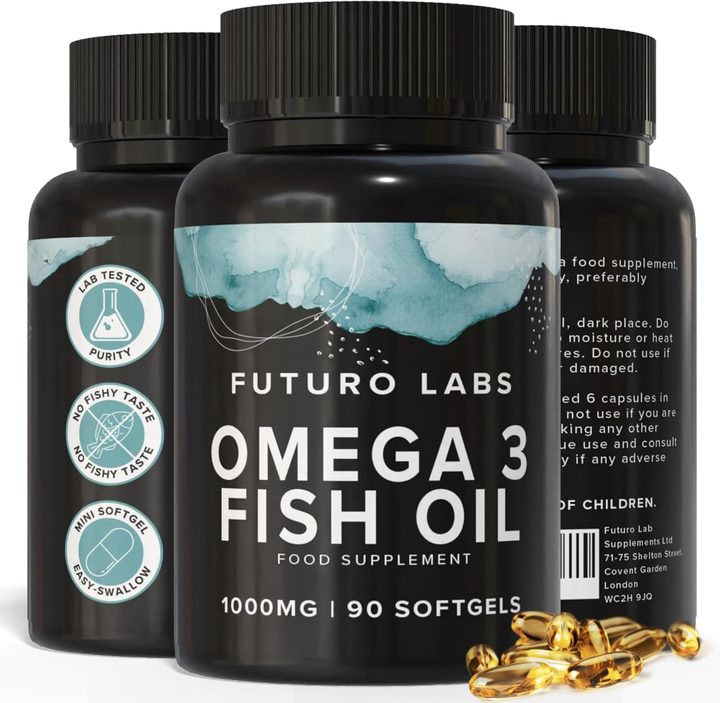
Our brand: the worked example on this page
Futuro Labs Omega 3 Fish Oil
- 17p a day
- 90 softgels, 1 softgel daily
- Lab tested
- Made in the UK
One softgel at one of the forty hours' meals: Futuro Labs Omega 3 Fish Oil on Amazon UK, 1 softgel with food, 180mg EPA and 120mg DHA, 90 for £14.99 at 17p. Full label breakdown. The recovery timeline is on the muscle recovery page; the repeated-bout effect on the DOMS page.
The forty hours, and the things that fill them and do the recovering
Does fish oil help with recovery between sessions is a question best answered by looking at what is between sessions, because a lifter training four days a week has around forty hours between one session and the next and those hours are filled by the things that recover a muscle, and the honest page lays them out and finds where a softgel sits. Two nights of sleep: a session on Monday evening and one on Wednesday evening have two nights between them, and sleep of seven to nine hours a night is where most of the recovering happens, growth hormone released in the deep stages, protein synthesis running through the night, the nervous system that a heavy session taxes restored, and a lifter who sleeps six hours has spent a quarter of the forty hours' recovery before anything on a shelf is considered, the recovery pages' first lever. Six or seven meals: two days of eating carry the protein a rebuilding muscle uses, at around 1.6 grams per kilogram of body weight a day split across the meals with twenty-five to forty grams at each, holding the register's muscle sentences and driving the synthesis the training switched on, the protein and synthesis literatures' levers, and the carbohydrate that refills the glycogen the session emptied, without which the next session is flat whatever else is done, so the meals are the second lever and the largest after sleep. Fluid across the two days, since a dehydrated muscle recovers and performs worse. Light movement, a walk on the day between, which eases the stiffness of a loaded muscle and moves the blood through it, the muscle stiffness literature's finding that tightness resolves with movement. And the programme's own volume, since forty hours can recover a sensible session and cannot recover a heroic one, the deload being the recognition that the hours have fallen behind the work.
Where fish oil sits in the forty hours, its one entry and its limits, what readiness at hour forty depends on, and the hours filed
Where fish oil sits in the forty hours is at one of the meals, as one softgel, taken for the plate's reason: a lifter's plate of chicken, rice and white fish carries less than the 250mg of EPA and DHA the register's heart claim is written for, and one standard softgel with the post-session meal or the next morning's breakfast meets it, at 17p and nine calories, the audit's answer for a low-fish plate, and that is what the softgel is doing in the forty hours, meeting a nutrition claim at a convenient meal rather than recovering anything. Its one recovery entry is the footnote the recovery pages carry: perceived soreness a point or so lower on a ten-point scale across the twenty-four to seventy-two hour peak, in trials that gave two to three grams of EPA and DHA a day for weeks or months before a novel, damaging session, the DOMS review's finding, with no faster return of strength or function at any point, and with the repeated-bout effect leaving a lifter's usual sessions with little soreness to shift, so the entry is real, small, conditional on high rungs and a long lead-in, and about how sore the middle of the forty hours feels rather than about how ready their end is. What readiness at hour forty depends on is the list above and not the softgel: a lifter who slept twice, ate the protein and the carbohydrate, drank, walked and programmed a volume the hours could match is ready at hour forty with or without fish oil, and a lifter who did not is not ready with or without it, the trials that added omega-3 to training programmes finding no change in the work done across a block, the performance literature's null. Two notes for the between-sessions reader: the softgel's timing within the forty hours is the meal's and not the session's, a months-long pool not caring which meal, so the post-session meal is a convenience and not an instruction; and a reader who feels better recovered on a new tub has the placebo pages' expectation and the routine that arrived with it, with a fortnight off sorting the two. The hours filed: two nights, six or seven meals, fluid, movement and a matched volume as the things that recover, one softgel at one meal for the heart claim as fish oil's place, a point less soreness at grams primed for weeks as its one entry, and readiness at hour forty decided by the list, with the worked example being one softgel at one of the forty hours' meals, £14.99 for 90 at 17p.
| What fills the hours | What it does | Its share of the recovering |
|---|---|---|
| Two nights of sleep, seven to nine hours each | Growth hormone, protein synthesis, nervous system restored | Most of it |
| Six or seven meals | Protein at 1.6 grams per kilogram split across them; carbohydrate refilling glycogen | The largest after sleep |
| Fluid and light movement | A hydrated muscle; stiffness eased by a walk | The supporting share |
| The programme's volume | A session the hours can match; a deload when they cannot | The ceiling on the rest |
| Fish oil, one softgel at one meal | The plate's 250mg heart claim; nine calories | None of the recovering |
| Fish oil's one entry | A point less soreness at two to three grams primed for weeks, before a novel session | How sore the middle feels, not how ready the end is |
The verdict, forty hours recovered by sleep, food, fluid, movement and a sensible volume, with a softgel at one meal for a different reason
Does fish oil help with recovery between sessions: not with the recovery, which the forty hours between sessions do through two nights of sleep that do most of it, six or seven meals carrying protein at around 1.6 grams per kilogram and the carbohydrate that refills glycogen, fluid, light movement and a programme whose volume the hours can match, while fish oil occupies one softgel at one of those meals for the plate's 250mg heart claim and adds, as its one recovery entry, a point less perceived soreness at two to three grams a day primed for weeks before a novel session, with no faster return of strength and no change to whether a lifter is ready at hour forty, which the list decides. One softgel at one of the forty hours' meals: Futuro Labs Omega 3 Fish Oil, one with food, 180mg EPA and 120mg DHA, 90 for £14.99 at 17p a day.
What to check on the label
- Sleep the two nights: most of the recovering.
- Eat the six or seven meals: protein split across them, carbohydrate refilled.
- Drink and walk: the supporting share.
- Programme a volume the hours can match: or deload.
- Put the softgel at one meal for the plate: not for the readiness.
Our brand
The worked example: Futuro Labs Omega 3 Fish Oil
Futuro Labs Omega 3 Fish Oil: 1 softgel daily with food, 1000mg fish oil providing 180mg EPA and 120mg DHA (300mg combined), 90 softgels for £14.99, 17p a day, lab-tested purity, UK GMP made. Gelatin shell, so not vegetarian.
- Fish oil per softgel
- 1000mg
- EPA / DHA per softgel
- 180mg / 120mg (300mg combined)
- Serving
- 1 softgel a day
- Bottle
- 90 softgels, 90 days
- Price
- £14.99 (17p a day)
- Softgel
- mini softgel, no fishy taste
Questions people also ask
What is the best way to recover between workouts?
Sleep seven to nine hours on each of the nights between, eat protein at around 1.6 grams per kilogram split across the meals with carbohydrate to refill glycogen, drink, walk on the day between to ease stiffness, and programme a volume the hours can match, which together decide whether a lifter is ready for the next session with or without any supplement.
Does fish oil make you recover faster between sessions?
No: the trials find no faster return of strength or function at any point and no change in the work done across a training block, the one entry being a point less perceived soreness at two to three grams a day primed for weeks before a novel session, which is about how sore the middle of the gap feels and not how ready its end is.
When should I take fish oil between workouts?
At any meal, since a months-long membrane pool does not care which: the post-session meal is a convenient anchor because it is reliable and fatty, and the softgel is there for the plate's 250mg heart claim rather than for the session on either side of it.
How long does it take to recover between weight training sessions?
For the same muscle group, around forty-eight to seventy-two hours after a normal session, less for a familiar programme with the repeated-bout effect in place and more for a novel or heroic one, decided by sleep, protein, carbohydrate, fluid and volume rather than by anything on a shelf.
Is fish oil worth taking for recovery at all?
Not for recovery: it is worth taking for the plate, one standard softgel meeting the 250mg heart claim a chicken-and-white-fish diet leaves unmet at 17p, and the soreness footnote at gram doses primed for weeks is a bonus at rungs a lifter is at for other reasons rather than a reason to be there.
Sources
- Review evidence on omega-3 supplementation and exercise-induced muscle damage and soreness: small positive findings mainly in untrained participants, mixed-to-null results in trained populations. PubMed record
- The muscle protein synthesis literature: resistance exercise and a leucine-rich protein dose of around 20 to 40 grams stimulate muscle protein synthesis for hours, with total daily protein, energy availability and the training stimulus determining net gain, and no trial of magnesium supplementation on muscle protein synthesis in trained adults. PubMed record
- The protein intake and resistance training literature: meta-analyses support intakes around 1.6g per kilogram of body weight daily for maximising resistance-training gains, with diminishing returns above. PubMed record
- Reviews of omega-3 supplementation and exercise performance: no consistent improvement in strength, power, endurance or performance tests in trained adults, with the more consistent findings being modest reductions in perceived soreness and inflammatory markers at gram-and-above doses over weeks. PubMed record