Ghost Fitness/Magnesium/What is a good amount of magnesium glycinate per day?
What is a good amount of magnesium glycinate per day?
The short answer
A good amount of magnesium glycinate is 300mg elemental a day: it covers the reference intake, sits 100mg under the supplement ceiling, lands in the trials' territory once food is added, and takes exactly two capsules. 150mg suits near-complete diets.
- 4 testscoverage, ceiling, trials, sustainability: what good means
- 300mgthe amount that passes all four
- 150mgthe good amount for a near-complete diet
- 2 capsulesthe sustainability test made literal
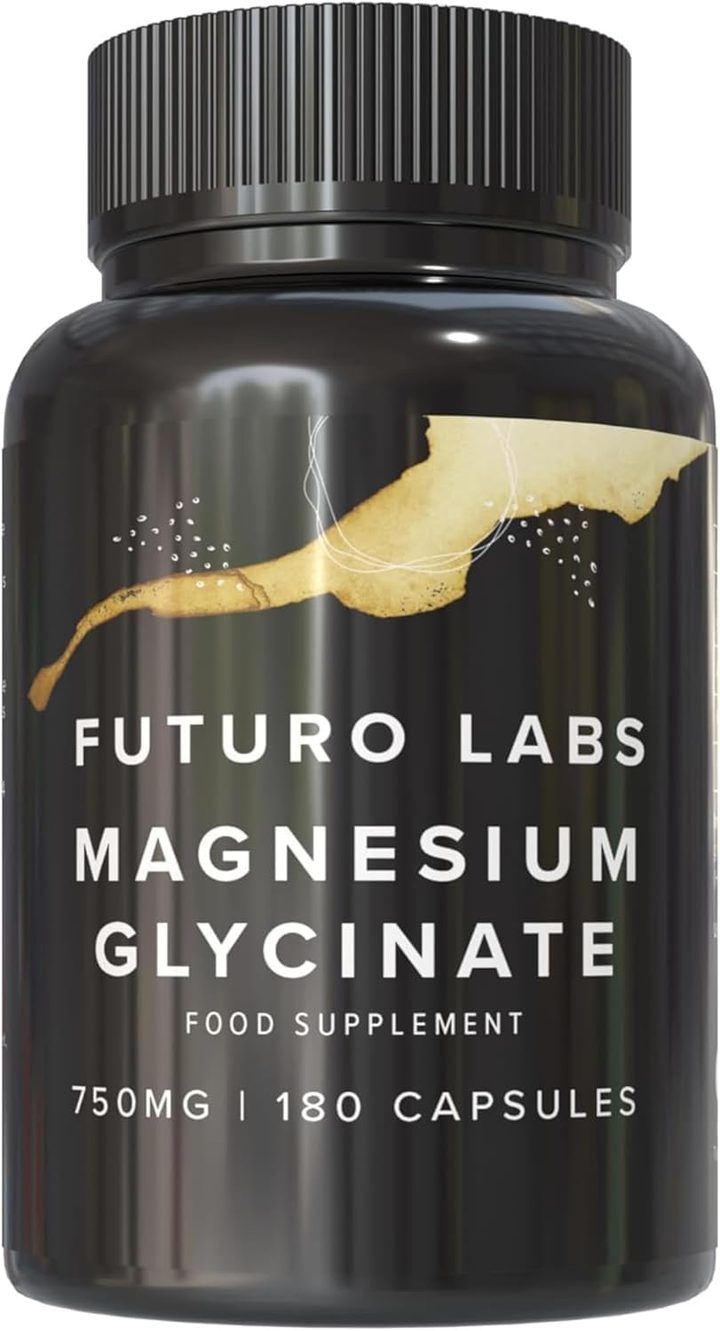
Our brand: the worked example on this page
Futuro Labs Magnesium Glycinate
- 22p a day
- 180 capsules, 2 capsules daily
- Lab tested
- Made in the UK
The four-test amount in product form: Futuro Labs Magnesium Glycinate on Amazon UK, 300mg elemental per 2 capsules, £19.99 for 180. Label breakdown. The elemental framing is on elemental magnesium per day; the ladder on 300, 400 and 500mg.
Defining good, so the number stops being folklore
Good is doing four jobs at once, and naming them turns a vibes question into an audit. Test one, coverage: a good amount guarantees the UK reference intake, 300mg for men and 270mg for women, on the worst dietary day of the week, since the supplement exists for exactly those days. Test two, ceiling: it leaves genuine headroom under the Expert Group on Vitamins and Minerals' 400mg supplement guidance level, so an antacid or fortified shake cannot tip the day over. Test three, evidence: combined with ordinary food it lands where the positive trials dosed, the 350mg athlete studies and the 320mg-to-500mg sleep work. Test four, sustainability: it maps onto a capsule count a human maintains nightly for months, because the perfect dose taken sporadically loses to the good dose taken always.
The candidates, run through the rubric
Run the shelf's common amounts through all four tests and the field thins fast. Token doses, 50mg to 100mg, fail coverage outright, gummies and compound-labelled costumes living here. 150mg passes a modified coverage test, topping up a diet that nearly gets there, and passes everything else, which is why it is the honest answer for the near-complete eater, one capsule. 300mg passes all four cleanly: coverage with margin, 100mg of ceiling headroom, trial territory once dinner joins, and exactly two capsules forever. 375mg passes coverage and evidence while scraping the ceiling test, 25mg of headroom being a labelling aesthetic rather than a margin. 400mg sits on the line and fails headroom by definition. And 500mg-plus fails two tests at once, over the ceiling with no trial reward, the supervised-study numbers masquerading as daily advice.
| Amount (elemental) | Covers the need? | Ceiling headroom? | Trial territory with food? | Sustainable count? | Verdict |
|---|---|---|---|---|---|
| 50mg to 100mg | No | Yes | No | Yes | Token: fails the point |
| 150mg | As a top-up, yes | Yes: 250mg | Approaches it | 1 capsule | Good, for near-complete diets |
| 300mgOurs | Yes, with margin | Yes: 100mg | Yes | Exactly 2 capsules | The good amount: passes all four |
| 375mg | Yes | Barely: 25mg | Yes | 2.5 capsules: untidy | Permissible, pointless versus 300mg |
| 400mg | Yes | None: it is the line | Yes | 2.67 capsules | The ceiling, not a choice |
| 500mg+ | Yes | Fails: over the line | Supervised trials only | Untidy | No |
The answer, sized to the person, and the product that embodies it
What is a good amount of magnesium glycinate per day: 300mg elemental for the narrow-diet lifter this site writes for, 150mg for the eater whose plates nearly cover it, both taken with the evening meal, both judged after four to eight weeks against the low-intake cluster, and neither ever needing to climb, because good amounts are thresholds, not trajectories. The embodiment: Futuro Labs Magnesium Glycinate, 150mg elemental per capsule so both good amounts are whole-capsule answers, 300mg at 80% NRV from 1500mg of bisglycinate at 20% as the standard 2-capsule serving, vegan, UK made under GMP and BRC, panels shown, £19.99 for 180 capsules, 22p a day at the full amount. Four tests, one number, two capsules: good, defined and delivered.
What to check on the label
- Good = four tests: coverage, ceiling headroom, trial territory, sustainable count.
- 300mg passes all four: the good amount for the narrow-diet lifter.
- 150mg is the good top-up for near-complete diets: one capsule.
- 375mg and 400mg trade headroom for aesthetics; 500mg fails outright.
- Good amounts are thresholds: the number never needs to climb.
Our brand
The worked example: Futuro Labs Magnesium Glycinate
Futuro Labs Magnesium Glycinate makes both good amounts whole-capsule answers: 150mg per capsule, 2 for the standard 300mg serving (80% NRV) or 1 as the top-up, 22p a day at the full amount from a £19.99 bottle of 180. Vegan, UK made, panels shown.
- Elemental magnesium per serving
- 300mg (80% NRV)
- Form
- magnesium bisglycinate 20%
- Serving
- 2 capsules a day
- Bottle
- 180 capsules, 90 days
- Price
- £19.99 (22p a day)
- Capsule
- vegetarian shell, vegan product
Questions people also ask
Is 200mg of magnesium glycinate a day enough?
It sits between the honest tiers: above a top-up, below full coverage. Round to 150mg on a good diet or 300mg on a narrow one and the logic stays clean.
Is 300mg of magnesium glycinate a day a good amount?
Yes, by all four tests: reference intake covered, 100mg under the ceiling, trial territory reached with food, and exactly two capsules forever.
Can a good amount change over time?
Only with your diet: plates that improve downshift you to 150mg or to nothing. The number responds to food, never to time served.
Why not take a bit more to be safe?
Safety runs the other way: adequacy is a threshold, so extra milligrams buy no benefit while eating the ceiling headroom that keeps ordinary days safe.
What amount of glycinate for sleep or recovery specifically?
The same 300mg: both use-cases run on corrected intake, and the trials behind each are reached once food joins the serving.
Sources
- Futuro Labs Magnesium Glycinate listing, Amazon UK, label and price checked 31 August 2026. https://www.amazon.co.uk/dp/B0BT7Z5VQW
- Department of Health. Dietary Reference Values for Food Energy and Nutrients for the United Kingdom. Report on Health and Social Subjects 41, 1991 (magnesium RNI 300mg men, 270mg women).
- Expert Group on Vitamins and Minerals. Safe Upper Levels for Vitamins and Minerals. Food Standards Agency, 2003 (magnesium guidance level 400mg a day from supplements). https://cot.food.gov.uk/sites/default/files/vitmin2003.pdf
- Setaro L, et al. Magnesium status and the physical performance of volleyball players: effects of magnesium supplementation. Journal of Sports Sciences 2014;32(5):438-445. PubMed record
- Abbasi B, et al. The effect of magnesium supplementation on primary insomnia in elderly: a double-blind placebo-controlled clinical trial. Journal of Research in Medical Sciences 2012;17(12):1161-1169. PubMed record
- Retained Regulation (EU) No 1169/2011, Annex XIII: nutrient reference value for magnesium 375mg. https://www.legislation.gov.uk/eur/2011/1169/annex/XIII
- EFSA Panel on Dietetic Products, Nutrition and Allergies. Scientific Opinion on the substantiation of health claims related to magnesium. EFSA Journal 2010;8(10):1807. https://efsa.onlinelibrary.wiley.com/doi/10.2903/j.efsa.2010.1807