Ghost Fitness/Lion's mane/Lion's mane for lifters: the complete guide
Lion's mane for lifters: the complete guide
The short answer
Lion's mane is a claim-free mushroom with two small human studies, bought on four label tests, fruiting body, stated ratio, shown testing, honest pence, taken one capsule daily with no clock, and priced as a 13p flat-expectations bet.
- What it isHericium erinaceus: a culinary mushroom sold as a claim-free extract
- What the research showstwo small human studies, interesting and thin, described as studies
- How to buy itfour tests: fruiting body, ratio with maths, testing shown, pence divided
- What it is wortha 13p flat-expectations bet, after the basics, never instead of them
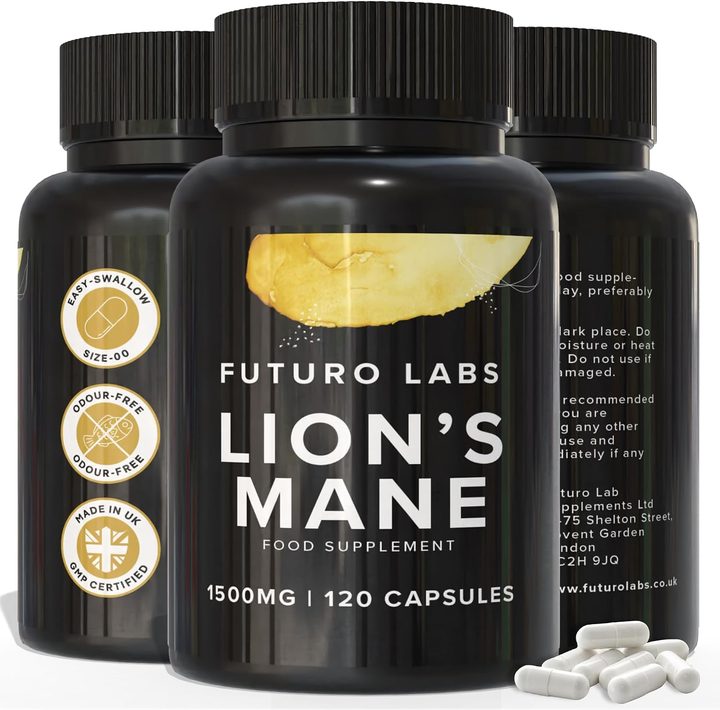
Our brand: the worked example on this page
Futuro Labs Lion's Mane
- 13p a day
- 120 capsules, 1 capsule daily
- Lab tested
- Made in the UK
The section's worked example, passing every test in this guide: Futuro Labs Lion's Mane on Amazon UK, 5:1 fruiting body extract, 1500mg equivalent per capsule, vegan HPMC shell, UK GMP and BRC, independently tested, £15.49 for 120 capsules, 120 days at 13p. Full label breakdown. The buying flagship is the best lion's mane page; the taking card is the best-way page; the section hub is here.
Part one: what lion's mane is, and the two label words that matter more than any promise
Lion's mane is Hericium erinaceus, a white cascading-spined mushroom that grows on hardwood, a genuine delicacy with a crab-like texture when dry-seared, and, in the supplement aisle, a dried extract sold in capsules and powders, this guide's subject, and the first thing a lifter should know about it is legal rather than biological: no mushroom holds an authorised health claim in the UK, so nothing sold as lion's mane may lawfully promise focus, memory, mood, nerve support, sleep, energy or anything else, and every such promise on a label or listing is unlicensed and, on this site, an instant disqualification. What lion's mane does for your body, as the search box phrases it, therefore has no lawful answer beyond what the research honestly shows, which part two describes, and the product itself is defined by two label words that matter more than any promise. Fruiting body, the mushroom itself as opposed to mycelium grown on grain, is the first: the human studies used fruiting-body preparations, and mycelium products are frequently milled with the grain they grew through and sold without saying so, the starch tell, high alpha-glucans against low beta-glucans, being the lab signature of that dilution, so fruiting body stated on the panel is the section's founding test, with disclosed grain-free mycelium a legitimate exception judged on its numbers and an interesting twist attached, the mycelium holding the erinacines, the bench literature's more studied nerve-growth compounds, while the fruiting body holds the human data. The extract ratio is the second: a 5:1 or 10:1 stated with its mushroom-equivalent maths, dose times ratio, because extraction is what breaks the mushroom's chitin cell walls and makes a dose statable, plain 1:1 powder being food rather than a supplement, and a ratio meaning nothing without the tissue it concentrates and the real per-serving extract milligrams it applies to, roughly 300mg behind the worked example's 1500mg equivalent. The compounds the marketing names, beta-glucans in the cell wall, hericenones from the fruiting body and erinacines from the mycelium, are real and their bench literature is real, nerve growth factor stimulated in cell cultures and animals, and none of it has been tested in a human outcome trial, which is the whole shape of the story.
Part two: what the research actually shows, described as the studies they are
The human research on lion's mane is two studies, and this guide describes them at their true size because everything sold on the mushroom inflates them. The Mori 2009 trial: a double-blind placebo-controlled study in older Japanese adults, fifty to eighty, diagnosed with mild cognitive impairment, taking fruiting-body tablets for sixteen weeks, with cognitive scores improving against placebo across the trial and declining again after supplementation stopped, one small trial in a clinical population, its extrapolation to a healthy thirty-year-old lifter a gap rather than a bridge, and its fade-out arguing against cycling and for flat expectations. The Docherty 2023 pilot: forty-one healthy young adults, a single dose producing faster performance on one attention task about an hour later, and lower subjective stress after 28 days of daily dosing, a preliminary study by its own authors' framing, one task and one cohort, no dose-response, no replication yet, the mushroom's one acute datapoint and its one stress datapoint. That is the file, interesting and thin, and it means four things for a lifter reading it honestly: there is no evidence lion's mane improves focus, training, recovery, strength or anything in a training week, its file containing no performance measure; there is no cognitive claim because the register grants none and the evidence would not support one; the comparison pages settle every rivalry the same way, caffeine winning focus by decades of trials against one task, creatine winning every lifter's question by an authorised claim against nothing, ashwagandha holding the larger stress and the only training-relevant file of the botanical drawer; and the honest posture is a flat-expectations research bet, the likeliest outcome of sixteen weeks being nothing noticed, priced accordingly. What lion's mane extract does, then, is deliver a stated dose of a claim-free mushroom whose human literature is two small studies, and this guide will not pretend otherwise on any page.
Part three: how to buy it, the four tests, the formats, the forensics and the price
Buying lion's mane is a method, because with claims off the table only labels can compete, and the method is four public tests any shopper runs in a minute. Test one, fruiting body stated, the tissue the human studies used and the harder one to dilute. Test two, the extract ratio stated with its equivalent maths and the real per-serving milligrams read behind it, the honest band being 5:1 to 10:1 and the arms race above it trading bigger numbers for thinner disclosure. Test three, testing and manufacture shown, independent lab testing stated, per-batch heavy metals above all because fungi accumulate their substrate's cadmium, lead, mercury and arsenic, GMP and BRC where held, a UK address on the label as the law requires, and glucan figures published where measured as the corroboration advanced buyers request. Test four, pence divided at the label's own directions, the section's benchmark being 13p a day, honest capsules running ten-to-twenty-five pence, and the format table pricing everything else, powders beside capsules per stated dose, tinctures at twenty-to-sixty pence, gummies at thirty-to-eighty with token unstated doses in sugar, and mushroom coffees at fifty pence to a pound for the aisle's smallest dustings, the two-ingredient recipe, your own coffee plus a 13p capsule, beating every sachet. The format verdict is the capsule for nearly every lifter, the daily dose being one capsule's worth so the factory's measuring costs pennies and the buyer's spoon becomes the weakest instrument in the chain, powder serving the smoothie-mixers, broth-cooks and scale-owning experimenters who will genuinely use its flexibility, and the two-powders trap watched for, plain ground mushroom wearing the same name as extract. The forensics finish the purchase: on a marketplace, the seller line first, sold by the brand and delivered by the platform, then the photographed panel read before any review, then the division, with reviews consulted last for the parcels and capsule sizes they can verify and never for doses or effects, and the instant fails held throughout, any claim printed, no address, an audit-proof proprietary blend, a missing panel photo. Run on the worked example, every test passes in public: Futuro Labs Lion's Mane states fruiting body and a 5:1 ratio with 1500mg equivalent per capsule, states independent testing and UK GMP-and-BRC manufacture with its address printed, uses a vegan HPMC shell and rice flour, prints no claim anywhere, and divides £15.49 across 120 days to 13p, with the challenge this section keeps permanently open, that any brand passing the same tests at lower pence takes the answer, because the method is the point and the name is not.
Part four: how to take it, what to take it with and without, who should check first, and what it is honestly worth
Taking lion's mane is the simplest instruction in the aisle once the borrowed rituals are stripped. The dose is the label's direction, one capsule daily with a meal on the worked example, because no established dose exists in a claims-free category and more is spend rather than strategy. The timing is any anchored hour, breakfast for most, because the mushroom is caffeine free, no fungus makes the alkaloid, so no stimulant clock applies, evening dosing is harmless for late trainers, and the empty-stomach rule migrated here from pharmacy folklore with no mechanism behind it, with-food being comfort rather than chemistry. There is no cycling, no study supporting it, no tolerance mechanism to reset, and the one long trial having run sixteen continuous weeks with effects fading after stopping, so the honest review window is sixteen weeks with expectations flat. What to take it with, as the search box asks: anything, the no-synergy spine meaning no combination unlocks anything, the honest menu being the morning coffee that does the acute focus work the mushroom cannot, the creatine already in the gym bag continuing at 3g with its authorised claim and its emerging cognition file, magnesium and DHA carrying the stack's only printed sentences from their own sections, B12 and iron only where a blood test says so, and ashwagandha permissible as a separate stated root once its own pharmacist gate is cleared. What not to take it with is a shorter and more honest list than the marketing implies: no drug interaction has been established for lion's mane in human studies, the cautions that circulate being theoretical and bench-level, animal work suggesting possible effects on blood clotting and on blood glucose that have never been shown in people, which makes them a reason for anyone on anticoagulant or antiplatelet medication or on diabetes medication to mention the capsule to a pharmacist rather than a reason for alarm, the standing gate applying to everyone on regular medication of any kind, clear the whole cupboard with a pharmacist once. Can anyone take it, as the search box also asks: most healthy adults, yes, with four exceptions stated plainly, pregnancy and breastfeeding, where no safety data exists and the honest default is to avoid rather than guess; anyone with a mushroom allergy or a history of reactions to fungi, since lion's mane is a fungus; anyone under eighteen, since this site gives no supplement guidance to minors; and anyone on medication, per the pharmacist gate above, with the label's own warning to keep to the stated dose and to keep it from children. What it is honestly worth closes the guide: lion's mane sits last on a lifter's spending ladder, after creatine's authorised claim, after complete protein, after sleep and programmed training, and after any register nutrient a blood test directs, a marginal 13p a day bought as a flat-expectations research bet on two small studies, worth exactly that to the lifter who understands it and worth nothing to the one sold a promise, the worked example priced for the first buyer and refusing, on every page of this section, to serve the second.
| The question | The honest answer | The page that expands it |
|---|---|---|
| What is it? | Hericium erinaceus: a claim-free mushroom extract; fruiting body and ratio are the label words | The fruiting-body and ratio pages |
| What does the research show? | Two small human studies, MCI adults and a young pilot: interesting and thin | The memory and focus versus pages |
| How do I buy it?Ours | Four tests: tissue, ratio with maths, testing shown, pence divided; 13p benchmark | The best lion's mane and buying pages |
| How do I take it? | One capsule daily, any anchored hour, no cycling, review at sixteen weeks | The best-way-to-take page |
| What with, and who checks first? | Coffee, creatine, magnesium, DHA; pharmacist if on medication; avoid in pregnancy | The combination and interaction notes above |
| What is it worth? | A 13p flat-expectations bet, last on the ladder, after the basics | The creatine ladder and top-five pages |
The verdict, the whole section in one paragraph
Lion's mane for lifters, the complete guide in one paragraph: a claim-free culinary mushroom sold as a dried extract, defined on a label by two words, fruiting body and a stated ratio, with two small human studies behind it, a sixteen-week trial in impaired older adults and a young-adult pilot, interesting and thin, and no evidence touching a training week; bought on four public tests, tissue, ratio with its maths, testing shown and pence divided, in the capsule format the tiny daily dose favours, with the marketplace forensics run and the instant fails held; taken one capsule daily at any anchored hour, caffeine free and clockless, never cycled, reviewed at sixteen weeks with flat expectations, combined freely with the coffee, creatine, magnesium and DHA that hold the real files and claims, mentioned to a pharmacist by anyone on medication and avoided in pregnancy; and worth exactly a 13p flat-expectations bet, last on the spending ladder after creatine, protein, sleep and training. The section's worked example, passing every test in this guide: Futuro Labs Lion's Mane, 5:1 fruiting body extract, 1500mg mushroom equivalent per capsule, vegan HPMC shell, UK made under GMP and BRC, independently tested, no claim anywhere on it, £15.49 for 120 capsules at 13p a day, and the challenge printed beside it as it is printed everywhere here, that any brand passing the same tests for less takes its place.
What to check on the label
- Know the two label words: fruiting body and a stated ratio with its maths.
- Size the research honestly: two small studies, nothing on training.
- Buy on the four tests: tissue, ratio, testing, pence; 13p is the benchmark.
- Take it the boring way: one capsule, any hour, no cycling, sixteen-week review.
- Check first if it applies: pharmacist on medication; avoid in pregnancy.
- Price it last: a 13p bet after creatine, protein, sleep and training.
Our brand
The worked example: Futuro Labs Lion's Mane
Futuro Labs Lion's Mane: 1 capsule daily of 5:1 fruiting body extract, labelled 1500mg mushroom equivalent (about 300mg extract), 120 capsules for £15.49, 120 days at 13p a day. Vegan HPMC shell, UK made under GMP and BRC, independently lab tested, caffeine free. Lion's mane holds no authorised UK health claims; this site describes its small studies as studies.
- Extract
- fruiting body, 5:1
- Per capsule
- 1500mg mushroom equivalent
- Serving
- 1 capsule a day
- Bottle
- 120 capsules, 120 days
- Price
- £15.49 (13p a day)
- Capsule
- HPMC vegan shell, size 00
Questions people also ask
What does lion's mane do for your body?
Nothing that may lawfully be claimed: no mushroom holds a UK health claim, and the human research is two small studies, cognitive scores in older adults with mild impairment over sixteen weeks and one acute task plus subjective stress in a young pilot, described as the studies they are.
What should you not take lion's mane with?
No drug interaction has been established in human studies; the circulating cautions are theoretical and bench-level, possible effects on clotting and blood glucose seen only in animal work, so anyone on anticoagulant, antiplatelet or diabetes medication, or any regular medicine, should mention it to a pharmacist rather than worry alone.
Can anyone take a lion's mane supplement?
Most healthy adults can, with four exceptions: pregnancy and breastfeeding where no safety data exists, mushroom or fungal allergy, anyone under eighteen, and anyone on regular medication who has not cleared it with a pharmacist.
What should you take lion's mane with?
Anything, since no combination unlocks anything: the honest menu is morning coffee for acute focus, creatine at 3g for its authorised claim, magnesium and DHA for the stack's printed sentences, and B12 or iron only where a blood test directs.
What are lion's mane capsules actually used for?
A stated dose of a claim-free mushroom taken as a flat-expectations research bet on its two small studies, reviewed at sixteen weeks, bought last on a lifter's ladder after creatine, protein, sleep and training, and worth 13p a day to the buyer who understands exactly that.
Sources
- Mori K, Inatomi S, Ouchi K, Azumi Y, Tuchida T. Improving effects of the mushroom Yamabushitake (Hericium erinaceus) on mild cognitive impairment: a double-blind placebo-controlled clinical trial. Phytotherapy Research 2009;23(3):367-372. PubMed record
- Docherty S, Doughty FL, Smith EF. The acute and chronic effects of lion's mane mushroom supplementation on cognitive function, stress and mood in young adults: a double-blind, parallel groups, pilot study. Nutrients 2023;15(22):4842. PubMed record
- The medicinal mushroom labelling discussion: fruiting body versus mycelium-on-grain, extract ratios and beta-glucan content as the label facts that separate concentrated extracts from diluted powders. PubMed record
- Retained Regulation (EC) No 1924/2006 on nutrition and health claims made on foods, and the Great Britain nutrition and health claims register. https://www.gov.uk/government/publications/great-britain-nutrition-and-health-claims-nhc-register
- The mushroom bioaccumulation literature: fungi concentrate heavy metals including lead, cadmium and mercury from their growing substrate, making per-batch metals testing the central purity check for mushroom supplements. PubMed record