Ghost Fitness/Lion's mane/What are the best lion's mane mushroom powder?
What are the best lion's mane mushroom powder?
The short answer
The dose scale flips the format logic: at 300mg a day, capsules carry convenience for pennies, and powder wins only for smoothie-mixers and dose-experimenters. Run the four tests plus a stated serving weight, and store it airtight.
- The fliptiny daily doses invert the collagen aisle's powder logic
- The powder's teststhe four, plus a stated serving weight and a measure
- The drift warninglevel versus heaped spoons swing doses by a third or more
- The honest buyerssmoothie-mixers, capsule-averse, deliberate dose-experimenters
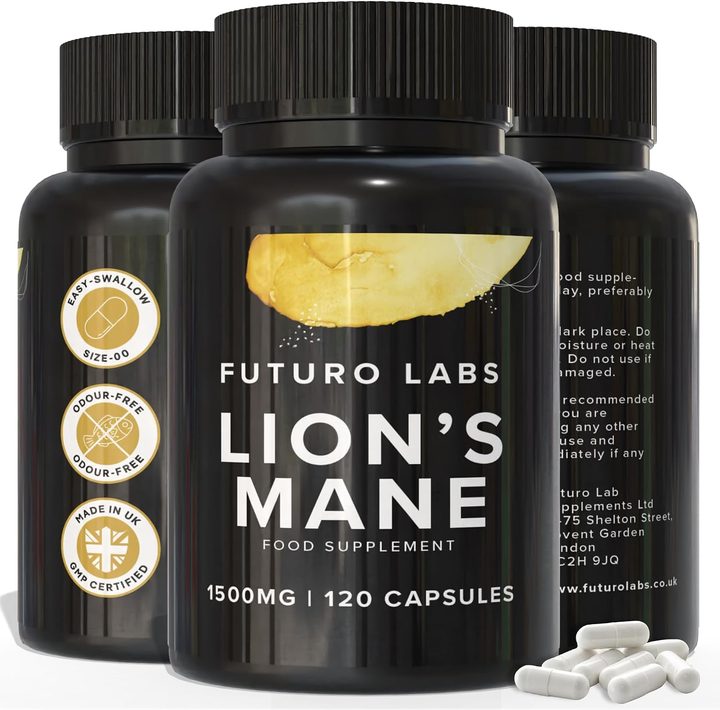
Our brand: the worked example on this page
Futuro Labs Lion's Mane
- 13p a day
- 120 capsules, 1 capsule daily
- Lab tested
- Made in the UK
The capsule side of the flip, priced: Futuro Labs Lion's Mane on Amazon UK, 1 capsule metering the 5:1 dose exactly, £15.49 for 120 days at 13p. Full label breakdown. The two-powders trap is on the powder-versus page; the consumption tour on the consume page.
The dose-scale flip taught, because this aisle inverts the format logic the site built elsewhere
Readers arriving from the collagen section carry a format rule this aisle inverts, so teach the flip first: over there, powder dominates because the honest doses are big, ten and fifteen grams turning capsules into seventeen-a-day absurdities and powder into the only civilised vehicle; here, the daily dose is tiny, roughly 300mg of actual extract on the worked example's 5:1, a single capsule's worth, which flips every term of the comparison, the capsule's convenience premium collapsing toward zero, one swallow metering the dose exactly at 13p, while powder's advantages, bulk pricing and scoop-your-own flexibility, shrink to the margins because there is almost no bulk to price and almost no range to scoop across in a claims-free category whose only lawful instruction is the label's own, the dose-scale flip in one sentence being that big-dose aisles belong to powder and tiny-dose aisles belong to capsules, and lion's mane is a tiny-dose aisle. The honest buyers powder still serves deserve their paragraph rather than a dismissal: the smoothie-and-coffee mixers who want the extract in the drink rather than beside it, the capsule-averse for whom any shell is a non-starter, the decoction-and-broth cooks running the consume page's kitchen chemistry, and the deliberate dose-experimenters, running personal n-of-ones with a scale, all legitimately in powder country, buying flexibility with the taxes the next section prices.
The powder-specific tests added to the standing four, the taxes priced, and the verdict split by buyer
Powder keeps the standing four tests, fruiting body stated, ratio with its maths, testing shown, pence divided, and adds three of its own that the loose format makes necessary. Test five, the stated serving: a serving weight in grams printed on the pack with a scoop supplied or a scale implied, because loose powder without a stated serving is a dose nobody can take twice, and the drift warning belongs here in bold, level versus heaped teaspoons swinging a nominal serving by a third to a half, the collagen aisle's level-scoop discipline imported whole, with a £10 pocket scale being the experimenter's honest tool. Test six, the per-equivalent division: powder prices compare via pence per milligram of mushroom equivalent, the ratio page's metric, price divided by servings at the stated weight, then against the 13p capsule benchmark, a comparison powders sometimes win on paper by margins too small to buy back the measuring. Test seven, the storage line: mushroom extracts are hygroscopic, clumping and degrading in humid cupboards, so airtight containers, dry spoons and reasonable turnover are part of the purchase, a six-month tub outliving its keeper's diligence being the format's quiet waste. And the two-powders trap gets its one-line advance warning here, fully taught on the versus page: lion's mane powder names both extract powder and plain ground dried mushroom, a 1:1 culinary product wearing supplement pricing, so the label must say extract with a ratio or the comparison is void. The verdict splits by buyer as the flip predicts: the default reader takes the capsule, one swallow, exact metering, 13p, no scale, no clumping; the mixers, cooks and experimenters take a powder passing all seven tests at an honest per-equivalent price; and nobody takes a bag whose label forgot the word extract.
| The item | Powder | The capsule default |
|---|---|---|
| The dose scale | ~300mg a day: almost nothing to scoop | One capsule meters it exactly |
| The added tests | Stated serving weight, per-equivalent price, storage | None: the shell does the work |
| The drift riskOurs | Level versus heaped swings a third or more | Zero |
| The honest buyers | Mixers, cooks, capsule-averse, experimenters | Everyone else, at 13p |
| The trap | Extract powder versus plain ground mushroom | The label must say extract with a ratio |
| The storage | Airtight, dry spoon, honest turnover | The bottle, closed |
The verdict, flipped and split
The best lion's mane mushroom powder: one passing all seven tests, the standing four plus a stated serving weight, an honest per-equivalent price and a storage plan, bought by the mixers, cooks and dose-experimenters powder genuinely serves, while the dose-scale flip hands everyone else the aisle's default, a tiny daily dose metered exactly by one capsule with no scale, no drift and no clumping. The default, priced: Futuro Labs Lion's Mane, one capsule of 5:1 fruiting body extract labelled 1500mg mushroom equivalent, UK made, lab tested, £15.49 for 120 days at 13p a day, the flip's conclusion in a single swallow, with powder left to the kitchens that actually need it.
What to check on the label
- Learn the flip: tiny-dose aisles belong to capsules.
- Add the powder tests: serving weight, per-equivalent price, storage.
- Fear the drift: level versus heaped is a third of the dose.
- Check for the word extract: the two-powders trap waits.
- Split by buyer honestly: mixers and cooks; everyone else, 13p.
Our brand
The worked example: Futuro Labs Lion's Mane
Futuro Labs Lion's Mane: 1 capsule daily of 5:1 fruiting body extract, labelled 1500mg mushroom equivalent (about 300mg extract), 120 capsules for £15.49, 120 days at 13p a day. Vegan HPMC shell, UK made under GMP and BRC, independently lab tested, caffeine free. Lion's mane holds no authorised UK health claims; this site describes its small studies as studies.
- Extract
- fruiting body, 5:1
- Per capsule
- 1500mg mushroom equivalent
- Serving
- 1 capsule a day
- Bottle
- 120 capsules, 120 days
- Price
- £15.49 (13p a day)
- Capsule
- HPMC vegan shell, size 00
Questions people also ask
Is lion's mane powder cheaper than capsules?
Sometimes on paper, rarely meaningfully: at roughly 300mg of extract a day the per-equivalent savings are pennies, too small to buy back the measuring, storage and drift the loose format adds.
How much lion's mane powder equals one capsule?
The worked example's capsule holds about 300mg of 5:1 extract, 1500mg mushroom equivalent, so a powder serving matching it is that stated weight of the same-ratio extract, weighed level or on a scale.
Why does the site push powder for collagen but capsules here?
The dose-scale flip: collagen's honest doses run to fifteen grams, where capsules become absurd, while lion's mane's tiny daily dose makes one capsule the exact, convenient meter.
What ruins lion's mane powder in the cupboard?
Humidity: the extracts are hygroscopic, clumping and degrading in damp storage, so airtight containers, dry spoons and honest turnover are part of the format's price.
What's the trap when buying lion's mane powder?
The two powders: plain ground dried mushroom sells under the same name as concentrated extract, so the label must say extract with a stated ratio or the product is a culinary powder at supplement prices.
Sources
- The medicinal mushroom labelling discussion: fruiting body versus mycelium-on-grain, extract ratios and beta-glucan content as the label facts that separate concentrated extracts from diluted powders. PubMed record
- The mushroom polysaccharide analysis literature: beta-glucan content marks fungal material while high alpha-glucan readings indicate grain starch, the analytical distinction between fruiting body extracts and mycelium-on-grain powders. PubMed record
- Mori K, Inatomi S, Ouchi K, Azumi Y, Tuchida T. Improving effects of the mushroom Yamabushitake (Hericium erinaceus) on mild cognitive impairment: a double-blind placebo-controlled clinical trial. Phytotherapy Research 2009;23(3):367-372. PubMed record
- EFSA Panel on Dietetic Products, Nutrition and Allergies. Scientific Opinion on the substantiation of health claims related to magnesium. EFSA Journal 2010;8(10):1807. https://efsa.onlinelibrary.wiley.com/doi/10.2903/j.efsa.2010.1807