Ghost Fitness/Collagen/Can you take too much collagen for skin?
Can you take too much collagen for skin?
The short answer
Not in a way skin notices: fibroblasts make collagen at their own rate, not the rate substrate arrives, and the trials show a flat dose-response, 2.5g and 10g giving similar instrument changes. Grams past ten buy calories, not skin.
- The production ceilingfibroblasts make collagen at a rate set by signalling, tension and age, not by substrate queued outside
- The flat dose-response2.5g and 10g a day over 8 to 12 weeks: similar cutometer and corneometer changes; no proportional gain
- Too much for skinany gram past 10g: no harm, no gain; four calories a gram, fullness at scoop doses, complete protein displaced
- The skin's real too-muchessugar in collagen gummies and drinks that glycates dermal collagen; high-dose vitamin A
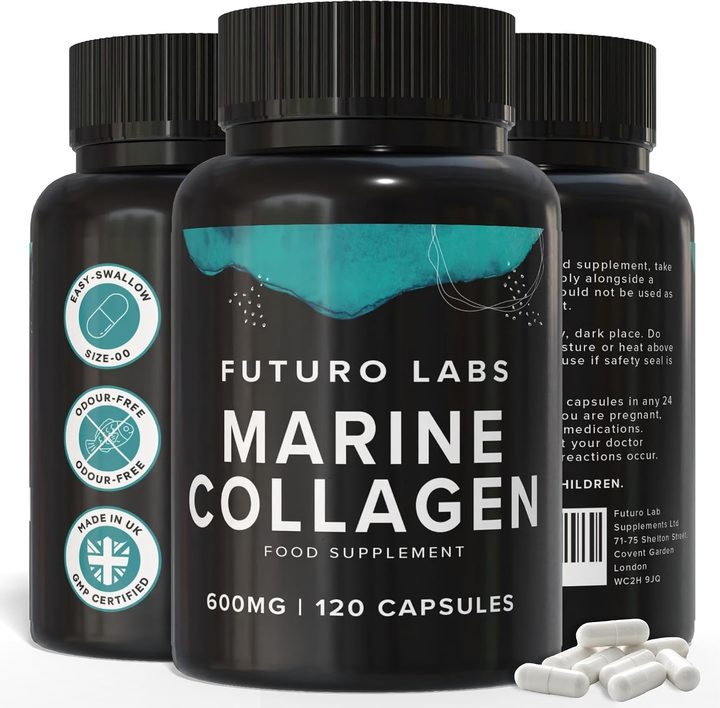
Our brand: the worked example on this page
Futuro Labs Marine Collagen
- 28p a day
- 120 capsules, 2 capsules daily
- Lab tested
- Made in the UK
Below the trials' floor and stated so: Futuro Labs Marine Collagen on Amazon UK, 2 capsules, 1200mg hydrolysed type 1 marine collagen with 12mg vitamin C at 15% NRV plus zinc, 120 for £16.99, 28p a day, lab tested and UK made, no sugar, taken for vitamin C's collagen formation sentence for skin and zinc's normal skin line. Full label breakdown. The three faces are on the too much collagen in the face page; the skin dose in milligrams on the how many mg for skin page; too much by reason on the how much is too much page.
The production ceiling: why the dermis cannot use more than a little
Can you take too much collagen for skin is a question that assumes the skin's collagen is limited by supply, so that more swallowed collagen means more skin collagen up to some point of excess, and the honest page begins with the biology that says otherwise, because the skin has a production ceiling and not a supply ceiling, and that one fact answers the question. Dermal collagen is made by fibroblasts, the sparse cells scattered through the dermis, and a fibroblast makes collagen at a rate set by its own state: the growth factors reaching it, the mechanical tension it feels in the matrix around it, the hormones in the blood, oestrogen above all in women, and its age, since fibroblast output falls across the decades and sharply after menopause. What does not set the rate, once a modest supply is met, is how much substrate is queued outside the cell, because the amino acids collagen is built from, glycine, proline and lysine, are abundant in the free amino acid pool of any fed adult, glycine and proline being made in the body and lysine supplied by every complete protein eaten, and a fibroblast reaching for them finds them whether or not the reader took collagen that morning. So the dermis is rate-limited by its cells and not by its supply, which is the same reason a factory running one shift does not produce more when a second lorry of raw material arrives at the gate: the material waits, or in the body's case is used elsewhere or burned for energy at four calories a gram. The small peptides that survive digestion, prolyl-hydroxyproline among them, are proposed to act on fibroblasts as a signal rather than a material, which is the honest mechanism behind the skin trials, and a signal is also rate-limited, since a cell told twice to do something it is already doing does not do it twice as fast. Everything above predicts one thing about dose: that beyond a modest intake, more collagen should produce no more skin collagen, and the trials were positioned to check.
The flat dose-response, what too much costs, the skin's real too-muches, and the worked example
The trials checked and the dose-response is flat. Across the oral collagen skin trials, doses of 2.5 grams a day and 10 grams a day over eight to twelve weeks produced changes in skin elasticity by cutometer and hydration by corneometer of similar size against placebo, a few percent in each case, with no trial demonstrating a proportional gain from the fourfold higher dose, the eight-week eye wrinkle depth trial at 2.5 grams sitting beside the ten-gram elasticity trials with results of the same order, and this flatness is the signature of a rate-limited process, the signal saturating at a modest dose and the extra grams doing nothing the instruments could find. So too much collagen for skin has a precise definition: any gram past ten, the top of the skin trials, and probably any gram past a good deal less, since 2.5 did what ten did. The excess does no harm to the skin, since there is no mechanism by which a queued amino acid damages a dermis and the trials at up to fifteen grams for a year recorded no skin adverse event above placebo, and it does nothing for the skin either, so the cost of too much is the cost of any unneeded protein: four calories a gram, thirty-six for a dessertspoon beyond the need and seventy-two for a scoop, fullness and mild bloating at scoop doses in the first fortnight, and, for a lifter tracking protein, complete protein displaced from the day if the collagen is counted as such. The skin's real too-muches live elsewhere in the same aisle and the honest page names them: the sugar in collagen gummies, shots and flavoured drinks, two to four grams a gummy and several a shot, taken daily for a skin habit, when the glycation literature links chronically high sugar exposure to cross-linked, stiffened dermal collagen, the opposite of the promise; and high-dose vitamin A in some skin, hair and nails formulas, the one skin nutrient with a real upper level and a real toxicity, none of which is in a plain collagen tub. Vitamin C, the cofactor the trials paired with collagen and the holder of the register's collagen formation sentence for skin, is water-soluble and has its excess excreted, so the pairing is not a too-much either at label doses. The worked example sits below the trials' floor and states its terms: two capsules, 1200mg hydrolysed type 1 marine collagen with 12mg vitamin C plus zinc, 120 for £16.99 at 28p a day, lab tested and UK made, no sugar, below the 2.5 grams at which the skin trials began, taken for vitamin C's collagen formation sentence for skin and zinc's normal skin line, a signal-sized dose that the flat dose-response suggests loses less to its smallness than the shelf implies and that this site still states as below the band. Can you take too much collagen for skin: the dermis stops using it long before any harm, the trials show the ceiling at a modest dose, and the excess is calories and fullness, while the aisle's real skin excesses are sugar and vitamin A.
| The item | The fact | What it means for too much |
|---|---|---|
| The fibroblast's rate | Set by growth factors, tension, hormones and age; not by substrate queued outside | A production ceiling, not a supply ceiling |
| The substrate | Glycine and proline made in the body; lysine in every complete protein; the pool is large | More swallowed collagen does not mean more skin collagen |
| The signal | Prolyl-hydroxyproline acts on fibroblasts in cell work; saturates like any signal | A cell told twice does not work twice as fast |
| The dose-response | 2.5g and 10g over 8 to 12 weeks: similar cutometer and corneometer changes; no proportional gain | Too much is any gram past ten, and probably past less |
| The cost of excess | Four calories a gram; fullness at scoop doses; complete protein displaced if counted | No harm to skin; nothing for it |
| The skin's real too-muches | Sugar in gummies and shots that glycates dermal collagen; high-dose vitamin A | Not in a plain collagen tub |
| The pairing | Vitamin C is water-soluble; excess excreted | Not a too-much at label doses |
| The worked exampleOurs | Two capsules, 1200mg marine collagen with 12mg vitamin C plus zinc, 28p a day, no sugar | Below the trials' floor; the vitamin C and zinc lines |
What to check on the label
- Remember the ceiling is the cell's: not the supply's.
- Read the flat dose-response: 2.5g did what 10g did.
- Stop at ten grams for skin: past it is calories.
- Watch the sugar, not the collagen: gummies glycate the dermis they promise.
- Check any skin formula for vitamin A: the real skin upper level.
Our brand
The worked example: Futuro Labs Marine Collagen
Futuro Labs Marine Collagen: 2 capsules daily, 1200mg hydrolysed type 1 marine collagen with 12mg vitamin C and 1.5mg zinc (15% NRV each), 120 capsules for £16.99, 60 days at 28p a day, lab-tested, UK GMP made. Slim veggie-shell capsules, odour free. Fish derived: pescatarian, not vegetarian or vegan.
- Collagen per serving
- 1200mg hydrolysed type 1 marine (fish)
- Co-factors
- vitamin C 12mg (15% NRV), zinc 1.5mg (15% NRV)
- Serving
- 2 capsules a day
- Bottle
- 120 capsules, 60 days
- Price
- £16.99 (28p a day)
- Capsule
- slim size 00, veggie shell, odour free
Questions people also ask
Is more collagen better for skin?
No: the skin trials show a flat dose-response, 2.5 grams and 10 grams a day over eight to twelve weeks producing instrument changes of similar size, because fibroblasts make collagen at a rate set by their own signalling and not by how much substrate is queued, so grams past a modest dose buy calories and fullness rather than skin.
Can too much collagen damage your skin?
No mechanism exists and the trials show none: hydrolysed collagen at up to fifteen grams a day for a year recorded no skin adverse event above placebo, an unneeded amino acid is used elsewhere or burned rather than deposited harmfully, and the aisle's real skin excesses are the sugar in collagen gummies and drinks, which glycates dermal collagen, and high-dose vitamin A.
How much collagen is too much for skin?
Any gram past ten, the top of the skin trials, and probably any gram past a good deal less, since 2.5 grams produced changes of the same order as ten in the trials, so the excess costs four calories a gram, fullness at scoop doses and, for a lifter counting protein, complete protein displaced, without harming or helping the skin.
Why does my skin not improve when I take more collagen?
Because the dermis has a production ceiling: fibroblasts make collagen at their own rate, the small peptides that may signal them saturate like any signal, and the trials found no proportional gain from a fourfold higher dose, so a reader who doubled the scoop and saw nothing extra saw exactly what the dose-response predicts.
Are collagen gummies bad for skin?
The sugar is: two to four grams a gummy and several grams a shot, taken daily for a skin habit, when chronically high sugar exposure glycates and stiffens dermal collagen, so the format most sold for a skin glow is the one carrying the aisle's real skin too-much, and a measured powder or capsule without sugar carries none.
Sources
- The collagen skin trial dose comparison: across the oral collagen skin trials, doses of 2.5 grams and 10 grams a day over eight to twelve weeks produced instrument changes of similar size, with no trial showing a proportional gain from the higher dose, consistent with fibroblast synthesis being rate-limited by the cell rather than by substrate supply once a modest intake is met. PubMed record
- The collagen and skin trial literature: randomised studies of oral collagen peptides on skin elasticity and hydration, mostly small, short and industry funded, with no authorised claim resulting. PubMed record
- The collagen and wrinkle depth trial: an eight-week randomised placebo-controlled trial of 2.5 grams a day of specific collagen peptides in women aged 45 to 65 reported reduced eye wrinkle depth measured by skin profilometry, with increases in dermal procollagen and elastin markers in biopsies, a manufacturer-funded trial of one peptide with an instrument outcome and no authorised claim. PubMed record
- The skin measurement literature: oral collagen trials assess skin by instrument, elasticity by cutometer suction, hydration by corneometer capacitance, dermal density by high-frequency ultrasound and wrinkle depth by profilometry, changes of a few percent that are detectable by the device and generally below what a person sees in a mirror. PubMed record