Ghost Fitness/Collagen/Can you take too much collagen in face?
Can you take too much collagen in face?
The short answer
Three faces. Swallowed: no upper level exists, and above the 2.5 to 10g trial doses more collagen adds calories, not face. Applied: collagen cannot cross skin, so more is thicker moisturiser. Injected: too much filler is real, a practitioner's question.
- Face one, swallowedno upper level; trials at 2.5 to 10g for 8 to 12 weeks; above that, calories at four a gram
- Face two, applieda protein far above 500 daltons does not cross intact skin; more is a thicker humectant layer
- Face three, injectedfillers: overfilling, lumps and migration are documented; the practitioner's consultation
- The registerno collagen claim; vitamin C's collagen formation sentence for skin, zinc and biotin's normal skin lines
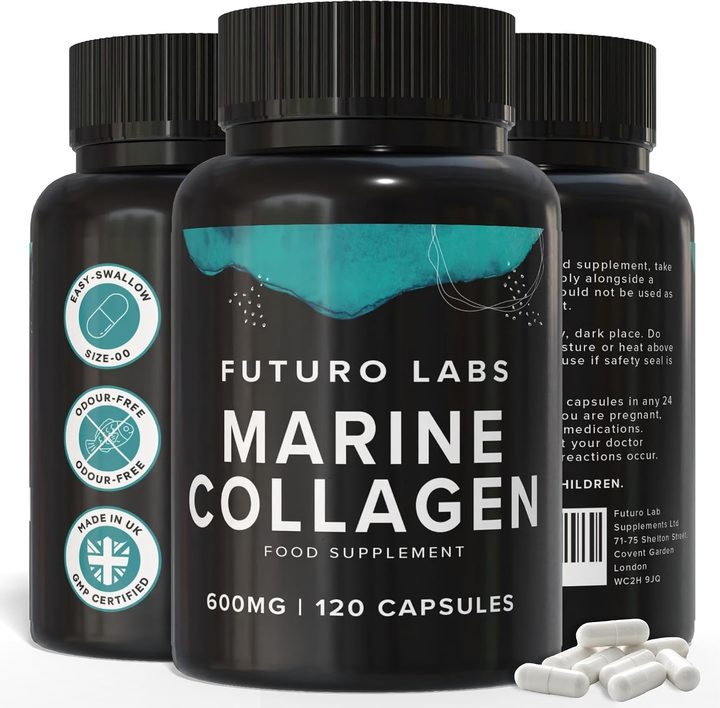
Our brand: the worked example on this page
Futuro Labs Marine Collagen
- 28p a day
- 120 capsules, 2 capsules daily
- Lab tested
- Made in the UK
The swallowed face on its true terms: Futuro Labs Marine Collagen on Amazon UK, 2 capsules, 1200mg hydrolysed type 1 marine collagen with 12mg vitamin C at 15% NRV plus zinc, 120 for £16.99, 28p a day, lab tested and UK made, below the 2.5 to 10g the skin trials gave, taken for vitamin C's collagen formation sentence and zinc's normal skin line. Full label breakdown. The 500 dalton rule for creams is on the collagen and vitamin C on the face page; what firms a face is on the firming skin page.
Face one and face two: the swallowed collagen and the applied collagen
Can you take too much collagen in the face is a question that means three different things depending on how the collagen gets there, and the honest page answers all three because a reader searching it may be holding a tub, a cream or a clinic's leaflet. Face one is swallowed collagen taken for the face, the tub, and here the answer is that too much does not exist as a face problem: hydrolysed collagen is a food protein with no upper level set by any authority, the oral skin trials gave 2.5 to 10 grams a day for eight to twelve weeks and measured small gains in elasticity and hydration by cutometer and corneometer, a few percent in small, mostly industry-funded trials, and above ten grams the skin trials simply have no data, so a reader taking twenty or thirty grams for the face is not overdosing the face but is paying for protein the face trials never tested, at four calories a gram, with fullness as the only effect the extra grams reliably produce. Nor does the face get more of a larger dose: a swallowed protein is digested to amino acids and small peptides distributed to wherever the body needs protein, with no address for the cheeks, and the dermis, the layer the trials target, turns over on a clock of months, the skin turnover literature's timescale, so the dose is a slow drip into a slow pool and doubling the drip does not double the pool. The swallowed face's ceiling is the trials' ceiling, ten grams, and its honest expectation is an instrument's few percent at eight to twelve weeks, never a mirror's. Face two is applied collagen, the cream, and here too much is a different kind of nothing: collagen is a large protein, hundreds of thousands of daltons intact and thousands even hydrolysed, and the 500 dalton rule describes why molecules far above that weight do not passively cross intact skin, so collagen in a cream does not reach the dermis where the skin's own collagen lives, it sits on the surface as a humectant, holding water in the top layer and making the skin feel smoother while it is there, which is a real cosmetic effect and a temporary one. More collagen in the cream, or more cream, is a thicker layer of humectant, and too much is a greasy face rather than a collagen face, with no route by which the excess could do anything beneath.
Face three: the injected collagen, and the three faces totalled
Face three is injected collagen, and it is the one face where too much is real, documented and serious, so the honest page names it and then steps back, because it is not a supplement question. Dermal fillers add volume beneath the skin as a medical procedure: the early fillers were bovine collagen, requiring allergy testing beforehand, and most modern fillers are hyaluronic acid gels, with collagen-stimulating fillers of other materials in the range, and all of them are placed by a practitioner with a needle or cannula into the lip, cheek, jaw or fold. Too much filler is the outcome the filler literature and the clinics spend the most time on: overfilling that changes the shape of a face beyond the natural, lumps and nodules where product pools, migration of filler from the lip into the skin above it over months, and the rare vascular complications when filler enters or compresses a vessel, all of which are the practitioner's consultation, technique and follow-up, and none of which a supplement page has any standing to advise on beyond saying that the injected face is a regulated medical decision made with a qualified practitioner, and that a filler consultation is where a reader worried about too much collagen in the face should be having that conversation if the face they mean is this one. The three faces totalled: swallowed, no upper level and no face effect from exceeding the trials' ten grams, only calories; applied, a humectant that cannot cross skin, where too much is a thicker layer; injected, a real overfilling risk and a practitioner's question. The register governs what the tub for face one may say, and it says collagen holds no authorised claim for skin, so the tub's sentences are vitamin C's, that it contributes to normal collagen formation for the normal function of skin, and zinc's and biotin's, that they contribute to the maintenance of normal skin, borrowed from the ingredients beside the collagen, and the honest capsule pairs them for that reason. This site covers face one only, and states its worked example on its true terms: two capsules, 1200mg hydrolysed type 1 marine collagen with 12mg vitamin C plus zinc, 120 for £16.99 at 28p a day, lab tested and UK made, a dose below the 2.5 to 10 grams the skin trials gave, taken for vitamin C's collagen formation sentence and zinc's normal skin line, and not a dose that any face, swallowed, applied or injected, could be given too much of. Can you take too much collagen in the face: by mouth, no, only too much protein; by cream, no, only too much cream; by needle, yes, and that is a practitioner's answer.
| The face | How the collagen arrives | Can there be too much | The reason |
|---|---|---|---|
| Swallowed | A tub, taken orally for the face | Not as a face problem | No upper level; trials at 2.5 to 10g; above that, calories and fullness only |
| Applied | A cream on the skin | Only as a thicker layer | A protein far above 500 daltons does not cross intact skin; a surface humectant |
| Injected | A dermal filler placed by a practitioner | Yes, documented | Overfilling, lumps, migration, vascular complications: the practitioner's consultation |
| The dermis clock | Where the trials' effect happens | Doubling the dose does not double it | Dermal collagen turns over on a clock of months |
| The register | What the tub may say | No collagen claim | Vitamin C's collagen formation sentence; zinc and biotin's normal skin lines |
| The worked exampleOurs | Two capsules, 1200mg marine collagen with 12mg vitamin C plus zinc, 28p a day | No face could be given too much of it | Below the skin trial doses; the vitamin C and zinc lines |
What to check on the label
- Swallowed: stop at the trials' ten grams: above it is calories.
- Applied: expect a humectant: nothing crosses.
- Injected: ask the practitioner: too much filler is real.
- Expect an instrument's few percent: at eight to twelve weeks, never a mirror's.
- Read the tub's sentences as vitamin C's and zinc's: collagen holds none.
Our brand
The worked example: Futuro Labs Marine Collagen
Futuro Labs Marine Collagen: 2 capsules daily, 1200mg hydrolysed type 1 marine collagen with 12mg vitamin C and 1.5mg zinc (15% NRV each), 120 capsules for £16.99, 60 days at 28p a day, lab-tested, UK GMP made. Slim veggie-shell capsules, odour free. Fish derived: pescatarian, not vegetarian or vegan.
- Collagen per serving
- 1200mg hydrolysed type 1 marine (fish)
- Co-factors
- vitamin C 12mg (15% NRV), zinc 1.5mg (15% NRV)
- Serving
- 2 capsules a day
- Bottle
- 120 capsules, 60 days
- Price
- £16.99 (28p a day)
- Capsule
- slim size 00, veggie shell, odour free
Questions people also ask
Can too much collagen make your face puffy?
Not swallowed collagen: a food protein at four calories a gram has no mechanism for facial swelling, and puffiness after starting a marine collagen would point to fish allergy rather than excess; puffiness after filler is the practitioner's question, since overfilling and swelling are documented filler outcomes.
How much collagen should I take for my face?
The skin trials gave 2.5 to 10 grams a day for eight to twelve weeks and measured a few percent by instrument, so ten grams is the ceiling with data, and a two-capsule 1200mg dose sits below the trial range and is taken on its true terms for vitamin C's collagen formation sentence and zinc's normal skin line.
Does collagen cream do anything for your face?
As a humectant, temporarily: collagen is a large protein that does not cross intact skin under the 500 dalton rule, so it holds water in the surface layer and smooths the feel while it is there, without reaching the dermis where the skin's own collagen lives, and more cream is a thicker layer rather than a deeper one.
Can you have too much collagen filler?
Yes, and it is documented: overfilling that changes the face's shape, lumps where product pools, migration of filler over months and rare vascular complications are the filler literature's main concerns, all of which belong to a qualified practitioner's consultation and follow-up and not to a supplement page.
Will taking more collagen make my skin improve faster?
No: the dermis turns over on a clock of months, the trials measured at eight to twelve weeks at 2.5 to 10 grams, and a swallowed protein is distributed wherever the body needs it with no address for the face, so doubling the dose adds calories and fullness rather than speed, and the honest expectation is an instrument's few percent at the trials' pace.
Sources
- The collagen and skin trial literature: randomised studies of oral collagen peptides on skin elasticity and hydration, mostly small, short and industry funded, with no authorised claim resulting. PubMed record
- The skin penetration literature: the 500 dalton rule describes the approximate molecular weight ceiling for meaningful passive penetration of intact skin, excluding large proteins from transdermal delivery. PubMed record
- The dermal filler literature: injectable fillers, historically bovine collagen and now mostly hyaluronic acid, add volume beneath the skin as a medical procedure with documented complications including overfilling, migration, lumps and vascular occlusion, performed by trained practitioners and outside the scope of any oral supplement. PubMed record
- The skin biology literature: the epidermis turns over in around four weeks while dermal collagen, the layer supplements target, turns over far more slowly, so the oral collagen skin trials measured elasticity and hydration after eight to twelve weeks of daily intake with no timing of day specified, consistency across weeks rather than time of day being the variable the trials controlled. PubMed record