Ghost Fitness/Collagen/How much collagen for joints?
How much collagen for joints?
The short answer
Two numbers, two molecules. Hydrolysed collagen peptides: around ten grams a day, a heaped dessertspoon, the joint trials' usual dose over months, with small effects and no claim. Undenatured type II collagen: 40mg a day, a different molecule with a different proposed mechanism and its own small trials. A 10,000mg tub and a 40mg tub are two products. A lifter's loaded joint is dosed by load, not by either.
- Hydrolysed collagen peptidesaround ten grams a day; the joint trials' cluster over three to six months; small effects; no claim
- Undenatured type II collagen40mg a day; native form; an immune-tolerance mechanism proposed; small trials; no claim
- Why the numbers differtwo molecules, two mechanisms: building material at grams, an immune signal at milligrams
- The loaded jointprogressive load and a physiotherapist; vitamin C and vitamin D hold the only joint-tissue sentences
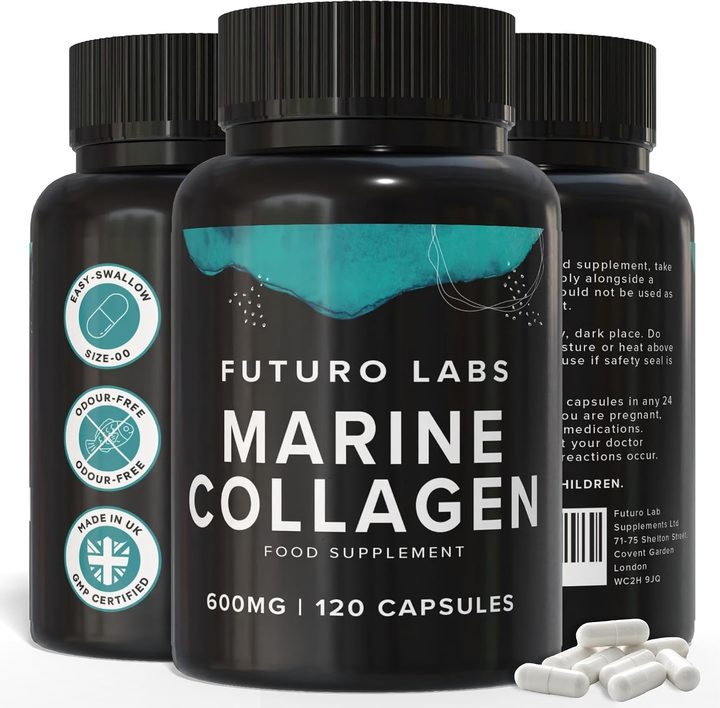
Our brand: the worked example on this page
Futuro Labs Marine Collagen
- 28p a day
- 120 capsules, 2 capsules daily
- Lab tested
- Made in the UK
A hydrolysed dose below the joint trials' cluster, taken for the vitamin C sentence that names cartilage: Futuro Labs Marine Collagen on Amazon UK, 2 capsules, 1200mg hydrolysed type 1 marine collagen with 12mg vitamin C at 15% NRV plus zinc, 120 for £16.99, 28p a day. Full label breakdown. Type II for joints is on the type II page; the dose for tendons and joints on the tendons and joints dose page.
The first number, around ten grams of hydrolysed collagen, and what the joint trials did with it
How much collagen for joints is a question that the shelf answers with two numbers three hundred times apart, and the honest page starts by explaining that they are not a typo but two molecules, because a reader who does not know that will buy the wrong one and dose it wrongly. The first number: hydrolysed collagen peptides, the powder in a tub and the collagen in most capsules, are collagen broken down into small peptides that are absorbed and supply glycine, proline and hydroxyproline, and the joint trials of hydrolysed collagen clustered around ten grams a day, a heaped dessertspoon of powder, taken for three to six months, reporting small improvements in joint comfort and function in people with joint complaints or osteoarthritis, in trials that are small, short and often industry funded, the collagen trial literature's range of 2.5 to 15 grams with the joint work in the middle, and no authorised claim resulting, collagen holding no joint sentence in the UK in any form. So the first answer to how much collagen for joint support, joint pain or joint health is around ten grams a day of hydrolysed collagen if a reader wants the dose the trials used, with the honesty that the trials' effects were small and that a loaded joint is a different question, and that the capsule dose of one to two grams that most tubs deliver sits below that cluster, the capsule product this site names stating its 1200mg plainly as below the band and taken for the vitamin C sentence that names cartilage rather than for the joint trials' dose.
The second number, 40mg of undenatured type II, why it is a different molecule, the loaded joint that neither doses, and the numbers filed
The second number: undenatured type II collagen, sold as UC-II and in the joint-branded capsules that say 40mg on the front, is not hydrolysed at all but kept in its native, folded form, and its proposed mechanism is not as building material but as a signal, a small daily dose taken up in the gut and shown to the immune system to induce tolerance to the body's own type II collagen, the cartilage collagen that the immune system attacks in some joint conditions, the undenatured type II literature's account, so the dose is 40mg a day, a fraction of a capsule, because a signal is dosed in milligrams and building material in grams, and the trials are small randomised studies at that dose against joint outcomes with no authorised claim resulting either. Why the two are different products and not a typo: a reader cannot take 40mg of hydrolysed peptides and expect the joint trials' effect, since that is a four-hundredth of the dose they used, and cannot take ten grams of undenatured type II, since it is sold in milligrams and would cost a fortune to try, so the molecule is picked first, hydrolysed peptides at grams for the building-material logic and undenatured type II at 40mg for the immune-signal logic, and the two are not added together for a bigger effect, there being no trial of the pair and no mechanism by which a signal needs more material. The loaded joint that neither doses is the lifter's: a knee sore in the squat, a shoulder in the press or an elbow at the bench is a tendon or a cuff whose load has outrun its adaptation, fixed by progressive loading, technique and volume with a physiotherapist, the tendinopathy literature's programme, and osteoarthritis guidance puts exercise, weight management and education first with supplements absent from the pathway, the osteoarthritis guidance's core, so neither number treats a loaded joint and the two sentences on the register that name a joint tissue belong to vitamin C, for normal collagen formation for the normal function of cartilage and bones, and vitamin D, for normal bones and muscle function, both cheap and both already on most plates. The numbers filed: around ten grams of hydrolysed collagen as the joint trials' cluster with small effects and no claim, 40mg of undenatured type II as a different molecule with a different mechanism and its own small trials, the molecule picked before the number, and the loaded joint dosed by load, with the worked example being a hydrolysed dose below the cluster taken for the vitamin C sentence, £16.99 for 120 at 28p a day.
| The product | The dose | What it is |
|---|---|---|
| Hydrolysed collagen peptides, powder | Around ten grams a day, a heaped dessertspoon, for three to six months | Building material; the joint trials' cluster; small effects; no claim |
| Hydrolysed collagen in capsules | One to two grams a day | Below the joint trials' cluster; taken for a vitamin C line |
| Undenatured type II collagen, UC-II | 40mg a day | A native molecule; an immune-tolerance signal; its own small trials; no claim |
| Why 10,000mg and 40mg both appear | Two molecules, two mechanisms | Not a typo; pick the molecule before the number |
| A lifter's loaded joint | Dosed by load | Progressive loading with a physiotherapist; exercise first in guidance |
| The sentences naming a joint tissue | Vitamin C and vitamin D | Normal collagen formation for cartilage and bones; normal bones and muscle function |
The verdict, ten grams of one molecule or 40mg of another, neither with a claim, and a loaded joint that load fixes
How much collagen for joints: around ten grams a day of hydrolysed collagen peptides, a heaped dessertspoon over three to six months, the dose the joint trials clustered around with small effects in small, often industry-funded studies and no authorised claim, or 40mg a day of undenatured type II collagen, a different molecule kept in its native form with an immune-tolerance mechanism proposed and its own small trials, so that a tub saying 10,000mg and a tub saying 40mg are two products and the molecule is picked before the number, while a lifter's loaded joint is dosed by progressive load and a physiotherapist rather than by either and the only register sentences naming a joint tissue belong to vitamin C and vitamin D. A hydrolysed dose below the cluster, taken for the vitamin C sentence that names cartilage: Futuro Labs Marine Collagen, 1200mg type 1 with 12mg vitamin C, 120 for £16.99 at 28p a day.
What to check on the label
- Pick the molecule first: hydrolysed peptides or undenatured type II.
- Dose hydrolysed at around ten grams: the joint trials' cluster, months, small effects.
- Dose undenatured type II at 40mg: a signal, not building material.
- Do not add them for a bigger effect: no trial of the pair.
- Dose a loaded joint with load: a physiotherapist, and vitamin C and D for the sentences.
Our brand
The worked example: Futuro Labs Marine Collagen
Futuro Labs Marine Collagen: 2 capsules daily, 1200mg hydrolysed type 1 marine collagen with 12mg vitamin C and 1.5mg zinc (15% NRV each), 120 capsules for £16.99, 60 days at 28p a day, lab-tested, UK GMP made. Slim veggie-shell capsules, odour free. Fish derived: pescatarian, not vegetarian or vegan.
- Collagen per serving
- 1200mg hydrolysed type 1 marine (fish)
- Co-factors
- vitamin C 12mg (15% NRV), zinc 1.5mg (15% NRV)
- Serving
- 2 capsules a day
- Bottle
- 120 capsules, 60 days
- Price
- £16.99 (28p a day)
- Capsule
- slim size 00, veggie shell, odour free
Questions people also ask
How much collagen should I take daily for joints?
Around ten grams a day of hydrolysed collagen peptides, a heaped dessertspoon, for three to six months if you want the dose the joint trials clustered around, with small effects in small studies and no authorised claim, or 40mg a day if the product is undenatured type II collagen, which is a different molecule with its own small trials and its own dose.
Why does one collagen say 10,000mg and another 40mg?
Because they are two molecules: hydrolysed collagen peptides are building material dosed in grams, and undenatured type II collagen is a native molecule proposed to act as an immune-tolerance signal and dosed in milligrams, so the numbers are not a typo apart and a reader picks the molecule before reading the dose.
Does collagen help joint pain?
Modestly in weak trials and with no claim: the hydrolysed collagen joint trials at around ten grams a day report small improvements in joint comfort over months in small, often industry-funded studies, collagen holds no authorised joint claim in the UK, and osteoarthritis guidance puts exercise, weight management and education first with supplements absent.
How much collagen for a lifter's sore knee?
None as a treatment: a knee sore in the squat is a tendon or a cartilage load problem fixed by progressive loading, technique and volume with a physiotherapist, and the two register sentences naming a joint tissue belong to vitamin C, for normal collagen formation for cartilage and bones, and vitamin D, for normal bones and muscle function, both cheap and usually already on the plate.
Is 1200mg of collagen enough for joints?
Not for the joint trials' dose, which clustered around ten grams: a capsule dose of 1200mg sits below the research band and is taken for a different reason, the vitamin C sentence that names cartilage and bones built in beside a modest collagen dose, stated plainly as below the band, while a reader who wants the trials' grams takes a powder.
Sources
- The collagen peptide trial literature: randomised controlled studies of hydrolysed collagen supplementation across skin, joint and connective-tissue outcomes, typically at 2.5g to 15g daily, with small effects and frequent industry funding. PubMed record
- The undenatured type II collagen (UC-II) trial literature: small randomised studies at 40mg daily against joint outcomes, a different mechanism and dose to hydrolysed collagen, with no authorised claim resulting. PubMed record
- Clinical guidance on osteoarthritis management: exercise, weight management and education form the core first-line care, with supplements absent from the recommended pathway. PubMed record
- The tendinopathy and loaded-joint pain literature: pain at the patellar, Achilles, rotator cuff and elbow tendons in lifters is a load-management problem, treated by progressive tendon loading, technique and volume adjustment, with rest alone and passive treatments performing poorly, and no supplement, omega-3 included, altering the course in the trials. PubMed record