Ghost Fitness/Collagen/Is collagen protein good for you?
Is collagen protein good for you?
The short answer
Good for one and a half of a protein's three jobs. Building muscle: no, it lacks tryptophan and most of whey's leucine. Connective tissue: research at 2.5 to 15g. Feeding you: yes, four calories a gram, but dearer than whey.
- Job one, muscleno tryptophan, near zero completeness, a third of whey's leucine: counts toward nothing at 1.6g per kilo
- Job two, connective tissueresearch: a marker doubled at 15g with vitamin C; skin instruments at 2.5 to 10g; joints at 10g over months
- Job three, feeding youfour calories a gram, satiating, no upper level, dearer per gram than whey
- Collagen as well as wheyyes, booked as two proteins for two jobs; the same glass is fine
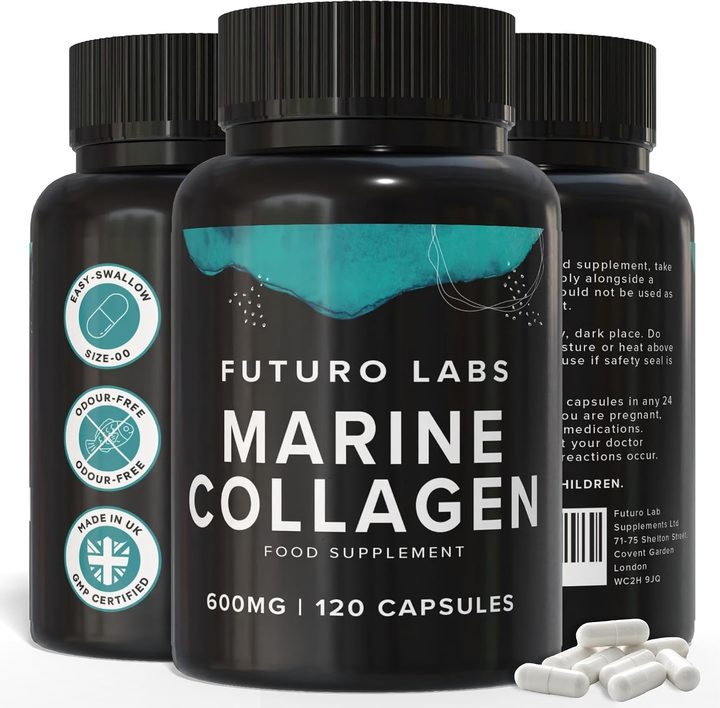
Our brand: the worked example on this page
Futuro Labs Marine Collagen
- 28p a day
- 120 capsules, 2 capsules daily
- Lab tested
- Made in the UK
The connective tissue protein on its true terms: Futuro Labs Marine Collagen on Amazon UK, 2 capsules, 1200mg hydrolysed type 1 marine collagen with 12mg vitamin C at 15% NRV plus zinc, 120 for £16.99, 28p a day, lab tested and UK made, below the research band and taken for vitamin C's collagen formation sentence beside, never instead of, the day's complete protein. Full label breakdown. The two rulers are on the good source of protein page; the whey comparison on the collagen versus whey page.
Job one, building muscle, and job two, supplying connective tissue
Is collagen protein good for you is a question with the word protein doing too much work, because a protein can do three different jobs and a protein good at one may be useless at another, so the honest page asks the question three times, once per job, and gives three different answers. Job one is building muscle, the job a lifter means by protein, and collagen is the wrong protein for it. Collagen is protein by the nitrogen test that puts the word on the label, and it is protein of a shape muscle cannot use well: it lacks tryptophan entirely, one of the nine essential amino acids, which puts it near zero on the completeness scales the food regulators use, and it carries around a third of the leucine per gram that whey does, leucine being the amino acid that triggers muscle protein synthesis after a meal or a session, so in the trials that compare them whey raises muscle protein synthesis and collagen barely moves it. A lifter eating around 1.6 grams per kilo for muscle cannot count a collagen scoop toward that number, since the body cannot build muscle protein from a source missing an essential amino acid, and the honest ledger books collagen as something else and reaches the 1.6 grams with whey, dairy, meat, fish, eggs, soya and the complete plant blends. Job two is supplying connective tissue precursors, and here collagen is not the wrong protein but a researched one. Hydrolysed collagen is a third glycine with proline and hydroxyproline, the amino acids connective tissue is built from, and the absorption studies show small peptides, prolyl-hydroxyproline among them, surviving digestion into the blood for hours and acting on fibroblasts and chondrocytes in cell work, the proposed mechanism for hydrolysed collagen doing more than its free amino acids would, a hypothesis with human marker data behind it: a collagen synthesis marker roughly doubled an hour after fifteen grams with vitamin C before loading in a small trial, skin elasticity and hydration up a few percent by instrument at 2.5 to 10 grams over eight to twelve weeks, and activity-related joint discomfort modestly down at ten grams over months, in trials that were small and mostly industry-funded, with no authorised claim resulting for any of it. So collagen is good at job two in the sense that it is the protein the connective tissue research used, at research doses and for research reasons, and the register's only collagen-adjacent sentence belongs to vitamin C's collagen formation line, which is why the honest capsule pairs them.
Job three, feeding you, collagen as well as a protein powder, and the three jobs totalled
Job three is the plainest, feeding you, and collagen does it as any protein does with two footnotes. It is four calories a gram, so ten grams is around thirty-six calories and a twenty-gram scoop around seventy-two; it is satiating, as protein is the most satiating macronutrient and has the highest thermic effect of feeding, so a collagen scoop in the morning coffee blunts the mid-morning appetite like any protein serving; it is safe, a food protein with no upper level set by any authority and no toxicity in trials at up to fifteen grams a day for months, with the two footnotes of oxalate for calcium stone formers and fish allergy for marine; and it is expensive for the job, costing more per gram than whey concentrate while feeding a reader no better and building muscle far worse, so a reader who wants protein for job three alone has cheaper and more complete options, and a reader who wants protein for job three and job two together has a reason to pay collagen's price. The secondary question, should I take collagen as well as protein powder, is answered by the three jobs: yes, when they are booked as two proteins for two jobs, the whey or the complete powder for muscle at 1.6 grams per kilo and the collagen for the connective tissue research or the vitamin C line, in the same glass if that is convenient since neither interferes with the other, and never as substitutes, so a reader who replaces a whey scoop with a collagen scoop has cut their muscle protein by a scoop and a reader who adds a collagen scoop on top has added connective tissue research and seventy calories. A reader who tracks protein writes the collagen down separately or not at all, so that the day's complete protein total is not inflated by grams that cannot do job one. The three jobs totalled: muscle, no, the wrong protein; connective tissue, research at 2.5 to 15 grams with vitamin C, no claim; feeding, yes, four calories a gram and satiating, at a price. The worked example is stated as the connective tissue protein it is and not as a muscle one: two capsules, 1200mg hydrolysed type 1 marine collagen with 12mg vitamin C plus zinc, 120 for £16.99 at 28p a day, lab tested and UK made, below the research band, taken for vitamin C's collagen formation sentence beside the day's complete protein and never instead of it, just over a gram of protein that no lifter would count and no lifter should. Is collagen protein good for you: good for feeding you, researched for your connective tissue, and the wrong protein for your muscle, which is the one job the word protein usually means.
| The job | Is collagen good at it | The reason | What to use |
|---|---|---|---|
| Building muscle | No | No tryptophan, near zero completeness, a third of whey's leucine; barely moves muscle protein synthesis | Whey, dairy, meat, fish, eggs, soya, complete plant blends at ~1.6g per kilo |
| Supplying connective tissue | Research | Glycine, proline, hydroxyproline; peptides survive digestion; a marker doubled at 15g with vitamin C; skin and joint instrument trials; no claim | Collagen at research doses, with vitamin C, for a research reason |
| Feeding you | Yes, at a price | Four calories a gram, satiating, no upper level; dearer than whey | Any protein; collagen when job two is also wanted |
| Collagen as well as whey | Yes | Two proteins for two jobs; neither interferes | The same glass is fine; never a substitute for each other |
| Tracking | Book it separately | Grams that cannot do job one should not inflate the muscle total | Write it on its own line, or not at all |
| The worked exampleOurs | Job two's protein, on its true terms | Two capsules, 1200mg marine collagen with 12mg vitamin C plus zinc, 28p a day | Beside the day's complete protein, never instead |
What to check on the label
- Name the job: muscle, connective tissue, or feeding.
- Never count it toward muscle: the wrong protein.
- Take it for connective tissue as research: with vitamin C, at research doses.
- Pay its price knowingly: dearer than whey for feeding alone.
- Stack it with whey, do not swap: two proteins, two jobs.
Our brand
The worked example: Futuro Labs Marine Collagen
Futuro Labs Marine Collagen: 2 capsules daily, 1200mg hydrolysed type 1 marine collagen with 12mg vitamin C and 1.5mg zinc (15% NRV each), 120 capsules for £16.99, 60 days at 28p a day, lab-tested, UK GMP made. Slim veggie-shell capsules, odour free. Fish derived: pescatarian, not vegetarian or vegan.
- Collagen per serving
- 1200mg hydrolysed type 1 marine (fish)
- Co-factors
- vitamin C 12mg (15% NRV), zinc 1.5mg (15% NRV)
- Serving
- 2 capsules a day
- Bottle
- 120 capsules, 60 days
- Price
- £16.99 (28p a day)
- Capsule
- slim size 00, veggie shell, odour free
Questions people also ask
Is collagen a good protein for building muscle?
No: collagen lacks tryptophan, scores near zero on the completeness scale and carries around a third of whey's leucine, so it barely raises muscle protein synthesis in the trials against whey and does not count toward the 1.6 grams per kilo a lifter eats for muscle, which is reached with complete proteins.
Should I take collagen as well as protein powder?
Yes, as two proteins for two jobs: the whey or complete powder for muscle at around 1.6 grams per kilo, the collagen for the connective tissue research or the vitamin C line, booked separately, mixed in the same glass if convenient, and never swapped for each other, since replacing a whey scoop with collagen cuts the muscle protein by a scoop.
Is collagen peptides protein powder good for you?
Good for feeding you and researched for connective tissue, at four calories a gram with no upper level and the footnotes of oxalate for stone formers and fish allergy for marine, and the wrong protein for muscle, so it is good for a reader who wants the connective tissue research and a poor buy for one who wanted protein in the muscle sense.
Why is collagen protein more expensive than whey?
Because of what it is made from and how: hides and fish skins extracted to gelatin and enzymatically hydrolysed into peptides cost more per gram than whey concentrate from the cheese process, and the price buys a protein that feeds no better and builds muscle far worse, so it is worth paying when job two, the connective tissue research, is the reason.
Does collagen count as protein on my macros?
On the label total yes, on the muscle total no: collagen is protein by the nitrogen test but cannot build muscle protein without tryptophan, so a reader tracking protein for muscle writes collagen on its own line or leaves it out, keeping the complete protein total honest.
Sources
- Comparative protein research: the leucine content of a protein drives its muscle protein synthesis response, with whey outperforming collagen in direct comparisons. PubMed record
- The protein quality literature: scoring systems such as PDCAAS and DIAAS rate proteins by essential amino acid completeness and digestibility, with collagen scoring at or near zero for lacking tryptophan. PubMed record
- The collagen peptide absorption literature: after oral hydrolysed collagen, small peptides such as prolyl-hydroxyproline and hydroxyprolyl-glycine appear in blood for several hours alongside free amino acids, and in cell and animal work these peptides act on fibroblasts and chondrocytes, the mechanism proposed for why hydrolysed collagen might do more than an equal quantity of its free amino acids, a hypothesis with human marker data behind it and no human outcome claim. PubMed record
- The protein and energy-restriction literature: higher protein intakes during a calorie deficit are studied for satiety and for preserving lean mass, the guard rails of sensible weight management. PubMed record