Ghost Fitness/Omega-3/How much omega-3 per day to reduce inflammation?
How much omega-3 per day to reduce inflammation?
The short answer
No dose carries an inflammation claim, the register's omega-3 sentences being heart, brain, vision, triglycerides and blood pressure. The mechanism is real: EPA and DHA built into membranes over months become resolvins that help inflammation resolve. The trials that moved a marker used two grams a day or more for months and found small CRP reductions, larger where CRP was raised. A lifter's post-session inflammation is repair.
- The claimnone for inflammation: heart, brain, vision, triglycerides and blood pressure only
- The mechanismmembrane EPA and DHA converted to resolvins, protectins and maresins that help inflammation resolve
- The marker trialstwo grams of EPA and DHA a day or more, weeks to months: small CRP reductions, larger where raised
- The condition trials2.7 to 4 grams for three months in inflammatory arthritis; a lifter's session inflammation is repair
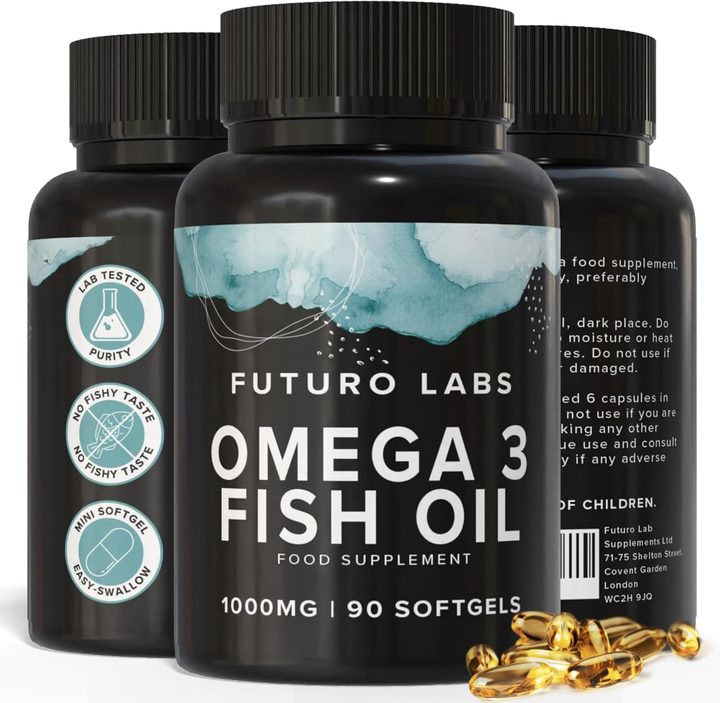
Our brand: the worked example on this page
Futuro Labs Omega 3 Fish Oil
- 17p a day
- 90 softgels, 1 softgel daily
- Lab tested
- Made in the UK
Omega-3 for its own sentences, with no inflammation word: Futuro Labs Omega 3 Fish Oil on Amazon UK, 1 softgel with food, 180mg EPA and 120mg DHA, 90 for £14.99 at 17p. Full label breakdown. The joint dose page is here; the high-dose ladder on the high-dose page.
No claim, a real mechanism, and the difference between the two
How much omega-3 per day to reduce inflammation is a question the careful-claims flag on this page answers in two parts that must be kept apart: no dose carries an inflammation claim, and the mechanism the question assumes is real. The claim first: the UK register authorises omega-3 sentences on the maintenance of normal heart function, normal brain function, normal vision, normal blood triglyceride levels and normal blood pressure, at 250mg, 250mg of DHA, two grams and three, and no sentence about inflammation, joints, soreness or recovery, so a fish oil label may not print anti-inflammatory and a reader who buys one for inflammation has bought it for a reason the register does not recognise. The mechanism next, because it is the reason the question exists: EPA and DHA built into cell membranes over three to four months of daily intake are converted, when inflammation occurs, into a family of mediators, resolvins, protectins and maresins, that help an inflammatory response switch off and resolve rather than persist, a mechanism demonstrated in cell and animal models and measurable in human blood after supplementation, the specialised pro-resolving mediator literature's finding and the biological reason the inflammation research on omega-3 exists at all. The difference between the two is the difference between a mechanism and an outcome that the regulator judged: a mediator in the blood is not a reduction in a disease, and until trials show the outcome at a dose the mechanism stays a mechanism, which is where the register has left it.
The doses in the trials that moved something, what a lifter's inflammation actually is, and the question filed
The doses in the trials that moved something are the honest numbers, with their limits named. The marker trials: meta-analyses of omega-3 and C-reactive protein, the blood marker of low-grade inflammation, find small reductions with EPA and DHA at around two grams a day or more over weeks to months, larger in people whose CRP was raised at baseline and small or absent in people whose CRP was normal, a marker effect in the inflamed rather than an anti-inflammatory effect in general, and a marker that weight loss, sleep and activity move far more, the same shape as the magnesium CRP file. The condition trials: the inflammatory arthritis meta-analysis found reduced joint pain and stiffness at 2.7 to 4 grams a day for at least three months, a specialist's condition at a concentrate's dose alongside treatment, and nothing in the wear-related or load-related joint pain a lifter has, the joint dose page's finding. What a lifter's inflammation actually is deserves the last word, because most readers asking this question mean the ache after a session: that inflammation is repair, the first stage of the process that rebuilds trained muscle, resolving on its own over a few days on the soreness timeline, not a condition to suppress and not something a supplement should aim to switch off, the DOMS review finding at most a modest reduction in perceived soreness at gram-and-above doses over weeks. A reader with inflammation of the other kind, a hot joint, a chronic condition, a raised CRP on a blood test, has a GP and a diagnosis first and an omega-3 decision second, made with the prescriber at the trials' doses if at all. The question filed: no dose reduces inflammation as a claim, the resolvin mechanism is real and slow, the marker and condition trials used two to four grams for months with modest effects in the inflamed, and a lifter's post-session inflammation is repair, with the worked example being omega-3 for its own sentences at the first rung, one softgel at 17p, £14.99 for 90.
| The item | The finding | The consequence |
|---|---|---|
| The claim | None for inflammation | No label may print anti-inflammatory |
| The mechanism | Membrane EPA and DHA become resolvins that help inflammation resolve | Real, slow, and not an outcome |
| The CRP trials | Two grams a day or more over months: small reductions, larger where CRP was raised | A marker effect in the inflamed |
| The arthritis trials | 2.7 to 4 grams for three months | A specialist's condition, alongside treatment |
| A lifter's post-session inflammation | Repair, resolving over days | Not something to switch off |
| The route for the other kind | A GP and a diagnosis first | The dose decided with the prescriber |
The verdict, a mechanism the register has not turned into a dose
How much omega-3 per day to reduce inflammation: no dose as a claim, the UK register's omega-3 sentences being heart, brain, vision, triglycerides and blood pressure with no inflammation word, while the mechanism is real, EPA and DHA built into membranes over months becoming the resolvins that help inflammation resolve, and the trials that moved something used two grams a day or more over months for small CRP reductions in the already inflamed and 2.7 to 4 grams for three months in inflammatory arthritis alongside treatment, with a lifter's post-session inflammation being repair that resolves on its own and inflammation of any other kind being a GP's diagnosis first. Omega-3 for its own sentences: Futuro Labs Omega 3 Fish Oil, one softgel with food, 180mg EPA and 120mg DHA, 90 for £14.99 at 17p a day.
What to check on the label
- Hold the register: no inflammation claim at any dose.
- Respect the mechanism: resolvins, over months, not an outcome.
- Read the trial doses: two to four grams for months, modest effects in the inflamed.
- Leave post-session inflammation alone: it is repair.
- Take the other kind to a GP: a diagnosis before a dose.
Our brand
The worked example: Futuro Labs Omega 3 Fish Oil
Futuro Labs Omega 3 Fish Oil: 1 softgel daily with food, 1000mg fish oil providing 180mg EPA and 120mg DHA (300mg combined), 90 softgels for £14.99, 17p a day, lab-tested purity, UK GMP made. Gelatin shell, so not vegetarian.
- Fish oil per softgel
- 1000mg
- EPA / DHA per softgel
- 180mg / 120mg (300mg combined)
- Serving
- 1 softgel a day
- Bottle
- 90 softgels, 90 days
- Price
- £14.99 (17p a day)
- Softgel
- mini softgel, no fishy taste
Questions people also ask
Is omega-3 anti-inflammatory?
By mechanism, in part: EPA and DHA built into cell membranes over months become resolvins and related mediators that help inflammation resolve, but no UK inflammation claim is authorised for omega-3 and the trials show modest marker reductions at two grams a day or more in the already inflamed rather than an anti-inflammatory effect in general.
How many grams of omega-3 reduce inflammation markers?
In the meta-analyses, around two grams of EPA and DHA a day or more over weeks to months produced small reductions in C-reactive protein, larger in people whose CRP was raised at baseline and small or absent where it was normal, a marker effect that weight loss, sleep and activity move far more.
Does fish oil reduce inflammation after a workout?
Post-session inflammation is repair, the first stage of rebuilding trained muscle, resolving over a few days on its own and not something to switch off; the DOMS review finds at most a modest reduction in perceived soreness at gram-and-above doses over weeks.
What dose of omega-3 did the arthritis studies use?
Around 2.7 to 4 grams of EPA and DHA a day for at least three months, a concentrate's dose alongside a rheumatologist's treatment in inflammatory arthritis, with nothing shown in the wear-related or load-related joint pain a lifter has.
Should I take omega-3 for inflammation?
Take it for its own sentences, the heart claim at 250mg if oily fish is not eaten twice a week or the index research at a gram, and take inflammation of the medical kind, a hot joint, a chronic condition or a raised CRP, to a GP for a diagnosis before any dose.
Sources
- The specialised pro-resolving mediator literature: EPA and DHA in cell membranes are converted to resolvins, protectins and maresins that help inflammation resolve, a mechanism demonstrated in cell and animal models and in human blood after supplementation, without an authorised inflammation claim for omega-3 in the UK. PubMed record
- Meta-analyses of omega-3 supplementation and C-reactive protein: small reductions in CRP with EPA and DHA at around two grams a day or more over weeks to months, larger where CRP was raised at baseline, a marker effect rather than a treatment of any condition. PubMed record
- Goldberg RJ, Katz J. A meta-analysis of the analgesic effects of omega-3 polyunsaturated fatty acid supplementation for inflammatory joint pain. Pain 2007;129(1-2):210-223. PubMed record
- Commission Regulation (EU) No 536/2013 authorising health claims for DHA and EPA: maintenance of normal blood triglyceride concentrations (2g DHA+EPA/day) and normal blood pressure (3g DHA+EPA/day), with a supplemental limit note of 5g/day. https://eur-lex.europa.eu/legal-content/EN/TXT/?uri=CELEX%3A32013R0536