Ghost Fitness/Omega-3/How much EPA and DHA per day for athletes?
How much EPA and DHA per day for athletes?
The short answer
Athletes need the same 250mg of combined EPA and DHA daily as everyone: training does not move the recommended figure. Gym culture runs 1g to 3g, which is research-participation territory, fine short-term but unmandated. One 300mg softgel covers the claims.
- 250mgcombined daily: the adult figure, and training does not move it
- 1g to 3gthe gym-culture and forum convention: research doses, not recommendations
- ~5gEFSA's supplemental comfort ceiling: the hard edge of the argument
- 1 softgelhow much product the actual answer requires
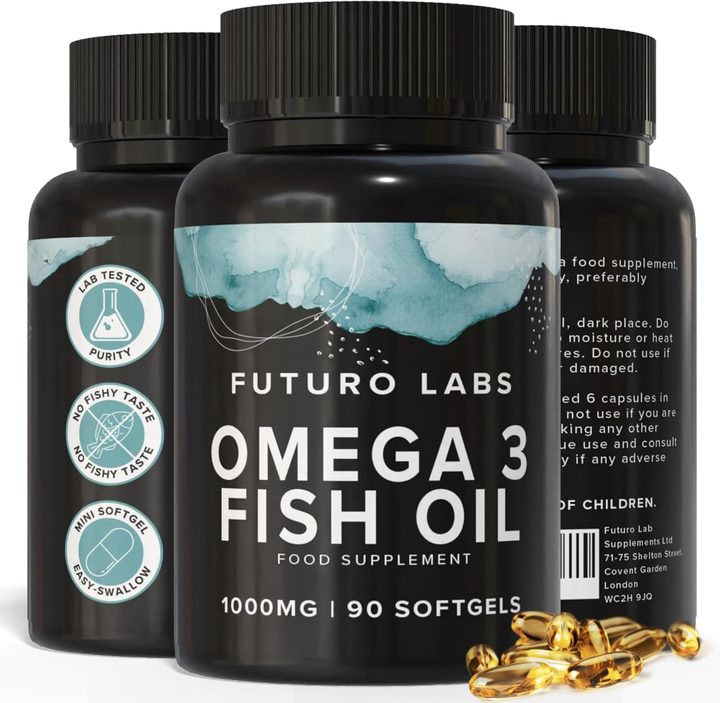
Our brand: the worked example on this page
Futuro Labs Omega 3 Fish Oil
- 17p a day
- 90 softgels, 1 softgel daily
- Lab tested
- Made in the UK
The 250mg floor in one capsule: Futuro Labs Omega 3 Fish Oil on Amazon UK, 300mg EPA+DHA per softgel, £14.99 for 90 days. Label breakdown. The number's provenance is on the recommended intake page; the full ladder on the EPA and DHA page.
The official number, and why an athlete's training does not move it
Start where the paperwork starts: the adult adequate intake is 250mg of combined EPA and DHA per day, the figure from the European dietary reference values opinion that the claims register turned into the heart-claim condition, and it is written for adults, full stop, with no athlete multiplier anywhere in the documents, because omega-3 is a structural and status nutrient rather than a fuel: training burns carbohydrate and stresses protein turnover, but it does not meaningfully drain EPA and DHA stores the way it drains glycogen, so a lifter, a runner and their sedentary neighbour hold the same recommended figure. How much EPA and DHA per day for adults and how much for athletes are, officially, the same question with the same answer, and the UK version adds only the food framing this site always adds: the two-portions fish advice averaging around 450mg daily for those who manage it, with the 250mg floor as what a supplement guarantees when the mackerel does not happen.
The forum number: where 1g to 3g comes from, and what it actually buys
Ask the same question on bodybuilding forums and reddit threads and the consensus answer jumps to 1g, 2g, sometimes 3g of combined EPA and DHA, a convention with a real genealogy worth stating fairly: the doses come from the research literature, the 4g protein-synthesis trial in older adults, the gram-scale rheumatology studies, the 2g and 3g quantified claim conditions, rounded into gym culture as more-must-be-better, and repeated until convention read as requirement. What the gram habit actually buys an athlete: participation in open research questions, the muscle and recovery literatures this section reads as mixed-to-null in the trained; coverage of claim conditions, blood triglycerides at 2g, that concern maintenance territory most lifters were never shopping for; and, at sustained gram scale, the one genuine cost in the ledger, the small atrial fibrillation signal the meta-analyses attached to high-dose use, which is why this site files multi-gram routines under deliberate, time-boxed experiments or GP conversations rather than defaults. The forum number is not dangerous folklore; it is a research protocol wearing a habit's clothes, and it should be chosen the way protocols are, on purpose.
| Daily EPA+DHA | Whose number it is | What it buys an athlete | Verdict |
|---|---|---|---|
| 250mg | The adult adequate intake and claim condition | The authorised territory: the actual answer | The floor: covered by one softgel |
| ~300mgOurs | The standard softgel's delivery | The floor with margin, at 17p | Where most lifters should stop |
| ~450mg | The fish advice's weekly average | The food version, with dinner attached | Eat toward it when the diet allows |
| 1g to 2g | Gym and forum convention | Research participation; the 2g claim territory | A chosen experiment, not a requirement |
| 3g to 4g | The heavy end of the research protocols | Study-scale dosing; the AF signal's territory | Time-boxed and ideally discussed with a GP |
| ~5g | EFSA's supplemental safety ceiling | Nothing further | The edge of the argument: stay under it |
Bodybuilders, lifters, runners: the variants answered in one paragraph
The versions of this search all collapse into the ladder. How much EPA and DHA should a bodybuilder take daily: 250mg-to-300mg for the claims, with gram-scale as an optional experiment the trained-population evidence does not require. How much do lifters need per day: the same, need being exactly what the adequate intake defines. Per day for adults generally, how much should I have in a day, and per day UK specifically: 250mg, the one figure with both a scientific opinion and a legal instrument behind it. The reddit consensus: understood, sourced above, and correctly labelled a protocol rather than a recommendation. And across every variant the practical arithmetic is identical: one honest 300mg softgel clears the answer daily for pennies, gram targets are two-capsule concentrate jobs chosen deliberately, and no version of the question ever required the athlete multiplier the sports aisle keeps implying.
The verdict, and the routine that ends the thread
How much EPA and DHA per day for athletes: 250mg of the pair combined, same as every adult, cleared with margin by one standard softgel and exceeded pleasantly by any week containing mackerel, with the 1g-to-3g forum ladder available above it as labelled research participation, bounded by the 5g ceiling and the high-dose caveats, and never as a requirement training smuggled in. The routine in product form: Futuro Labs Omega 3 Fish Oil, one softgel with dinner every day of the training week, 180mg EPA and 120mg DHA for 300mg combined, £14.99 for 90 days at 17p, lab-tested, UK made, the entire evidence-mandated answer in one swallow, which is the least dramatic thing an athlete will read all day and the most settled.
What to check on the label
- 250mg combined daily: the adult figure: no athlete multiplier exists in the documents.
- One 300mg softgel clears it: the whole mandated answer, 17p.
- The 1g-to-3g forum number is a research protocol: choose it deliberately or not at all.
- Sustained gram scale carries the AF signal: time-box it, ideally with a GP.
- The 5g supplemental ceiling bounds every argument: nobody's target.
Our brand
The worked example: Futuro Labs Omega 3 Fish Oil
Futuro Labs Omega 3 Fish Oil: 1 softgel daily with food, 1000mg fish oil providing 180mg EPA and 120mg DHA (300mg combined), 90 softgels for £14.99, 17p a day, lab-tested purity, UK GMP made. Gelatin shell, so not vegetarian.
- Fish oil per softgel
- 1000mg
- EPA / DHA per softgel
- 180mg / 120mg (300mg combined)
- Serving
- 1 softgel a day
- Bottle
- 90 softgels, 90 days
- Price
- £14.99 (17p a day)
- Softgel
- mini softgel, no fishy taste
Questions people also ask
How much EPA and DHA should a bodybuilder take daily?
250mg-to-300mg covers everything authorised: the gram-scale bodybuilding convention is research-dose territory, optional and unmandated by any trained-population outcome.
Do hard training days increase omega-3 needs?
No: EPA and DHA are status nutrients, not fuels, and the adequate intake carries no training adjustment. Weekly averages are what matter.
Is 1000mg of fish oil a day enough for an athlete?
A standard 1000mg softgel delivers about 300mg of EPA and DHA, which clears the 250mg answer: the oil weight and the answer are different numbers.
Is the reddit 2 to 3g recommendation wrong?
It is a research protocol repeated as convention: legal territory under the 5g ceiling, with the high-dose AF signal as its real cost, and nothing in the trained evidence requiring it.
Should I split my omega-3 dose across the day?
No need at everyday amounts: one softgel with dinner does it. Gram-scale users split for comfort, not effect.
Sources
- Futuro Labs Omega 3 Fish Oil listing: 1000mg fish oil per softgel providing 180mg EPA and 120mg DHA, 90 softgels. Amazon UK, accessed 31 August 2026. https://www.amazon.co.uk/dp/B0CP9T3BTN
- EFSA Panel on Dietetic Products. Scientific opinion on Dietary Reference Values for fats: Adequate Intake of 250mg combined EPA and DHA per day for adults. EFSA Journal 2010;8(3):1461. https://www.efsa.europa.eu/en/efsajournal/pub/1461
- EFSA Panel on Dietetic Products. Scientific opinion on the substantiation of health claims related to EPA and DHA and normal function of the heart (250mg daily condition of use). EFSA Journal 2010;8(10):1796. https://www.efsa.europa.eu/en/efsajournal/pub/1796
- Scientific Advisory Committee on Nutrition and Committee on Toxicity. Advice on fish consumption: benefits and risks (two portions of fish a week, one oily). TSO, 2004. https://www.gov.uk/government/publications/sacn-advice-on-fish-consumption-benefits-and-risks
- Gencer B, Djousse L, Al-Ramady OT, et al. Effect of long-term marine omega-3 fatty acids supplementation on the risk of atrial fibrillation in randomized controlled trials: a systematic review and meta-analysis. Circulation 2021;144(25):1981-1990. PubMed record
- EFSA Panel on Dietetic Products. Scientific opinion on the tolerable upper intake level of EPA, DHA and DPA: supplemental intakes of EPA and DHA combined up to about 5g/day do not raise safety concerns for adults. EFSA Journal 2012;10(7):2815. https://www.efsa.europa.eu/en/efsajournal/pub/2815
- Smith GI, Atherton P, Reeds DN, et al. Dietary omega-3 fatty acid supplementation increases the rate of muscle protein synthesis in older adults: a randomized controlled trial. American Journal of Clinical Nutrition 2011;93(2):402-412. PubMed record