Ghost Fitness/Omega-3/How do I know if my body needs omega-3?
How do I know if my body needs omega-3?
The short answer
The body will not tell you; the plate will. Low omega-3 status is silent, with no symptom, sign or feeling marking it, and true clinical deficiency is rare and a clinician's. So read the need off two questions: how many portions of oily fish a week, two meeting the 250mg the claims are written for and fewer leaving one softgel to meet it, and whether there is a specific reason for more. A finger-prick index test is the only way the body answers.
- What the body saysnothing: a low index is silent; the shelf's symptom lists belong to other causes; true deficiency is rare and a clinician's
- Question one, the platetwo portions of oily fish a week average around 450mg a day and meet the 250mg claims; fewer, and one softgel meets them
- Question two, a specific reasonpregnancy and the maternal DHA claim; a GP's triglyceride plan; the index research range
- The body's one answera finger-prick omega-3 index test: four percent is typical, eight the research range
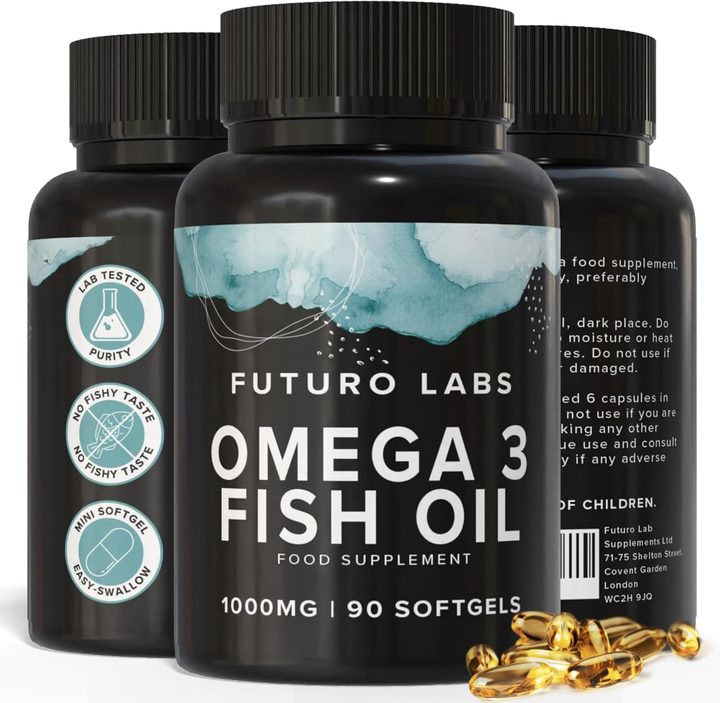
Our brand: the worked example on this page
Futuro Labs Omega 3 Fish Oil
- 17p a day
- 90 softgels, 1 softgel daily
- Lab tested
- Made in the UK
For the plate that answers question one with fewer than two: Futuro Labs Omega 3 Fish Oil on Amazon UK, 1 softgel with food, 180mg EPA and 120mg DHA, 90 for £14.99 at 17p. Full label breakdown. The false tells and the two true ones are on the how-to-tell page; the causes of low status on the causes page.
Why the body will not tell you, the silent index, the shelf's symptom list, and the rare deficiency that is a clinician's
How do I know if my body needs omega-3 is a question that assumes the body sends a signal, and the honest page's first job is to say that it does not, because a reader waiting for a sign will wait for a lifetime. The silent index: omega-3 status is the share of EPA and DHA in red-cell membranes, the omega-3 index, and on a typical British plate with little oily fish it sits around four percent against a research range around eight, the index literature's distribution, and it sits there silently, a person at four percent feeling exactly as a person at eight feels, with no symptom, sign, sensation or blood-test abnormality outside the index itself marking the difference, which is why the index exists as a test and why nobody discovers their status by noticing anything. The shelf's symptom list is the second thing to dismiss: dry skin, brittle nails, tiredness, poor concentration, low mood, aching joints and dry eyes are the signs a tub or a forum lists for omega-3 deficiency, and every one of them belongs to other causes first, the skin to the season and the water, the nails to their six-month growth clock, the tiredness to sleep, iron and the thyroid, the concentration and the mood to sleep and to a GP, the joints to load and the eyes to screens, with no trial linking any of them to a low index and no trial finding omega-3 improving any of them in a person with one, the feel-better and tiredness pages' ledgers, so a reader with three of the seven has three separate questions and none of them is omega-3. The rare deficiency that is a clinician's is the one case where the body does speak: essential fatty acid deficiency, in which the skin scales and the wounds heal slowly, is seen in fat-free intravenous feeding, severe fat malabsorption and starvation, the essential fatty acid deficiency literature's settings, is diagnosed by a clinician on a blood fatty acid profile, and is corrected by restoring fat properly rather than by a softgel, a different condition from the low status most readers mean.
The two questions the plate answers, the one test the body answers, what each answer means, and the need filed
The plate answers the need in two questions, and a reader can answer both at the table. Question one: how many portions of oily fish a week? Salmon, mackerel, sardines, herring, trout and fresh or oil-packed tuna count, at around one and a half to two grams of EPA and DHA a portion, while cod, haddock, tilapia, pollock and light tuna in brine do not, at a few tens of milligrams, the lean-fish audit's distinction. Two portions a week average around 450mg of EPA and DHA a day, above the 250mg the register's heart claim is written for and above the 250mg of DHA the brain and vision claims ask, so a reader at two needs nothing from a shelf; one portion averages around 200mg and sits just under; and none, which is most lifters and most of the country by the national survey, leaves the claims unmet every day and one standard softgel at 300mg meeting them, the oily-fish audit that every omega-3 page on this site runs and that is the need's real measure, a dietary shortfall against a defined intake rather than a bodily state. Question two: is there a specific reason for more? Pregnancy or breastfeeding, for the maternal claim's extra 200mg of DHA a day from a body or algal oil with the midwife knowing; a GP's plan for raised triglycerides, where the register's two-gram claim applies with the GP's agreement; and a wish to reach the index research range, for a reader who wants the number the fish-eating populations have, at a gram a day for a season, with no other reason on the register, the muscle, joint, mood, skin and energy reasons being empty files. The one test the body answers with is the finger-prick omega-3 index, a dried blood spot sent to a laboratory, which reports the share of EPA and DHA in red-cell membranes and is the only way to know a status rather than infer it, taken before starting and again at three to four months for a reader who wants a receipt, and unnecessary for a reader content to act on the plate. The need filed: a silent index the body never reports, a shelf symptom list that belongs to other causes, a rare true deficiency that is a clinician's, two questions the plate answers, the portions of oily fish against 250mg and any specific reason for more, and one test the body answers, with the worked example being one softgel for the plate that answers question one with fewer than two, £14.99 for 90 at 17p.
| The source | The question | The answer |
|---|---|---|
| The body | Any symptom, sign or feeling? | None: a low index is silent |
| The shelf's symptom list | Dry skin, tiredness, poor concentration, joints? | Other causes first; no trial links them to a low index |
| A clinician | True essential fatty acid deficiency? | Rare: fat-free feeding, malabsorption; scaling skin; a clinician corrects it |
| The plate, question one | How many portions of oily fish a week? | Two meets the 250mg claims; fewer, and one softgel meets them |
| The plate, question two | A specific reason for more? | Pregnancy and the maternal DHA claim; a GP's triglyceride plan; the index range |
| The test | The omega-3 index by finger-prick | Four percent typical, eight the research range; before and at three to four months |
The verdict, no signal from the body, two questions for the plate, and one test if you want the number
How do I know if my body needs omega-3: the body will not tell you, since low omega-3 status is a silent index with no symptom, sign or feeling marking it, the shelf's list of dry skin, tiredness, poor concentration and aching joints belonging to other causes, and the true clinical essential fatty acid deficiency being rare, seen in fat-free feeding and severe malabsorption, and a clinician's, so the need is read off two questions the plate answers, how many portions of oily fish a week against the 250mg a day the claims are written for, two meeting it and fewer leaving one softgel to meet it, and whether there is a specific reason for more, pregnancy, a GP's triglyceride plan or the index research range, with a finger-prick omega-3 index test as the only way the body itself answers. For the plate that answers question one with fewer than two: Futuro Labs Omega 3 Fish Oil, one with food, 180mg EPA and 120mg DHA, 90 for £14.99 at 17p a day.
What to check on the label
- Stop waiting for a symptom: a low index is silent.
- File the shelf's list under other causes: skin, nails, tiredness, mood, joints, eyes.
- Count the oily fish: two portions a week, or one softgel.
- Name any specific reason for more: pregnancy, a GP's plan, the index.
- Test if you want the number: before, and at three to four months.
Our brand
The worked example: Futuro Labs Omega 3 Fish Oil
Futuro Labs Omega 3 Fish Oil: 1 softgel daily with food, 1000mg fish oil providing 180mg EPA and 120mg DHA (300mg combined), 90 softgels for £14.99, 17p a day, lab-tested purity, UK GMP made. Gelatin shell, so not vegetarian.
- Fish oil per softgel
- 1000mg
- EPA / DHA per softgel
- 180mg / 120mg (300mg combined)
- Serving
- 1 softgel a day
- Bottle
- 90 softgels, 90 days
- Price
- £14.99 (17p a day)
- Softgel
- mini softgel, no fishy taste
Questions people also ask
What are the symptoms of low omega-3?
There are none that mark it: a low omega-3 index is silent, and the dry skin, brittle nails, tiredness, poor concentration, low mood and aching joints a shelf lists belong to other causes first, with no trial linking them to a low index and no trial finding omega-3 improving them in a person with one, so a reader with those symptoms has other questions to ask.
Is there a test for omega-3 deficiency?
The omega-3 index: a finger-prick dried blood spot sent to a laboratory reports the share of EPA and DHA in red-cell membranes, around four percent on a typical British plate and around eight in the fish-eating populations the research range is drawn from, taken before starting and again at three to four months for a reader who wants a receipt.
How do I know if I get enough omega-3 from food?
Count the oily fish: two portions a week of salmon, mackerel, sardines, herring, trout or fresh tuna average around 450mg of EPA and DHA a day and meet the 250mg the claims are written for, while cod, haddock, tilapia and light tuna in brine carry a few tens of milligrams a portion and do not count, so a plate with fewer than two oily portions leaves the claims unmet.
Can you be deficient in omega-3 without knowing?
Yes, and most people on a low-fish plate are low without knowing, since the index sits silently at four percent for a lifetime, while the true clinical essential fatty acid deficiency, with scaling skin and slow wound healing, is rare, seen in fat-free feeding and severe malabsorption, and is a clinician's to diagnose and correct.
Who actually needs omega-3 supplements?
A reader whose plate carries fewer than two portions of oily fish a week, for the 250mg heart, brain and vision claims that one standard softgel meets, a pregnant or breastfeeding reader for the maternal claim's extra 200mg of DHA, a reader on a GP's triglyceride plan at two grams, and a reader who wants the index research range at a gram a day, with no other reason on the register.
Sources
- Harris WS, von Schacky C. The omega-3 index: red blood cell EPA and DHA as a measurable marker of omega-3 status, the research standard for judging how effectively intake raises tissue levels. PubMed record
- The essential fatty acid deficiency literature: true deficiency, with scaly dermatitis, poor wound healing and growth failure, is rare and seen almost only in fat-free feeding or severe malabsorption, while a low omega-3 status, an omega-3 index below about four percent, is common on a low-fish diet and has no symptoms of its own. PubMed record
- Scientific Advisory Committee on Nutrition and Committee on Toxicity. Advice on fish consumption: benefits and risks (two portions of fish a week, one oily). TSO, 2004. https://www.gov.uk/government/publications/sacn-advice-on-fish-consumption-benefits-and-risks
- EFSA Panel on Dietetic Products. Scientific opinion on the substantiation of health claims related to EPA and DHA and normal function of the heart (250mg daily condition of use). EFSA Journal 2010;8(10):1796. https://www.efsa.europa.eu/en/efsajournal/pub/1796