Ghost Fitness/Omega-3/What should you check on an omega-3 label?
What should you check on an omega-3 label?
The short answer
Check five things on any omega-3 label: EPA and DHA in named milligrams, the serving arithmetic, the source, the form, and a testing statement with dates. Then apply the aisle's own trap: DHA-only algae, ALA blends, krill's small numbers.
- 5 checksmilligrams, arithmetic, source, form, testing-and-dates: universal
- Every aisle, one trapfish, algae, blend and krill each hide a different catch
- The two linesEPA and DHA named in mg: the check that fails most products
- ALA is not the pairthe blend aisle's padding converts at single-digit rates
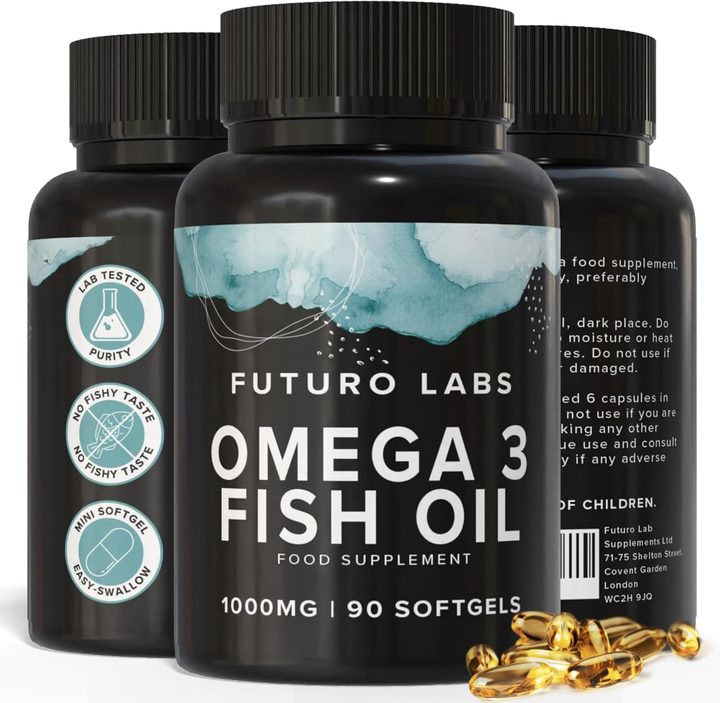
Our brand: the worked example on this page
Futuro Labs Omega 3 Fish Oil
- 17p a day
- 90 softgels, 1 softgel daily
- Lab tested
- Made in the UK
A label that passes all five without squinting: Futuro Labs Omega 3 Fish Oil on Amazon UK, 180mg EPA + 120mg DHA declared, £14.99 for 90 days. Label breakdown. The fish-oil-specific walkthrough is on the six-line label read; the headline trap on the 1000mg page.
The five checks that transfer to every product type
Omega-3 is sold as fish oil, concentrates, algae oil, krill oil and plant blends, and five checks transfer across all of them. One, the two lines: EPA and DHA as named milligram figures per capsule, the check that fails more products than the other four combined, because family-name totals, omega-3 1000mg, are the aisle's universal ambiguity and the claims read only the members. Two, the serving arithmetic: per how many capsules, times servings per pot, converted to honest days of supply, the sum that reprices every bottle. Three, the source, stated: fish, and ideally which fish, algal oil by name, krill, or the seed oils that signal a different product entirely. Four, the form where relevant: triglyceride, re-esterified, ethyl ester or phospholipid, with concentrate-strength silence read as ethyl ester and the fatty-meal rule attached. Five, the trust block: a named testing statement, better still certificates, plus a best-before with runway, the freshness-and-purity minimum this site's testing pages justify at length. Pass all five and the product is at least honest; the question of whether it is right for you belongs to the traps.
The trap each aisle sets, and the closing division
Each product type then adds its own signature catch, and knowing which trap lives where is the second half of label literacy. The fish oil aisle: the headline trap, 1000mg of oil masquerading as 1000mg of omega-3, defused by check one's member lines and the 30% conversion the dedicated page teaches. The concentrate shelf: form silence and the with-food instruction, plus per-serving figures spread across multiple capsules. The algae aisle: the DHA-only catch, many algal oils carrying little or no EPA by production method, honest for the DHA claims and wrong for a buyer wanting the pair, plus the shell trap of plant oil in gelatin. The blend aisle: ALA padding, flax and chia milligrams dressed in the family name while converting to the marine pair at single-digit rates, the impostor warning that follows this site everywhere. The krill shelf: proud phospholipid language over small member numbers at large prices, defused by the same two lines as everything else. And the close, identical on every aisle: divide price by honest days for pence per day, and by combined EPA and DHA for pence per 100mg, the division under which every trap above becomes arithmetic and every label becomes an invoice.
| Where you are | The universal five still apply | The aisle's own trap |
|---|---|---|
| Fish oil shelf | Two lines, arithmetic, source, form, trust block | The 1000mg headline: oil is not the pair |
| Concentrate shelf | As above, meal rule attached | Form silence, and servings split across capsules |
| Algae aisle | As above, source must say algal | DHA-only oils answering an EPA-and-DHA search |
| Blend aisle | As above, if it even states members | ALA padding wearing the family name |
| Krill shelf | As above | Phospholipid prose over small, dear milligrams |
The verdict, and the checklist as a pocket habit
What should you check on an omega-3 label: the same five things everywhere, named EPA and DHA milligrams, merciless serving arithmetic, a stated source, a decoded form, and a trust block of testing plus dates, then the one trap your aisle specialises in, then the division that prices it all fairly. It is a pocket habit rather than a study: thirty seconds per bottle once learned, and it converts the entire omega-3 category, five aisles of competing vocabulary, into a single comparable spreadsheet. The worked example is the habit's calibration bottle: Futuro Labs Omega 3 Fish Oil, 180mg EPA and 120mg DHA declared per single softgel, 90 days honest supply, fish-sourced and stated, natural triglyceride at standard strength, independently lab tested and dated, £14.99 at 17p a day and about 5.6p per 100mg, UK made, a label built to pass the five checks precisely because its whole sales pitch is that you should run them.
What to check on the label
- The two lines first, everywhere: EPA and DHA in named milligrams.
- Serving arithmetic without mercy: honest days of supply reprice bottles.
- Source and form, stated and decoded: silence has a reading.
- The trust block: testing plus dates: the freshness-and-purity minimum.
- Know your aisle's trap, then divide: pence per day and per 100mg close every read.
Our brand
The worked example: Futuro Labs Omega 3 Fish Oil
Futuro Labs Omega 3 Fish Oil: 1 softgel daily with food, 1000mg fish oil providing 180mg EPA and 120mg DHA (300mg combined), 90 softgels for £14.99, 17p a day, lab-tested purity, UK GMP made. Gelatin shell, so not vegetarian.
- Fish oil per softgel
- 1000mg
- EPA / DHA per softgel
- 180mg / 120mg (300mg combined)
- Serving
- 1 softgel a day
- Bottle
- 90 softgels, 90 days
- Price
- £14.99 (17p a day)
- Softgel
- mini softgel, no fishy taste
Questions people also ask
What is the single most important thing on an omega-3 label?
The EPA and DHA lines in named milligrams: every authorised claim reads those two numbers, and their absence ends the read on any aisle.
Are the checks different for algae omega-3?
Same five checks, one extra trap: many algal oils are DHA-only, so a buyer wanting both molecules needs a genuine EPA figure and a shell as vegan as the oil.
How do I compare products across different types?
Convert everything to pence per 100mg of combined EPA and DHA and pence per day: the division under which fish, algae, krill and blends finally trade fairly.
What does a missing form statement mean?
At standard strength, natural triglyceride by norm; at concentrate strength, read silence as ethyl ester and attach the fatty-meal rule.
Are plant omega-3 blends worth checking at all?
Check them and mostly walk: flax and chia supply ALA, which converts to EPA and DHA at single-digit rates, so the family name on the front rarely survives the panel.
Sources
- Futuro Labs Omega 3 Fish Oil listing: 1000mg fish oil per softgel providing 180mg EPA and 120mg DHA, 90 softgels. Amazon UK, accessed 31 August 2026. https://www.amazon.co.uk/dp/B0CP9T3BTN
- EFSA Panel on Dietetic Products. Scientific opinion on the substantiation of health claims related to EPA and DHA and normal function of the heart (250mg daily condition of use). EFSA Journal 2010;8(10):1796. https://www.efsa.europa.eu/en/efsajournal/pub/1796
- EFSA Panel on Dietetic Products. Scientific opinion on health claims related to DHA: maintenance of normal brain function and normal vision (250mg DHA daily condition of use). EFSA Journal 2010;8(10):1734. https://www.efsa.europa.eu/en/efsajournal/pub/1734
- Commission Regulation (EU) No 536/2013 authorising health claims for DHA and EPA: maintenance of normal blood triglyceride concentrations (2g DHA+EPA/day) and normal blood pressure (3g DHA+EPA/day), with a supplemental limit note of 5g/day. https://eur-lex.europa.eu/legal-content/EN/TXT/?uri=CELEX%3A32013R0536
- GOED Voluntary Monograph: the omega-3 industry's quality standard setting limits for heavy metals, dioxins and oxidation (peroxide, anisidine and TOTOX values) in fish oils. https://goedomega3.com