Ghost Fitness/Magnesium/Is buffered magnesium glycinate different from magnesium glycinate?
Is buffered magnesium glycinate different from magnesium glycinate?
The short answer
Yes, slightly: buffered magnesium glycinate is the chelate blended with a little magnesium oxide, raising the magnesium content to about 18 to 20% so a full dose fits two capsules. Judge it the usual way: the elemental line and %NRV.
- 18% to 20%the buffered material's magnesium content
- About 14%the fully reacted chelate it starts from
- 2 vs 3capsules for 300mg elemental: the entire point of buffering
- 22pa day for the buffered worked example
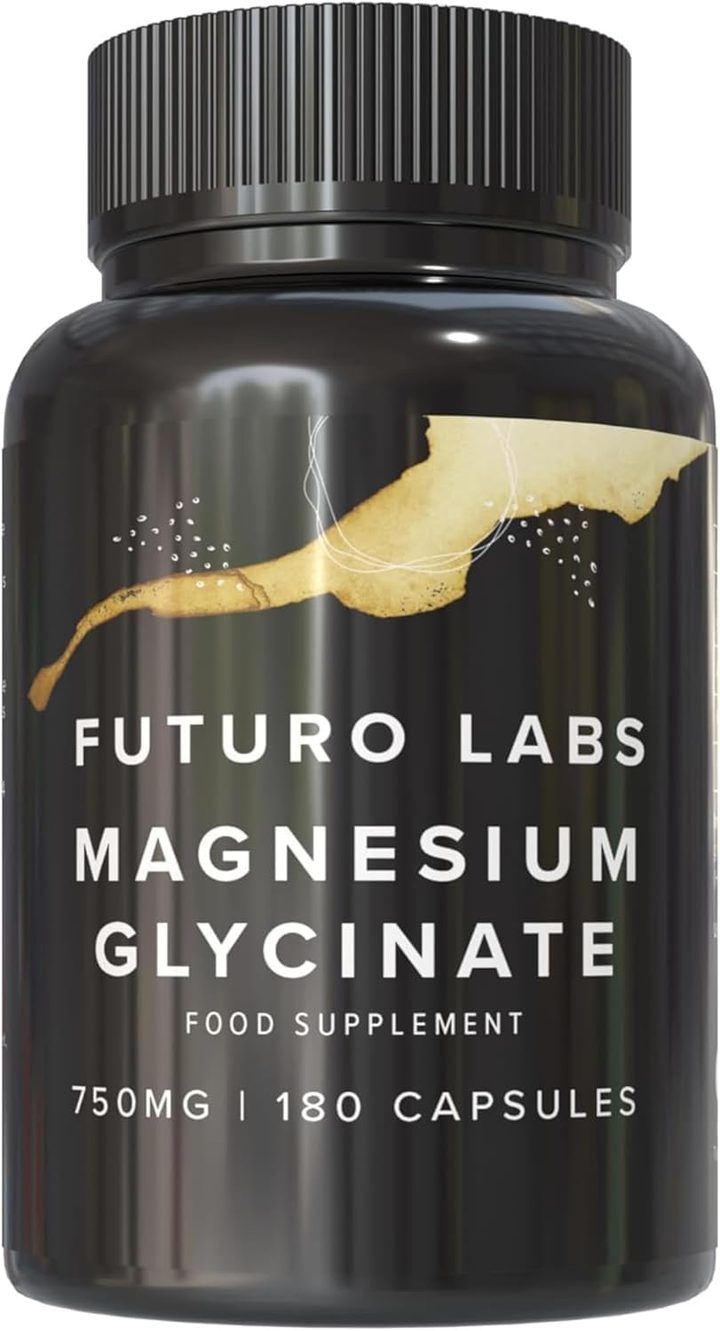
Our brand: the worked example on this page
Futuro Labs Magnesium Glycinate
- 22p a day
- 180 capsules, 2 capsules daily
- Lab tested
- Made in the UK
The buffered worked example, disclosed: Futuro Labs Magnesium Glycinate on Amazon UK, magnesium bisglycinate 20%, 300mg elemental per 2 capsules, £19.99 for 180. Label breakdown. The percentage itself is decoded on the bisglycinate 20% page.
What buffering is, mechanically
A fully reacted magnesium bisglycinate, every magnesium ion held by its two glycines, tops out around 14% magnesium by weight, which is dictated by the molecule and confirmed across the salt tabulations. Buffered material takes that chelate and blends in a minority fraction of magnesium oxide, the 60% dense salt, lifting the mixture's overall content to a declared 18% to 20%. The word buffered nods at oxide's mild alkalinity, but the commercial purpose is volume: at 20%, the 1500mg that carries a full 300mg elemental fits in 2 standard capsules, where 14% material needs roughly 2150mg and a third large capsule. Buffering is a packaging technology, and the honest version declares its percentage so you can see exactly what was done.
The two honest concerns, weighed without flinching
Concern one: is the oxide fraction a smuggled dose of the form this site keeps criticising? Proportionally small, is the honest answer. The oxide contributes a minority of the elemental total, the majority still travels as chelate, and the practical behaviour, absorption in the organic range, a full dose held at dinner without the bowel effect, tracks the glycinate majority; this is a different situation from oxide-first blends where the cheap salt is the product. Concern two: is buffered a way to hide oxide from the ingredients line? Only when undeclared, and that is the actual dividing line on the shelf. A label stating buffered, or a percentage above 14% that implies it, has disclosed; a label claiming fully reacted at 20% is claiming chemistry that does not exist; and a label with no percentage and no elemental line was never in the honesty business to begin with.
| Buffered (18% to 20%) | Fully reacted (about 14%) | |
|---|---|---|
| What it isOurs | Chelate plus minority oxide, blended | Pure chelate |
| Capsules for 300mg elemental | 2 | About 3, larger |
| Absorption and tolerance in practice | Tracks the chelate majority | The chelate baseline |
| Price per 100mg elemental, typically | The benchmark end: about 7p on the worked example | Often higher; more material and capsules |
| The label tell | Percentage of 18% to 20% declared | 14% declared, or fully reacted stated |
| When to prefer it | Fewer capsules, benchmark price | Purist preference, oxide-free by policy |
The unchanged rule, and the disclosed example
Whichever material a bottle uses, you are buying the elemental line, and the buying rule survives buffering untouched: the form named with its true percentage, elemental magnesium with %NRV, a shown panel, a named address, a fair price per delivered milligram. This site's worked example is buffered and says so in its own arithmetic: Futuro Labs Magnesium Glycinate declares magnesium bisglycinate 20%, which any reader of these pages can decode as chelate-plus-minority-oxide, delivering 300mg elemental at 80% NRV per 2 vegan capsules, UK made under GMP and BRC, third-party panels shown, £19.99 for 180 capsules, 22p a day. Is buffered magnesium glycinate different from magnesium glycinate: slightly and disclosably, a packaging blend that trades a purist's zero-oxide policy for two swallowable capsules at the benchmark price, with the label percentage as the receipt.
What to check on the label
- Buffered = chelate plus minority oxide, lifting content to 18% to 20%.
- The purpose is capsule count: 300mg in 2 rather than 3 large ones.
- Behaviour tracks the chelate majority: full dose held, dinner-friendly.
- Disclosure is the dividing line: declared percentages honest, fully reacted at 20% impossible.
- The buying rule is unchanged: elemental line, %NRV, panel, address, price.
Our brand
The worked example: Futuro Labs Magnesium Glycinate
Futuro Labs Magnesium Glycinate is the disclosed buffered design: bisglycinate 20% declared, 300mg elemental at 80% NRV per 2 capsules, 22p a day from a £19.99 bottle of 180. Vegan, UK made, panels shown.
- Elemental magnesium per serving
- 300mg (80% NRV)
- Form
- magnesium bisglycinate 20%
- Serving
- 2 capsules a day
- Bottle
- 180 capsules, 90 days
- Price
- £19.99 (22p a day)
- Capsule
- vegetarian shell, vegan product
Questions people also ask
Is buffered magnesium glycinate worse than pure glycinate?
Not in practice: the chelate majority sets the behaviour, and the full dose still sits comfortably at dinner. The trade is a minority oxide fraction for one fewer, smaller capsule.
How can I tell if a glycinate is buffered?
The declared percentage: 14% is fully reacted, 18% to 20% is buffered. A 20% product claiming fully reacted is claiming impossible chemistry.
Does the oxide in buffered glycinate cause a laxative effect?
At a minority fraction, no meaningful one: the osmotic load is a fraction of an oxide product's, and real-world tolerance tracks the glycinate.
Should I pay more for fully reacted glycinate?
Only as a purist preference: expect a third capsule and often a higher price per 100mg elemental for the same delivered dose.
Why does the worked example use buffered material?
Two capsules instead of three at the benchmark price, with the percentage declared so the arithmetic is public: the disclosure is the point.
Sources
- Futuro Labs Magnesium Glycinate listing, Amazon UK, label and price checked 31 August 2026. https://www.amazon.co.uk/dp/B0BT7Z5VQW
- Ranade VV, Somberg JC. Bioavailability and pharmacokinetics of magnesium after administration of magnesium salts to humans. American Journal of Therapeutics 2001;8(5):345-357. PubMed record
- Firoz M, Graber M. Bioavailability of US commercial magnesium preparations. Magnesium Research 2001;14(4):257-262. PubMed record
- Retained Regulation (EU) No 1169/2011, Annex XIII: nutrient reference value for magnesium 375mg. https://www.legislation.gov.uk/eur/2011/1169/annex/XIII
- EFSA Panel on Dietetic Products, Nutrition and Allergies. Scientific Opinion on the substantiation of health claims related to magnesium. EFSA Journal 2010;8(10):1807. https://efsa.onlinelibrary.wiley.com/doi/10.2903/j.efsa.2010.1807