Ghost Fitness/Collagen/Is marine collagen type 1 collagen?
Is marine collagen type 1 collagen?
The short answer
Yes: fish skin yields essentially pure type 1, which is why marine labels print one numeral. The inferences people draw from that yes, targeting, superiority over bovine, a quality marker, are each wrong; it is a disclosure of source.
- The yesfish skin is a type 1 tissue: marine hydrolysate is essentially type 1
- Wrong inference onetype 1 in, type 1 tissues served: the routing myth
- Wrong inference twopurer numeral, better product: both sources pool identically
- The honest readingthe numeral is the fish announcing itself: a disclosure
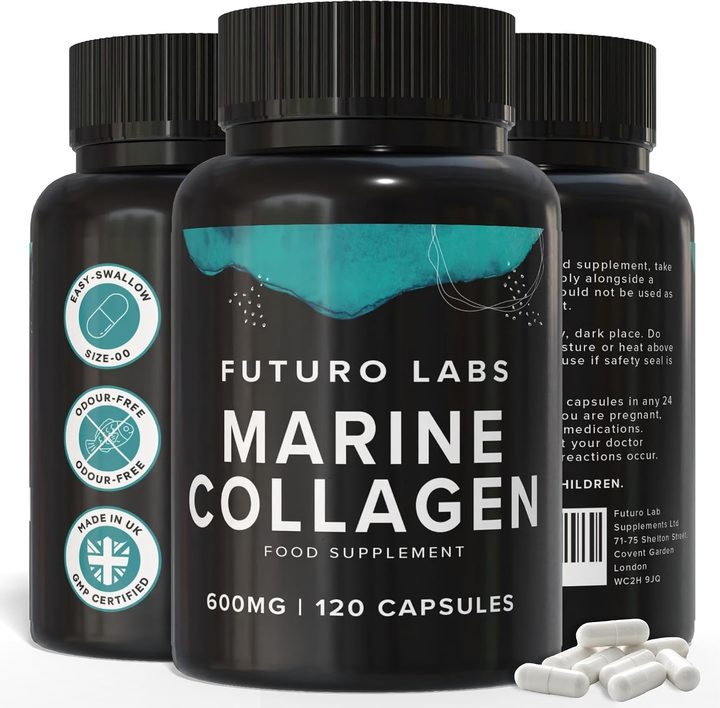
Our brand: the worked example on this page
Futuro Labs Marine Collagen
- 28p a day
- 120 capsules, 2 capsules daily
- Lab tested
- Made in the UK
The one-numeral disclosure, worn plainly: Futuro Labs Marine Collagen on Amazon UK, 1200mg hydrolysed type 1 marine with vitamin C and zinc at 15% NRV, £16.99 for 60 days at 28p. Full label breakdown. The reference card for all three numerals is on the difference page; the source draw on the bovine-or-marine page.
The yes, given properly, and why the fish prints one numeral
Yes, cleanly and without hedging: marine collagen is type 1 collagen, essentially in its entirety, because fish skin, the raw material of nearly all marine collagen, is a type 1 tissue, the dermis of a fish being built from the same structural workhorse fibre as mammalian skin, tendon and bone matrix, so when the factory tour's stations extract and hydrolyse it, what emerges is a near-pure type 1 peptide pool, and the single numeral on a marine label is simply that biology reported, in the same way that a bovine label's types 1 and 3 report hide's natural pair, numeral count on a collagen tub being, decoded, the animal announcing itself. Scales-derived marine collagen tells the same story with a mineral footnote, scales being type 1 plus the demineralising the preparation station handles, and the rare marine type 2 products, extracted from fish cartilage, are exactly the niche exception their labels must declare, so the working rule holds across the shelf: marine means type 1 unless a label works hard to say otherwise. That is the yes, complete in a paragraph, and the page's real work begins where most readers' next thought does, because the yes is routinely made to carry three inferences it cannot lawfully or biologically hold.
The three inferences corrected, and the disclosure left standing at its true size
Inference one, targeting: type 1 builds skin, bone and tendon, marine is type 1, therefore marine serves those tissues, and the correction is the routing myth's standing demolition, digestion pooling every swallowed peptide into one unaddressed amino supply before any tissue is consulted, the numeral dissolving in the stomach along with the marketing, no trial ever having shown a type-matched delivery effect and no claim existing to reward one. Inference two, superiority: marine's pure single numeral against bovine's pair reads like refinement, and the correction is the geology page's, both signatures being extraction reports rather than formulation choices, both sources pooling identically, no head-to-head crowning either, the purity framing being a disclosure dressed as a tier, and the marine premium, where charged, owed to raw-material economics and deodorisation work, never to the numeral. Inference three, quality: type 1 stated on the label as a marker of a better product, and the correction is that the statement is table stakes, effectively every hydrolysate on the shelf being type 1 or 1-and-3, so the words select nothing, quality living instead in the checkable file this site audits everywhere, stated dose at true scale, vitamin C at 15% NRV carrying the lawful sentences, single named source, per-batch heavy-metals and microbiology certificates, marine's metals panel non-negotiable, honest dates, fair pence. Corrected three times, the yes stands at its true size: a fact about fish skin, useful for reading labels, decisive for nothing, with the purchase decided, as always, by the paperwork the numeral never was.
| The item | The claim | The correction |
|---|---|---|
| The yes itself | Marine collagen is type 1 | True: fish skin is a type 1 tissue, reported on the label |
| Inference: targeting | Type 1 in, type 1 tissues served | Digestion pools everything: the routing myth, demolished |
| Inference: superiority | One pure numeral beats bovine's pair | Both are extraction reports: no trial crowns either |
| Inference: quality marker | Type 1 stated means a better product | Table stakes: nearly every hydrolysate says it |
| The honest reading | A disclosure of source | The fish announcing itself, nothing more |
| What decides the buy | The checkable file | Dose, C at 15% NRV, testing, dates, pence |
The verdict, sized correctly
Is marine collagen type 1 collagen: yes, essentially entirely, fish skin being a type 1 tissue and the label's single numeral being that biology disclosed, and the yes licenses none of the three inferences habitually loaded onto it, not targeting, which digestion pools away, not superiority over bovine's pair, which no trial or mechanism supports, and not quality, which lives in certificates rather than numerals. The worked example wears the disclosure at its correct size: Futuro Labs Marine Collagen, 1200mg hydrolysed type 1 from fish, stated as fact rather than feature, with 12mg vitamin C and 1.5mg zinc at 15% NRV carrying the label's lawful sentences, heavy-metal tested per batch, UK made, £16.99 for 60 days at 28p a day, a yes on the panel and a file behind it, in that order of importance reversed.
What to check on the label
- Yes: marine is type 1: fish skin is a type 1 tissue, reported.
- Targeting does not follow: digestion pools every numeral.
- Superiority does not follow: extraction reports, not tiers.
- Quality does not follow: the statement is table stakes.
- The file decides: dose, cofactors at 15% NRV, testing, pence.
Our brand
The worked example: Futuro Labs Marine Collagen
Futuro Labs Marine Collagen: 2 capsules daily, 1200mg hydrolysed type 1 marine collagen with 12mg vitamin C and 1.5mg zinc (15% NRV each), 120 capsules for £16.99, 60 days at 28p a day, lab-tested, UK GMP made. Slim veggie-shell capsules, odour free. Fish derived: pescatarian, not vegetarian or vegan.
- Collagen per serving
- 1200mg hydrolysed type 1 marine (fish)
- Co-factors
- vitamin C 12mg (15% NRV), zinc 1.5mg (15% NRV)
- Serving
- 2 capsules a day
- Bottle
- 120 capsules, 60 days
- Price
- £16.99 (28p a day)
- Capsule
- slim size 00, veggie shell, odour free
Questions people also ask
Is all marine collagen type 1?
Essentially yes: fish skin and scales are type 1 tissues, so marine hydrolysates are near-pure type 1, with rare fish-cartilage type 2 products as declared exceptions.
Does being type 1 make marine better for skin and bones?
No: digestion pools every swallowed peptide into one supply, no delivery-by-type effect has ever been shown, and no skin or bone claim exists for any collagen.
Is marine's single numeral better than bovine's 1 and 3?
No: both are extraction signatures, hide yielding the pair and fish skin yielding one, with identical pooling, no head-to-head trial and no claims either side.
Why do marine labels advertise type 1 so hard?
Because it reads like a feature: in fact it is table stakes, nearly every hydrolysate on the shelf being type 1 or 1-and-3, so the words select nothing between products.
What should actually decide my marine purchase?
The file: stated dose, vitamin C at 15% NRV, fish declared as the allergen it is, per-batch heavy-metals and microbiology certificates, honest dates and the pence divided.
Sources
- The collagen manufacturing literature: raw hides and fish skins are cleaned, extracted to gelatine and enzymatically hydrolysed into low molecular weight peptides before filtration and spray-drying. PubMed record
- The collagen peptide trial literature: randomised controlled studies of hydrolysed collagen supplementation across skin, joint and connective-tissue outcomes, typically at 2.5g to 15g daily, with small effects and frequent industry funding. PubMed record
- Futuro Labs Marine Collagen listing and label: 1200mg hydrolysed type 1 marine collagen per 2-capsule serving with 12mg vitamin C and 1.5mg zinc at 15% NRV each, 120 capsules, independently lab tested, UK made. https://www.amazon.co.uk/dp/B0C2J7N364
- EFSA Panel on Dietetic Products, Nutrition and Allergies. Scientific Opinion on the substantiation of health claims related to magnesium. EFSA Journal 2010;8(10):1807. https://efsa.onlinelibrary.wiley.com/doi/10.2903/j.efsa.2010.1807