Ghost Fitness/Collagen/How much collagen should a 70 year old woman take?
How much collagen should a 70 year old woman take?
The short answer
The dose stays unaged at 70: the numbers that matter are the bone-and-balance file's, resistance and balance training, calcium, vitamin D and a raised per-meal protein floor. The aisle sells her skin; the evidence buys fracture prevention.
- The unaged, unsexed lanes1-2g habit, 2.5-10g band, 15g protocol: the same tub numbers
- The bone file at 70fifteen-plus post-menopausal years: fracture prevention is the headline
- The balance linestrength and balance training: the falls-prevention pair
- The inversionmarketed at her skin; evidenced at her bones and balance
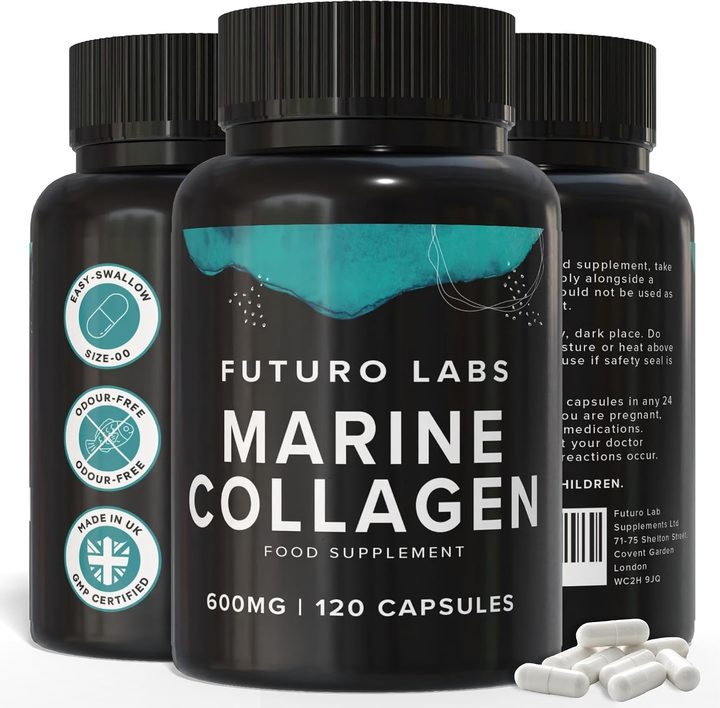
Our brand: the worked example on this page
Futuro Labs Marine Collagen
- 28p a day
- 120 capsules, 2 capsules daily
- Lab tested
- Made in the UK
The lawful bone-adjacent sentence at 28p: Futuro Labs Marine Collagen on Amazon UK, 1200mg hydrolysed type 1 whose vitamin C at 15% NRV includes normal bone function in its collagen-formation family, £16.99 for 60 days. Full label breakdown. The per-meal floor is on the 70-year-old page; the 50s file on the 50-year-old page.
The dose dismissed in a line, and the inversion this page exists to name
Every dose page in this cluster has earned the right to answer fast: no collagen lane is aged or sexed, so a 70-year-old woman's tub numbers are everyone's, 1-to-2g for the cofactor habit, 2.5-to-10g for the trial band whose evidence base was mostly women anyway, 15g with C for the rare protocol reader, and the pregnancy gate long behind her leaves the medication gate as her live one, near-universal at this age and handled by the pharmacist screen. Now the inversion, because it is the honest heart of this exact query: the supplement aisle markets a 70-year-old woman almost entirely at her skin, collagen's imagery, the firming vocabulary the verb-audit pages keep returning unsold, the beauty framing that follows her demographic everywhere, while the evidence file for a woman in her eighth decade has a different headline entirely, fracture prevention, because she is now fifteen-plus years past the menopause transition, the accelerated bone loss of that era compounded, fracture risk climbing with age, and a hip or vertebral fracture being the event that genuinely threatens independence in a way no wrinkle ever will, which makes the honest reallocation of her attention and pennies the most valuable thing a page with this title can print: the aisle sells her skin; the evidence buys her bones and her balance, and the rest of this page prices that purchase.
The bone-and-balance programme priced, collagen's one lawful line in it, and the plan on a card
The programme with evidence, priced lever by lever: resistance training, two-to-three sessions weekly, loading bone as well as muscle, the single intervention that serves the skeleton, the sarcopenia file and the balance system at once; balance work alongside it, the falls-prevention pair, since fractures need both weak bone and a fall, and balance training, tai chi being the classic studied form, attacks the second factor the gym's strength work starts on; dietary calcium met from food where possible, dairy doing the heavy lifting; vitamin D per UK guidance, the winter supplement this site endorses on its own authorised ground, muscle function and bone maintenance both in its lawful family; the per-meal protein floor imported whole from the 70-year-old page, 25-to-30g complete protein per main meal against anabolic resistance, appetite fortified rather than lectured; and the GP's role stated plainly, bone-density conversations, fracture-risk assessment and any medication review belonging there, a pathway this careful territory routes to without drama. Collagen's one lawful line in that programme is small and worth stating exactly: vitamin C's authorised collagen-formation family includes the normal function of bones, riding at 15% NRV on the habit tub, a maintenance sentence beside a programme, never a substitute for one, and the skin lane she was marketed remains available on its own honest terms, the trial band's modest instrument-read offer, funded after sunscreen, after the programme, from whatever pennies the inversion leaves over. The plan on a card: train twice weekly for strength, add balance work, clear three protein floors a day, meet calcium and D, screen blends with the pharmacist, keep the 28p habit if its sentences appeal, and let the aisle's skin pitch wait its turn behind the skeleton that actually carries her.
| The item | The aisle's pitch | The evidence's purchase |
|---|---|---|
| The headline at 70 | Firmer skin | Fracture prevention and independence |
| The training | Rarely mentioned | Resistance twice weekly plus balance work |
| The nutrients | Collagen imagery | Calcium, vitamin D, per-meal protein floors |
| Collagen's lawful line | Implied transformation | C's bone-function sentence at 15% NRV |
| The skin lane | The whole story | A modest trial band, funded after sunscreen |
| The professional | Absent from adverts | GP: bone density, fracture risk, medication review |
The verdict, spent where the evidence points
How much collagen should a 70-year-old woman take: the unaged, unsexed lanes answer the tub question in a line, 1-to-2g habit, band and protocol for their own readers, and the page's real answer is the inversion, that at 70 the aisle markets her skin while the evidence file's headline is fracture prevention, purchased with resistance and balance training, calcium, vitamin D, per-meal protein floors and a GP's bone-density conversation, with collagen's one lawful contribution being vitamin C's bone-function sentence at 15% NRV. The worked example carries exactly that line and no more: Futuro Labs Marine Collagen, 1200mg hydrolysed type 1 with 12mg vitamin C and 1.5mg zinc at 15% NRV, lab tested, UK made, £16.99 for 60 days at 28p a day, a modest companion to a programme, priced behind the skeleton that actually carries her.
What to check on the label
- The tub numbers never move: unaged, unsexed, the same lanes.
- Name the inversion: marketed at skin, evidenced at bones.
- Buy the pair: resistance plus balance training, weekly.
- Clear three floors a day: 25-30g complete protein per meal.
- Route the big questions to the GP: density, fracture risk, medications.
Our brand
The worked example: Futuro Labs Marine Collagen
Futuro Labs Marine Collagen: 2 capsules daily, 1200mg hydrolysed type 1 marine collagen with 12mg vitamin C and 1.5mg zinc (15% NRV each), 120 capsules for £16.99, 60 days at 28p a day, lab-tested, UK GMP made. Slim veggie-shell capsules, odour free. Fish derived: pescatarian, not vegetarian or vegan.
- Collagen per serving
- 1200mg hydrolysed type 1 marine (fish)
- Co-factors
- vitamin C 12mg (15% NRV), zinc 1.5mg (15% NRV)
- Serving
- 2 capsules a day
- Bottle
- 120 capsules, 60 days
- Price
- £16.99 (28p a day)
- Capsule
- slim size 00, veggie shell, odour free
Questions people also ask
What collagen dose should a woman take at 70?
The same lanes as any adult: 1 to 2g for the cofactor habit, 2.5 to 10g for the trial band, 15g with vitamin C for the protocol, with the medication gate handled at the pharmacy.
What matters more than collagen for a woman at 70?
The fracture-prevention file: resistance and balance training, dietary calcium, vitamin D per UK guidance, per-meal protein floors and a GP's bone-density conversation.
Does collagen help bones after menopause?
Its lawful part is one sentence: vitamin C's collagen-formation family includes normal bone function at 15% NRV, a maintenance line beside the programme, never a substitute for it.
Is the skin marketing at this age dishonest?
It is misweighted: the trial band's modest instrument-read offer is real on its own terms, but it belongs behind sunscreen and far behind the bone-and-balance work the evidence prioritises.
Why does balance training matter as much as strength?
Fractures need weak bone and a fall: strength work loads the skeleton while balance training, tai chi being the classic form, attacks the fall half of the equation.
Sources
- The menopause and bone literature: the decline in oestrogen around menopause accelerates bone loss in the following years, the reason bone health guidance sharpens for post-menopausal women. PubMed record
- The protein distribution literature: studies in older adults support spreading intake so each main meal reaches roughly 25-30g of complete protein, countering anabolic resistance better than skewed patterns. PubMed record
- Review literature on protein intake and muscle mass in older adults: higher protein intakes support the maintenance of muscle in ageing, the evidence base behind the register's protein and muscle-mass claims mattering more with age. PubMed record
- Futuro Labs Marine Collagen listing and label: 1200mg hydrolysed type 1 marine collagen per 2-capsule serving with 12mg vitamin C and 1.5mg zinc at 15% NRV each, 120 capsules, independently lab tested, UK made. https://www.amazon.co.uk/dp/B0C2J7N364