Ghost Fitness/Collagen/What is the highest mg of collagen should I take daily?
What is the highest mg of collagen should I take daily?
The short answer
No toxicological ceiling exists, collagen being food protein: the working ceilings are evidential, nothing above the 15g research band, and nutritional, high collagen grams displacing the complete protein your targets actually need. Most people's honest maximum is their goal's dose.
- Ceiling 1: toxicologicalabsent: collagen is food protein with no set upper limit
- Ceiling 2: evidential~15g: nothing above the research band earns anything
- Ceiling 3: nutritionalopportunity cost: collagen grams displacing complete protein
- Ceiling 4: practicalcomfort, budget, and the label's own caution list
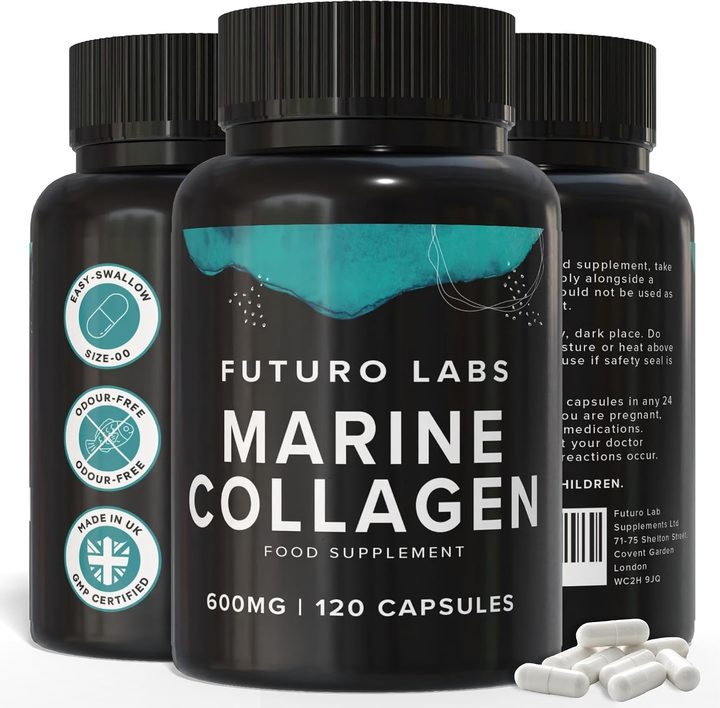
Our brand: the worked example on this page
Futuro Labs Marine Collagen
- 28p a day
- 120 capsules, 2 capsules daily
- Lab tested
- Made in the UK
The goal-sized dose, stated plainly: Futuro Labs Marine Collagen on Amazon UK, 1200mg hydrolysed type 1 per 2 capsules with vitamin C at 15% NRV, £16.99 for 60 days at 28p. Full label breakdown. The research band lives on the protocol page; the protein arithmetic on the bones-and-muscles page.
Ceilings one and two: why toxicity is the wrong frame, and where the evidence stops
The question expects a safety ceiling and the honest first answer is that the expected ceiling does not exist: collagen is food protein, the same material as the gelatine in desserts and the connective tissue in a slow-cooked joint of meat, with no established toxicological upper limit, no UL in the reference tables, and no poisoning literature, which is why the maximum-dose question cannot be answered the way it can for vitamin A or iron, nutrients with genuine ceilings, and why any figure this page gives must come from other kinds of limit. The first real ceiling is evidential, and it sits at roughly 15g: the research band runs from the 2.5g skin-and-joint studies up to the 15g pre-loading protocol, with occasional 20g arms, and above that band lies nothing, no studies, no proposed mechanisms scaling with dose, no claim at any amount since none exists at all, meaning that a reader taking 30g daily is not being dangerous, they are being unaccompanied, spending money in territory the entire literature never visited, the definition of pointless rather than perilous. Between zero and the band's top, the honest dose was never highest-safe but goal-sized: 1-to-2g capsule scale for the daily habit and its label sentences, 10-to-15g powder scale for the reader running the protocols with expectations flattened, each amount chosen by purpose, not bravado.
Ceilings three and four: the opportunity cost that actually bites, and the practical list
The ceiling that genuinely bites at high intakes is nutritional, and it is the section's leucine arithmetic wearing a dose question: collagen is incomplete protein, missing tryptophan and low in leucine, so its grams do not honestly count toward the 1.2-to-2.2g-per-kilogram protein targets the tissue and training pages set, and at serious daily amounts, 20g, 30g, the collagen begins displacing the complete protein that does count, filling appetite and budget with the shelf's weakest protein while the whey, eggs and meat that trigger synthesis get crowded out, an opportunity cost invisible on any label and the true answer to what goes wrong at high doses, nothing toxic, something nutritionally backwards. The fourth ceiling is the practical list: digestive comfort, very large single powder doses sitting heavily for some, split servings the fix; budget, 30g a day burning a tub in a week for no evidential return; and the label's own caution population, the worked example's not-for-use wording covering pregnancy, nursing and other medications, plus the standing pharmacist gate for any medicine list, ceilings of circumstance rather than milligrams. Assembled, the four ceilings return the question answered at its true size: there is no highest safe number to find, the evidence stops near 15g, the nutrition argues against going near it without the protocol reason, and most people's honest maximum is simply their goal's dose, two capsules or one scoop, taken consistently, with the heroic amounts left to nobody, since not even the research went there.
| The ceiling | Where it sits | What it means |
|---|---|---|
| Toxicological | Absent: no UL exists for food protein | The expected ceiling is the one that isn't there |
| Evidential | ~15g: the research band's top | Above it you are unaccompanied, not endangered |
| Nutritional | Wherever collagen displaces complete protein | The opportunity cost: the ceiling that actually bites |
| Practical | Comfort, budget, the label's caution list | Split servings, honest sums, the pharmacist gate |
| Capsule scale, 1-2g | The habit dose | The label sentences: C and zinc at threshold |
| Powder scale, 10-15g | The protocol dose | Expectations flattened, physio conversation attached |
The verdict, and the maximum sized to the goal
What is the highest mg of collagen to take daily: the question's expected ceiling, toxicity, does not exist for a food protein, and the ceilings that do exist answer it better, the evidence stopping near 15g with nothing earned above the band, the nutrition biting first as incomplete collagen grams displace the complete protein that actually counts, and the practical list of comfort, budget and the label's caution population closing the file. Most readers' honest maximum is their goal's dose, not a limit's: the worked example's two capsules at 1200mg for the habit and its sentences, or a 10-to-15g scoop for the protocol reader with a physio in the loop. Futuro Labs Marine Collagen states its side plainly, 1200mg hydrolysed type 1 with 12mg vitamin C at 15% NRV, lab tested, UK made, £16.99 for 60 days at 28p a day, a dose sized to a purpose, which was always the only sizing that made sense.
What to check on the label
- No toxic ceiling exists: collagen is food protein without a UL.
- The evidence stops near 15g: above the band is unaccompanied, not unsafe.
- The real bite is nutritional: incomplete grams displacing complete protein.
- Practical ceilings close the file: comfort, budget, the label's cautions.
- Size the dose to the goal: capsule habit or protocol scoop, nothing heroic.
Our brand
The worked example: Futuro Labs Marine Collagen
Futuro Labs Marine Collagen: 2 capsules daily, 1200mg hydrolysed type 1 marine collagen with 12mg vitamin C and 1.5mg zinc (15% NRV each), 120 capsules for £16.99, 60 days at 28p a day, lab-tested, UK GMP made. Slim veggie-shell capsules, odour free. Fish derived: pescatarian, not vegetarian or vegan.
- Collagen per serving
- 1200mg hydrolysed type 1 marine (fish)
- Co-factors
- vitamin C 12mg (15% NRV), zinc 1.5mg (15% NRV)
- Serving
- 2 capsules a day
- Bottle
- 120 capsules, 60 days
- Price
- £16.99 (28p a day)
- Capsule
- slim size 00, veggie shell, odour free
Questions people also ask
Is there a maximum safe dose of collagen per day?
No toxicological limit exists: collagen is food protein without a UL. The working ceilings are evidential, nothing studied above roughly 15g, and nutritional, the opportunity cost of displacing complete protein.
Can I take 30g of collagen daily?
You would be unaccompanied rather than endangered: no research visited that territory, and at those amounts incomplete collagen starts crowding out the complete protein your targets actually need.
What dose should I actually take?
The goal's dose: 1-2g capsule scale for the daily habit with the vitamin C sentences aboard, or 10-15g powder scale for the pre-loading protocol, raised with a physio.
Does more collagen mean more results?
No dose-response exists to climb: no claim exists at any amount, and the trial band tops out near 15g with modest findings throughout. More buys unaccompanied territory, not outcomes.
Who should cap collagen at zero regardless?
The label's own caution list: pregnancy and nursing, and anyone on other medications until the thirty-second pharmacist check clears it against their actual list.
Sources
- The collagen peptide trial literature: randomised controlled studies of hydrolysed collagen supplementation across skin, joint and connective-tissue outcomes, typically at 2.5g to 15g daily, with small effects and frequent industry funding. PubMed record
- The gelatin and vitamin C pre-exercise research (Shaw, Baar and colleagues): 15g gelatin with vitamin C taken about an hour before loading, studied for markers of collagen synthesis, the protocol behind the tendon-training conversation. PubMed record
- Comparative protein research: the leucine content of a protein drives its muscle protein synthesis response, with whey outperforming collagen in direct comparisons. PubMed record
- Futuro Labs Marine Collagen listing and label: 1200mg hydrolysed type 1 marine collagen per 2-capsule serving with 12mg vitamin C and 1.5mg zinc at 15% NRV each, 120 capsules, independently lab tested, UK made. https://www.amazon.co.uk/dp/B0C2J7N364
- EFSA Panel on Dietetic Products, Nutrition and Allergies. Scientific Opinion on the substantiation of health claims related to magnesium. EFSA Journal 2010;8(10):1807. https://efsa.onlinelibrary.wiley.com/doi/10.2903/j.efsa.2010.1807