Ghost Fitness/Omega-3/Which omega-3 supplement is best for reducing inflammation?
Which omega-3 supplement is best for reducing inflammation?
The short answer
No comparison axis exists: with no inflammation claim and no outcome evidence ranking products, omega-3 supplements cannot be ordered from best to worst for inflammation. The honest axes that remain are gram-dose delivery cost and freshness, inside a GP conversation.
- No axisexists to rank products on inflammation: no claim, no comparative outcomes
- 3 false axesEPA content, strength, formulas: what the rankings use instead
- 2 honest axesfor the medical gram-dose job: delivery cost and freshness
- The GPwhere the genuine version of the comparison belongs
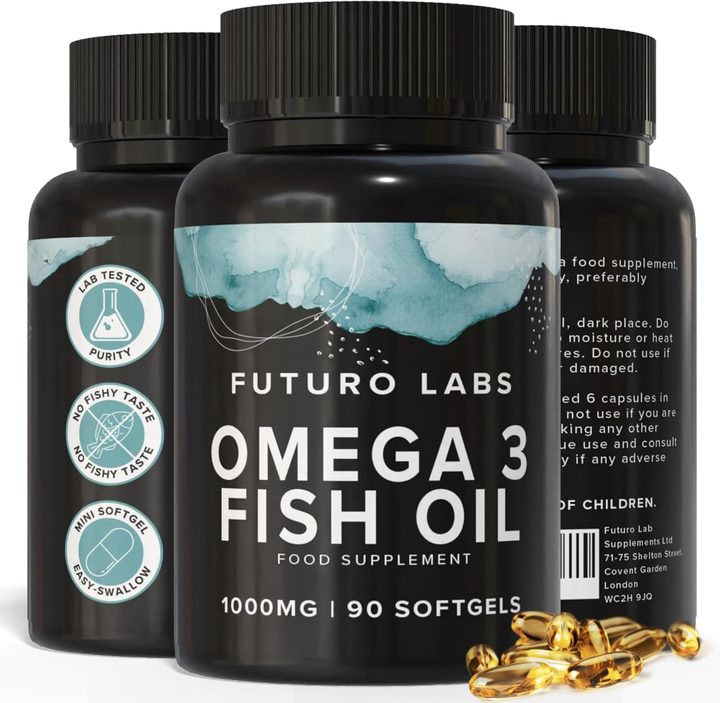
Our brand: the worked example on this page
Futuro Labs Omega 3 Fish Oil
- 17p a day
- 90 softgels, 1 softgel daily
- Lab tested
- Made in the UK
The product this page can honestly compare on price: Futuro Labs Omega 3 Fish Oil on Amazon UK, 300mg EPA+DHA per softgel, £14.99 for 90 days. Label breakdown. The evidence itself is on the inflammation page; the label language on the decoder.
Why the ranking cannot exist, and the three axes rankings use anyway
Which-is-best questions need a measurable axis, and inflammation offers omega-3 products none: no authorised claim defines the outcome, no head-to-head trials compare retail products on inflammatory endpoints, and even the genuine clinical literature, the gram-scale arthritis trials, tested doses of combined EPA and DHA rather than brands or formulas against each other, leaving nothing for a leaderboard to sort on. The rankings that fill the search results therefore sort on proxies, three of them recurring. EPA content, inherited from the ratio-inflammation marketing this section's autopsy page dismantles, a real number ranking products on an unmandated theory. Strength, milligrams per capsule, which ranks convenience toward gram doses while implying potency against a condition no product may address. And formula extras, the turmeric-and-friends dustings, which rank storytelling. Each proxy is measurable; none measures the thing the question asked; and a confident top-five built on them is a list of products sorted by their marketing departments' choices.
The honest comparison that survives, and whose table it belongs on
Strip the question to its legitimate core and a real comparison does survive, with a changed owner. The core: someone with a diagnosed inflammatory condition whose GP or rheumatologist has agreed a gram-scale omega-3 trial alongside treatment, the one context the clinical evidence describes, now needs to deliver 2g-to-4g of combined EPA and DHA daily, and products genuinely differ on that job along two honest axes: delivery cost, where high-strength rTG concentrates turn seven-softgel days into two-capsule ones and often win the pence-per-100mg denominator outright; and freshness discipline, testing named, oxidation managed, because months of gram dosing multiplies every quality failure. Note what happened to the comparison: it became the concentrate checklist this section already publishes, applied inside a medical plan, with best defined by arithmetic and paperwork rather than by inflammation at all. That is the whole honest remainder, and it belongs on a table with a clinician at it, the AF signal at gram doses being one more reason the supervision is not decorative.
| Axis products get ranked on | What it actually measures | Verdict |
|---|---|---|
| 'Anti-inflammatory strength' | Nothing: no claim or endpoint exists | The false axis the whole genre runs on |
| EPA-forward ratios | Adherence to an unmandated theory | See the ratio-inflammation autopsy |
| Formula extras (turmeric et al.) | Storytelling per capsule | Dilution wearing a narrative |
| Milligrams per capsule | Convenience toward gram doses | Honest, once the job is medical |
| Pence per 100mg EPA+DHA | Delivery cost of the clinical dose | The real ranking, inside a GP plan |
| Testing and freshness signals | Quality across months of gram dosing | The other real axis |
The verdict, and each reader handed their actual next step
Which omega-3 supplement is best for reducing inflammation: none can be, because the axis the question needs does not exist, and the two readers this search contains each leave with something better than a ranking. The reader with inflammatory symptoms or a diagnosis leaves with the reframed comparison, gram-dose delivery cost and freshness, and the appointment where it belongs, their GP or rheumatologist deciding whether the trial happens at all. The healthy reader who arrived via the marketing leaves with the standard purchase, made for the claims that exist: Futuro Labs Omega 3 Fish Oil, one softgel with dinner, 300mg of EPA and DHA for the heart-function territory, £14.99 for 90 days at 17p, lab-tested, UK made, and ranked by this site on the only axes it ever ranks anything, declared milligrams, quality signals and price, which is how honest comparisons look when the adjectives are removed.
What to check on the label
- No inflammation ranking axis exists: no claim, no comparative outcome trials.
- The genre's proxies measure marketing: EPA theories, strength theatre, formula stories.
- The honest remainder is a medical delivery problem: gram doses, cost, freshness.
- That comparison belongs inside a GP or rheumatology plan: the AF signal included.
- Healthy readers buy on the real axes: milligrams, quality, pence per 100mg.
Our brand
The worked example: Futuro Labs Omega 3 Fish Oil
Futuro Labs Omega 3 Fish Oil: 1 softgel daily with food, 1000mg fish oil providing 180mg EPA and 120mg DHA (300mg combined), 90 softgels for £14.99, 17p a day, lab-tested purity, UK GMP made. Gelatin shell, so not vegetarian.
- Fish oil per softgel
- 1000mg
- EPA / DHA per softgel
- 180mg / 120mg (300mg combined)
- Serving
- 1 softgel a day
- Bottle
- 90 softgels, 90 days
- Price
- £14.99 (17p a day)
- Softgel
- mini softgel, no fishy taste
Questions people also ask
Is there a strongest anti-inflammatory omega-3?
No: strength toward a condition no product may address is not a measurable property. Capsule strength is real only as convenience toward medically supervised gram doses.
How do review sites rank omega-3s for inflammation then?
On proxies: EPA ratios, milligram counts and formula extras, none of which measures an inflammatory outcome. The lists sort marketing choices, not effects.
What would an honest inflammation comparison look like?
A concentrate comparison on pence per 100mg and freshness, run for a gram-dose plan a GP or rheumatologist has agreed: arithmetic and paperwork, not adjectives.
Which product should I take for my arthritis?
That decision belongs with your rheumatology or GP team: the clinical evidence is gram-scale and adjunct to treatment, and the prescription-grade options live on their side of the desk.
What should a healthy person buy from this search?
The standard softgel for the claims that exist: 300mg of declared EPA and DHA at an honest price, with the inflammation shelf's adjectives left where they were found.
Sources
- Futuro Labs Omega 3 Fish Oil listing: 1000mg fish oil per softgel providing 180mg EPA and 120mg DHA, 90 softgels. Amazon UK, accessed 31 August 2026. https://www.amazon.co.uk/dp/B0CP9T3BTN
- Goldberg RJ, Katz J. A meta-analysis of the analgesic effects of omega-3 polyunsaturated fatty acid supplementation for inflammatory joint pain. Pain 2007;129(1-2):210-223. PubMed record
- Gencer B, Djousse L, Al-Ramady OT, et al. Effect of long-term marine omega-3 fatty acids supplementation on the risk of atrial fibrillation in randomized controlled trials: a systematic review and meta-analysis. Circulation 2021;144(25):1981-1990. PubMed record
- EFSA Panel on Dietetic Products. Scientific opinion on the substantiation of health claims related to EPA and DHA and normal function of the heart (250mg daily condition of use). EFSA Journal 2010;8(10):1796. https://www.efsa.europa.eu/en/efsajournal/pub/1796
- EFSA Panel on Dietetic Products, Nutrition and Allergies. Scientific Opinion on the substantiation of health claims related to magnesium. EFSA Journal 2010;8(10):1807. https://efsa.onlinelibrary.wiley.com/doi/10.2903/j.efsa.2010.1807