Ghost Fitness/Magnesium/Why does a label say 1500mg magnesium bisglycinate but only 300mg magnesium?
Why does a label say 1500mg magnesium bisglycinate but only 300mg magnesium?
The short answer
Because bisglycinate is a carrier: 1500mg is the whole compound's weight, magnesium plus two glycine molecules, and magnesium makes up about 20% of it, so 300mg is the mineral actually delivered. Labels showing both numbers are the honest ones.
- 1500mgthe compound: magnesium plus its two glycine carriers, weighed together
- 300mgthe elemental magnesium inside it: the number your body counts
- 20%the ratio connecting the two figures
- Both numbers shownthe signature of an honest label
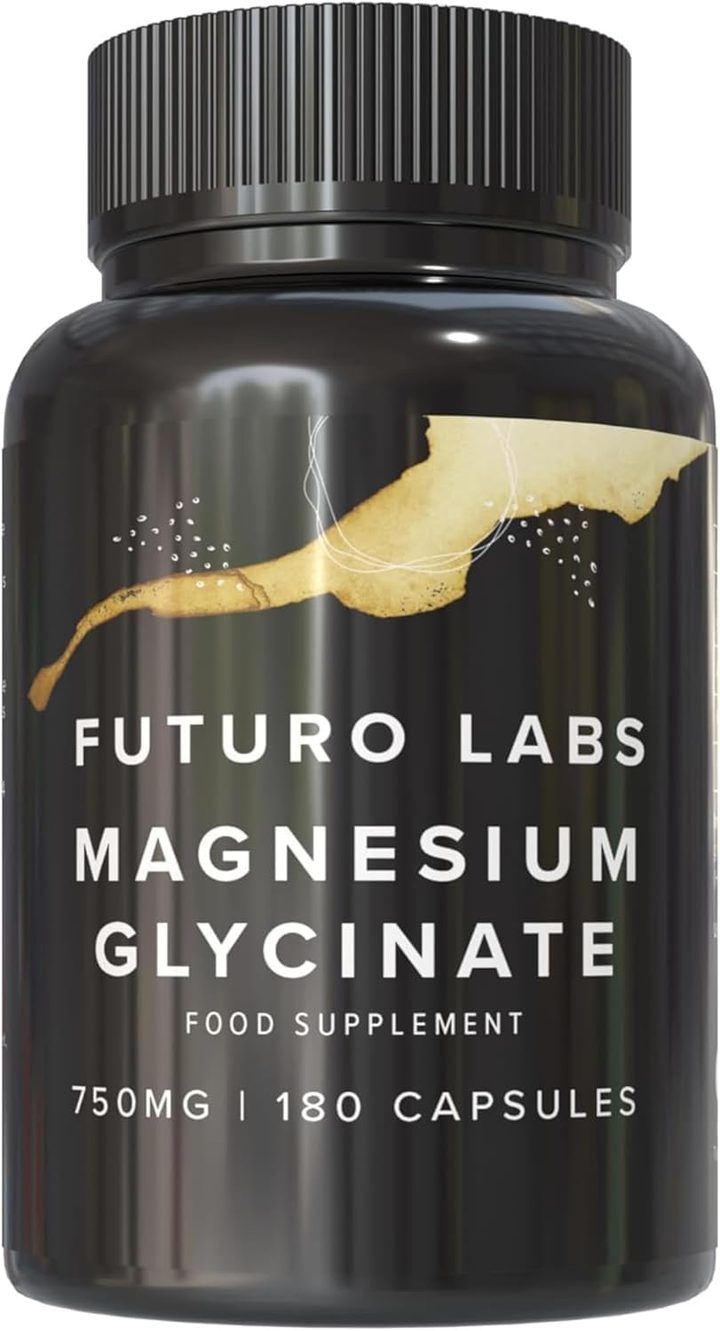
Our brand: the worked example on this page
Futuro Labs Magnesium Glycinate
- 22p a day
- 180 capsules, 2 capsules daily
- Lab tested
- Made in the UK
The label this page decodes: Futuro Labs Magnesium Glycinate on Amazon UK, 1500mg bisglycinate providing 300mg magnesium (80% NRV), £19.99 for 180 capsules. Full label breakdown. The general tutorial is on how to read a magnesium label; the elemental concept on elemental magnesium.
The line, read word by word
Take the exact sentence that prompts this search, Magnesium Bisglycinate 1500mg, providing Magnesium 300mg, 80% NRV, and walk it. Magnesium bisglycinate names the whole molecule: one magnesium atom chelated between two glycine amino acids, a deliberate structure that shields the mineral through digestion. 1500mg weighs that whole molecule, carriers included, the way a parcel's shipping weight includes the box. Providing magnesium 300mg then does the honest subtraction, declaring the mineral alone, the payload your body actually receives, which is about 20% of a true chelate's mass. And 80% NRV converts the payload into the comparison yardstick, 300 divided by the 375mg Nutrient Reference Value. Nothing on the line is redundant: the first number tells you what the capsule contains, the second what you get, the percentage how that compares.
Why honest labels need both numbers, and what the alternatives look like
The dual declaration exists because each number alone can mislead. Compound-only labels, magnesium bisglycinate 1000mg full stop, let the big carrier weight impersonate a big dose, the costume this site's decode pages keep catching, with the missing providing-line as the tell. Elemental-only labels, magnesium 300mg with no compound stated, hide the form question instead, leaving you unable to verify the bisglycinate claim against the arithmetic, since 300mg elemental from pure chelate requires about 1500mg of compound, more than one capsule can hold. Show both and the label audits itself: 300 divided by 1500 is exactly the 20% a genuine bisglycinate should be, a ratio check anyone can run in their head, and one that instantly exposes the buffered blends whose numbers only reconcile once undeclared oxide enters the equation. The double declaration is not clutter; it is the receipt.
| Label style | What it shows | What it hides | Verdict |
|---|---|---|---|
| Compound only: 'Magnesium Bisglycinate 1500mg' | The big impressive weight | The 300mg payload; the NRV maths | The costume: assume ~20% and decode |
| Elemental only: 'Magnesium 300mg' | The payload | Whether the form claim survives the arithmetic | Incomplete: the form is unverifiable |
| Dual declaration: '1500mg providing 300mg (80% NRV)'Ours | Everything: compound, payload, yardstick | Nothing | The honest format; the ratio self-audits |
Running the check on any bottle, and the label that invites it
The transferable skill is one division: elemental over compound should land near 20% for a true bisglycinate, near 14% to 16% for looser glycinate materials, and anywhere much higher means a denser salt is helping, oxide at 60% being the usual guest. The worked example prints everything the check needs because it passes it: Futuro Labs Magnesium Glycinate declares 1500mg of magnesium bisglycinate providing 300mg of magnesium at 80% NRV per 2-capsule serving, the 20% ratio exact, the ingredients line oxide-free, vegan, UK made under GMP and BRC, panels shown, £19.99 for 180 capsules, 22p a day. Why does a label say 1500mg bisglycinate but only 300mg magnesium: because one number is the parcel and the other is the contents, and a brand willing to weigh both in public is telling you it has nothing to hide in the difference.
What to check on the label
- 1500mg = the parcel: magnesium plus two glycine carriers, weighed together.
- 300mg = the contents: the elemental mineral your body counts.
- The ratio self-audits: 300 over 1500 is the 20% a true chelate should be.
- Compound-only labels are the costume; elemental-only labels hide the form check.
- Both numbers shown is the honest signature: the receipt, not clutter.
Our brand
The worked example: Futuro Labs Magnesium Glycinate
Futuro Labs Magnesium Glycinate is the dual declaration done properly: 1500mg bisglycinate providing 300mg magnesium (80% NRV) per 2 capsules, the 20% ratio exact, 22p a day from a £19.99 bottle of 180. Vegan, UK made, panels shown.
- Elemental magnesium per serving
- 300mg (80% NRV)
- Form
- magnesium bisglycinate 20%
- Serving
- 2 capsules a day
- Bottle
- 180 capsules, 90 days
- Price
- £19.99 (22p a day)
- Capsule
- vegetarian shell, vegan product
Questions people also ask
Is 1500mg of magnesium bisglycinate the same as 1500mg of magnesium?
No: the 1500mg weighs the whole compound, carriers included. The magnesium inside is about 300mg, which is why honest labels state both.
Am I only getting 300mg from a 1500mg capsule serving: is that a rip-off?
It is the chemistry, not a con: every chelate is mostly carrier by weight, and 300mg elemental is a full day's serving.
What does 'providing' mean on a supplement label?
It introduces the elemental declaration: the compound named first, then the mineral it actually delivers. It is the word that separates parcel from contents.
How do I check the 20% ratio on other brands?
Divide elemental milligrams by compound milligrams: near 0.20 confirms true bisglycinate, and much higher means a denser salt like oxide is in the mix.
Which number counts toward the 400mg daily limit?
The elemental one: 300mg in this example. Guidance levels, reference intakes and the NRV all speak elemental.
Sources
- Futuro Labs Magnesium Glycinate listing, Amazon UK, label and price checked 31 August 2026. https://www.amazon.co.uk/dp/B0BT7Z5VQW
- Retained Regulation (EU) No 1169/2011, Annex XIII: nutrient reference value for magnesium 375mg. https://www.legislation.gov.uk/eur/2011/1169/annex/XIII
- Walker AF, Marakis G, Christie S, Byng M. Mg citrate found more bioavailable than other Mg preparations in a randomised, double-blind study. Magnesium Research 2003;16(3):183-191. PubMed record
- Expert Group on Vitamins and Minerals. Safe Upper Levels for Vitamins and Minerals. Food Standards Agency, 2003 (magnesium guidance level 400mg a day from supplements). https://cot.food.gov.uk/sites/default/files/vitmin2003.pdf
- The Food Supplements (England) Regulations 2003 (food supplements are regulated as foods in the UK). https://www.legislation.gov.uk/uksi/2003/1387/contents/made
- EFSA Panel on Dietetic Products, Nutrition and Allergies. Scientific Opinion on the substantiation of health claims related to magnesium. EFSA Journal 2010;8(10):1807. https://efsa.onlinelibrary.wiley.com/doi/10.2903/j.efsa.2010.1807