Ghost Fitness/Collagen/How many collagen capsules equal 10g of collagen?
How many collagen capsules equal 10g of collagen?
The short answer
At typical fills the arithmetic is brutal: 10g needs about 17 capsules at 600mg, 20 at 500mg, 25 at 400mg. Read your label's per-capsule figure, divide 10,000 by it, and then buy powder, which is what the sum means.
- The formula10,000mg divided by your label's per-capsule fill
- The typical answers17 at 600mg, 20 at 500mg, 25 at 400mg
- The physics behind itsize-00 shells cap out around 400-600mg of collagen
- The crossover sum10g daily in capsules costs several times the powder price
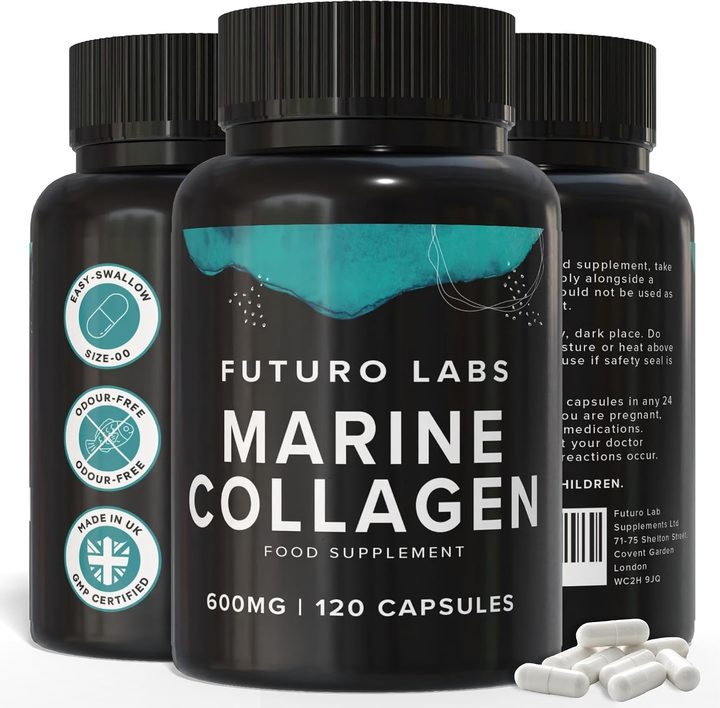
Our brand: the worked example on this page
Futuro Labs Marine Collagen
- 28p a day
- 120 capsules, 2 capsules daily
- Lab tested
- Made in the UK
The honest capsule lane, at capsule scale: Futuro Labs Marine Collagen on Amazon UK, 600mg per capsule, 1200mg per two-capsule serving with vitamin C and zinc at 15% NRV, £16.99 for 60 days at 28p, built for the habit, never for 10g. Full label breakdown. The lane converter is on the marine dose page; the format decision tree on the capsules-versus-powder page.
The conversion done properly: the formula, the table, and the physics that fixes it
The conversion is one division, so give it exactly and then print the table the division produces. The formula: 10g is 10,000mg, and the capsule count is 10,000 divided by your label's per-capsule collagen figure, which itself is the per-serving dose divided by the serving's capsule count, the two-second check any tub allows, so a label declaring 1200mg per 2 capsules is a 600mg-per-capsule product and 10g of it is 10,000 over 600, seventeen capsules rounded up. The table at the shelf's typical fills: 400mg capsules, twenty-five for 10g, the arithmetic every protocol page quotes at 15g's twenty-five-for-a-scoop absurdity, here already absurd at ten; 500mg capsules, twenty exactly; 600mg capsules, the top of the standard range and the worked example's fill, seventeen; the occasional 750mg oversize, thirteen-to-fourteen, bought at the cost of a capsule some throats decline. Why the fills sit where they sit is physics rather than stinginess: a size-00 shell, the largest most people comfortably swallow, holds roughly 400-to-600mg of hydrolysed collagen powder at its practical density, the ceiling that no marketing raises, which is why no capsule product anywhere delivers 10g in a civilised count and why the question's real answer was always going to be a redirect. Two label traps close the section: some tubs print the per-serving figure large and the capsule count small, making a 500mg capsule look like a 1500mg one until the division is done; and gelatine-shell products count their shell weight nowhere, the fill figure being the only number that converts.
The crossover sum that settles the format, and the honest uses of each lane restated
Run the money alongside the count and the conversion finishes itself. A 10g-daily capsule habit at 600mg fills burns seventeen capsules a day, emptying a 120-capsule bottle in a week, which at typical capsule pricing lands somewhere between three and eight times the pence-per-10g of plain unflavoured powder, the exact multiple varying by brand and the direction never varying at all, because capsules charge for encapsulation, shells, bottling and per-unit handling that powder simply skips, a premium that is fair value at habit scale, where two capsules buy metering, portability and tastelessness, and pure waste at band scale, where seventeen swallows buy nothing a scoop and ten seconds of stirring would not. The honest uses of each lane, restated for the reader the division just re-routed: capsules own the 1-to-2g cofactor habit, the fixed daily dose with vitamin C and zinc at 15% NRV, the worked example's whole design, two swallows, 28p, done; powder owns everything from the trial band's 2.5g floor upward, the 10g this query asked after sitting deep in powder country, and the protocol's 15g further still, level-scooped into 150-to-250ml per the barista card; and the split reader runs both without contradiction, capsules for the daily habit, a powder tub in the cupboard for band or protocol days, the formats doing the jobs their physics assigned. The verdict the arithmetic was always going to deliver: seventeen-to-twenty-five capsules equal 10g, no capsule product should be asked to, and the division that answers this question is also the one that tells you which aisle to be standing in.
| Per-capsule fill | Capsules for 10g | The reading |
|---|---|---|
| 400mg | 25 | The protocol pages' standing absurdity, arrived early |
| 500mg | 20 | A blister strip a day: powder country |
| 600mg | 17 | The standard ceiling: still powder country |
| 750mg oversize | 13-14 | Bought with a capsule some throats decline |
| The formula | 10,000 divided by the per-capsule figure | Per-serving dose over capsule count, first |
| The crossover | Several times powder's pence per 10g | Capsules meter habits; powder moves grams |
The verdict, counted out and redirected
How many collagen capsules equal 10g: divide 10,000 by your label's per-capsule figure and read the table, seventeen at 600mg, twenty at 500mg, twenty-five at 400mg, counts that size-00 physics makes inevitable and pence-per-gram makes pointless, powder owning everything at this scale for a fraction of the cost. The worked example demonstrates the division and its honest conclusion at once: Futuro Labs Marine Collagen, 600mg per capsule, 1200mg per two-capsule serving with 12mg vitamin C and 1.5mg zinc at 15% NRV, lab tested, UK made, £16.99 for 60 days at 28p a day, a capsule product built for the habit lane its format serves, and the first tub to tell you that 10g was always a scoop.
What to check on the label
- One division answers it: 10,000 over the per-capsule figure.
- Seventeen to twenty-five: the table at typical 400-600mg fills.
- Physics sets the ceiling: size-00 shells hold what they hold.
- Run the crossover sum: capsules cost several times powder at 10g.
- Each lane keeps its job: capsules meter habits, powder moves grams.
Our brand
The worked example: Futuro Labs Marine Collagen
Futuro Labs Marine Collagen: 2 capsules daily, 1200mg hydrolysed type 1 marine collagen with 12mg vitamin C and 1.5mg zinc (15% NRV each), 120 capsules for £16.99, 60 days at 28p a day, lab-tested, UK GMP made. Slim veggie-shell capsules, odour free. Fish derived: pescatarian, not vegetarian or vegan.
- Collagen per serving
- 1200mg hydrolysed type 1 marine (fish)
- Co-factors
- vitamin C 12mg (15% NRV), zinc 1.5mg (15% NRV)
- Serving
- 2 capsules a day
- Bottle
- 120 capsules, 60 days
- Price
- £16.99 (28p a day)
- Capsule
- slim size 00, veggie shell, odour free
Questions people also ask
How many capsules make 10 grams of collagen?
Divide 10,000mg by your label's per-capsule figure: about 17 at 600mg fills, 20 at 500mg and 25 at 400mg, the per-capsule number being the serving dose divided by its capsule count.
Why don't brands just make bigger capsules?
Physics: a size-00 shell, the largest most people swallow comfortably, holds roughly 400 to 600mg of collagen at practical density, a ceiling marketing cannot raise.
Is it cheaper to take 10g as capsules or powder?
Powder, always and by multiples: encapsulation, shells and bottling put capsule pence-per-gram at several times plain powder's, a fair premium at habit scale and pure waste at 10g.
What are capsules actually good for then?
The habit lane: 1 to 2g metered identically every day with the cofactors at 15% NRV aboard, two swallows, portable and tasteless, which is the format's whole honest design.
What's the trap to watch on capsule labels?
The per-serving headline: a bold 1500mg over a three-capsule serving is a 500mg capsule, so always do the division before comparing tubs.
Sources
- Futuro Labs Marine Collagen listing and label: 1200mg hydrolysed type 1 marine collagen per 2-capsule serving with 12mg vitamin C and 1.5mg zinc at 15% NRV each, 120 capsules, independently lab tested, UK made. https://www.amazon.co.uk/dp/B0C2J7N364
- The collagen and skin trial literature: randomised studies of oral collagen peptides on skin elasticity and hydration, mostly small, short and industry funded, with no authorised claim resulting. PubMed record
- EFSA Panel on Dietetic Products. Scientific opinion on Dietary Reference Values for fats: Adequate Intake of 250mg combined EPA and DHA per day for adults. EFSA Journal 2010;8(3):1461. https://www.efsa.europa.eu/en/efsajournal/pub/1461
- EFSA Panel on Dietetic Products, Nutrition and Allergies. Scientific Opinion on the substantiation of health claims related to magnesium. EFSA Journal 2010;8(10):1807. https://efsa.onlinelibrary.wiley.com/doi/10.2903/j.efsa.2010.1807