Ghost Fitness/Omega-3/Can you take too much omega-3 side effects?
Can you take too much omega-3 side effects?
The short answer
Keep the one-off and the habit apart. A handful of softgels swallowed once produces loose stools, fishy burps and nothing else in a healthy adult, the oil being a fat the gut passes rather than a mineral the kidney must clear. A habit at several grams a day carries the real notes: the antiplatelet effect for anticoagulant users, an LDL rise, and the atrial fibrillation signal. The amount is counted in EPA and DHA. Bleeding signs on an anticoagulant need a call.
- The one-offa handful of softgels once: loose stools and burps; nothing else in a healthy adult; no call
- The habitseveral grams of EPA and DHA a day: the antiplatelet note, an LDL rise at two grams and more, the atrial fibrillation signal most evident at four
- The unitEPA and DHA, not oil: ten standard softgels are three grams of actives, not ten
- The callan anticoagulated reader with bleeding signs; otherwise none
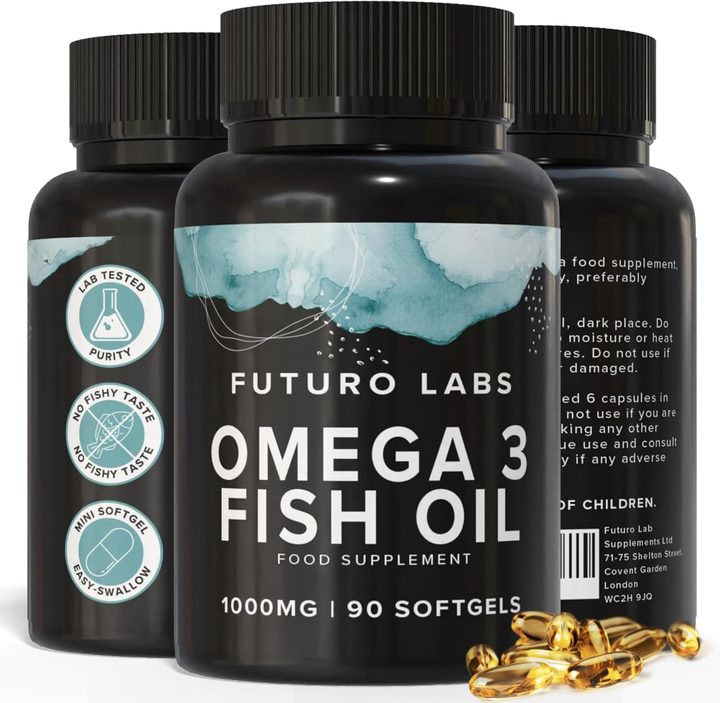
Our brand: the worked example on this page
Futuro Labs Omega 3 Fish Oil
- 17p a day
- 90 softgels, 1 softgel daily
- Lab tested
- Made in the UK
A standard dose a long way below both: Futuro Labs Omega 3 Fish Oil on Amazon UK, 1 softgel with food, 180mg EPA and 120mg DHA, 90 for £14.99 at 17p. Full label breakdown. The high-dose ladder is on the high-dose page; the downsides on two axes on the downside page.
The one-off, a handful of softgels once, and why it produces almost nothing
Can you take too much omega-3, and what are the side effects, is a question that needs its two halves kept apart, the one-off and the habit, because they have different answers and the search usually means the first. The one-off: a reader who has swallowed a handful of softgels at once, a whole strip taken by mistake, a double or triple dose to catch up, or a child who has found the tub, has taken a quantity of fat, and a fat is handled by the gut and the liver rather than excreted by the kidney, so there is no accumulation, no blood level that spikes toward a danger and no organ that must clear it, the contrast with the mineral pages' accidental-dose triage being complete. What happens is what happens with any large dose of oil: loose stools or frank diarrhoea within hours as the unabsorbed fat reaches the colon, fishy burps and reflux as the oil floats in the stomach, perhaps nausea, and nothing else in a healthy adult, the episode passing within a day, the poisons literature recording no serious outcome from fish oil ingestion in adults or children beyond the gut, so that no call is needed and no treatment beyond water, a bland meal and patience. The one honest exception on the one-off side is the reader already on an anticoagulant or antiplatelet medicine who has taken a very large dose and notices bleeding signs, unusual bruising, nosebleeds or blood in the stool, who calls their prescriber or a pharmacist, the antiplatelet note applied to a rare event. A child who has swallowed a cod liver oil in quantity has a vitamin A question rather than an omega-3 one, the liver-oil pages' point, and a call is made for that.
The habit, several grams a day, with the real notes, the unit that decides which half you are in, and the question filed
The habit is the half with real side effects, and they arrive by dose. A habit at a gram or two of EPA and DHA a day, the index rung and the triglyceride claim, carries loose stools and a fishy taste in some, fixed by a split, and the antiplatelet note, EPA and DHA modestly reducing platelet stickiness in an effect that matters for a reader on warfarin, a direct oral anticoagulant, aspirin or clopidogrel and before surgery, and a possible rise in LDL cholesterol in some people at the triglyceride-lowering doses, the lipid literature's consistent finding and a reason the two-gram claim is taken with a GP. A habit at three or four grams a day, the blood pressure claim and the research and prescription doses, adds the atrial fibrillation signal, the cardiovascular outcome trials showing a dose-related rise in AF risk most evident at four grams and small or absent below a gram, the honest ceiling for a healthy adult and the reason those doses need a reason. A habit above five grams is above the regulator's safe level and has no reason at all. The unit decides which half a reader is in, and it is EPA and DHA rather than oil: ten standard 1000mg softgels swallowed at once are three grams of actives, a one-off producing the gut's response and nothing more, while ten a day every day are a three-gram habit carrying the notes above, and a reader who reads their dose in oil weight has overstated it three times, the 1000mg pages' decode in reverse. The side effects that the folklore adds and the evidence does not, weight gain, liver harm, kidney harm and immune suppression, appear at no dose in the trials up to five grams, the downsides page's non-downsides. The question filed: too much omega-3 as a one-off is loose stools and burps in a healthy adult with no call needed, too much as a habit is the antiplatelet note, an LDL rise and the atrial fibrillation signal at several grams a day, the unit is EPA and DHA, and the reader who needs a call is the anticoagulated one with bleeding signs, with the worked example being a standard dose a long way below both, one softgel at 17p, £14.99 for 90.
| The situation | What happens | What to do |
|---|---|---|
| A handful of softgels once | Loose stools, burps, perhaps nausea; passes within a day | Water, a bland meal, patience; no call |
| A child and the tub | The same, in a smaller body; a vitamin A question if it was cod liver oil | A call for a liver oil; otherwise the gut's response |
| A habit at one to two grams a day | Loose stools in some; the antiplatelet note; a possible LDL rise at two grams | A split; the prescriber's knowledge on anticoagulants; a GP for the two-gram claim |
| A habit at three to four grams | The atrial fibrillation signal most evident at four | A reason and a GP; the honest ceiling |
| Above five grams | Above the safe level | No reason at all |
| The unit | EPA and DHA, not oil | Ten standard softgels are three grams of actives |
The verdict, a one-off that the gut answers and a habit that the notes answer
Can you take too much omega-3, and what are the side effects: as a one-off, a handful of softgels once, loose stools, fishy burps and perhaps nausea in a healthy adult, passing within a day with no call needed because a fat is handled by the gut rather than cleared by the kidney; as a habit at several grams of EPA and DHA a day, the real notes, the antiplatelet effect for anticoagulant users, a possible LDL rise at the triglyceride-lowering doses and the atrial fibrillation signal most evident at four grams, with five grams the regulator's ceiling, the amount counted in EPA and DHA rather than oil, and the reader who needs a call being the anticoagulated one with bleeding signs or a child who found a cod liver oil. A standard dose a long way below both: Futuro Labs Omega 3 Fish Oil, one softgel with food, 180mg EPA and 120mg DHA, 90 for £14.99 at 17p a day.
What to check on the label
- Separate the one-off from the habit: different answers.
- Expect the gut and nothing else from a one-off: no call in a healthy adult.
- Know the habit's notes: antiplatelet, LDL at two grams, AF at four.
- Count in EPA and DHA: not in oil weight.
- Call only for bleeding signs on an anticoagulant: or a child and a liver oil.
Our brand
The worked example: Futuro Labs Omega 3 Fish Oil
Futuro Labs Omega 3 Fish Oil: 1 softgel daily with food, 1000mg fish oil providing 180mg EPA and 120mg DHA (300mg combined), 90 softgels for £14.99, 17p a day, lab-tested purity, UK GMP made. Gelatin shell, so not vegetarian.
- Fish oil per softgel
- 1000mg
- EPA / DHA per softgel
- 180mg / 120mg (300mg combined)
- Serving
- 1 softgel a day
- Bottle
- 90 softgels, 90 days
- Price
- £14.99 (17p a day)
- Softgel
- mini softgel, no fishy taste
Questions people also ask
What happens if you accidentally take too much fish oil?
In a healthy adult, loose stools, fishy burps and perhaps nausea within hours, passing within a day, because a fat is handled by the gut and the liver rather than accumulating like a mineral, so no call is needed beyond water, a bland meal and patience.
Can you overdose on omega-3?
Not in the sense of an acute poisoning: the poisons literature records no serious outcome from fish oil ingestion beyond the gut, and the real risks belong to a habit at several grams of EPA and DHA a day, the antiplatelet note, an LDL rise and the atrial fibrillation signal, with five grams the regulator's ceiling.
Is 10 fish oil capsules a day too much?
As a one-off, three grams of actives from ten standard softgels producing the gut's response and nothing more; as a daily habit, a three-gram dose carrying the antiplatelet note, a possible LDL rise and the atrial fibrillation signal, which needs a triglyceride or blood pressure reason and a GP.
When should I seek help after taking too much fish oil?
If you are on warfarin, a direct oral anticoagulant, aspirin or clopidogrel and notice bleeding signs, unusual bruising, nosebleeds or blood in the stool, call the prescriber or a pharmacist; and if a child has swallowed cod liver oil in quantity, call for the vitamin A rather than the omega-3.
Does too much omega-3 damage the liver or kidneys?
No: trials up to five grams of EPA and DHA a day and decades of use show no liver or kidney harm, the folklore side effects of weight gain and immune suppression appearing at no dose, and the real notes being the gut, the antiplatelet effect, an LDL rise and atrial fibrillation at high habitual doses.
Sources
- EFSA Panel on Dietetic Products. Scientific opinion on the tolerable upper intake level of EPA, DHA and DPA: supplemental intakes of EPA and DHA combined up to about 5g/day do not raise safety concerns for adults. EFSA Journal 2012;10(7):2815. https://www.efsa.europa.eu/en/efsajournal/pub/2815
- Meta-analyses of cardiovascular outcome trials of marine omega-3: a dose-related increase in the risk of atrial fibrillation, most evident at doses of four grams a day and small or absent below one gram, a finding that sets the honest ceiling of high-dose omega-3 for a healthy adult. PubMed record
- Meta-analytic evidence on omega-3 fatty acids and LDL cholesterol: triglyceride lowering is the consistent effect, with LDL unchanged or modestly raised, particularly with DHA-containing preparations. PubMed record
- The cod liver oil and vitamin A literature: cod liver oil carries preformed vitamin A at hundreds of micrograms per teaspoon or capsule, the adult upper level for preformed vitamin A being 3000 micrograms a day and pregnancy advice being to avoid liver oils, so a cod liver oil stacked with a multivitamin or a vitamin A supplement is the one combination in which a fish oil can push a vitamin over its limit. https://www.gov.uk/government/publications/sacn-vitamin-a-and-health