Ghost Fitness/Omega-3/How to avoid fish burps from fish oil?
How to avoid fish burps from fish oil?
The short answer
A shopping checklist. A stated triglyceride form, which sits better than an unstated ethyl ester and oxidises more slowly. Freshness: a stated oxidation value or a recent date, and a tub small enough to finish within months. A 500mg or 1000mg softgel rather than a 1400mg one. A lemon flavour or an odour-controlled oil for what a rare burp carries. An enteric coat only if the rest fails. And the free line every product needs: the middle of a meal.
- One, the forma stated triglyceride or re-esterified triglyceride form; not an unstated ethyl ester
- Two, freshnessa stated oxidation value or a recent date; a tub finished within two or three months
- Three and four, size and flavour500mg or 1000mg softgels rather than 1400mg; lemon or odour-controlled for the rare burp
- Five and the free linean enteric coat only if the rest fails; mid-meal timing with every product
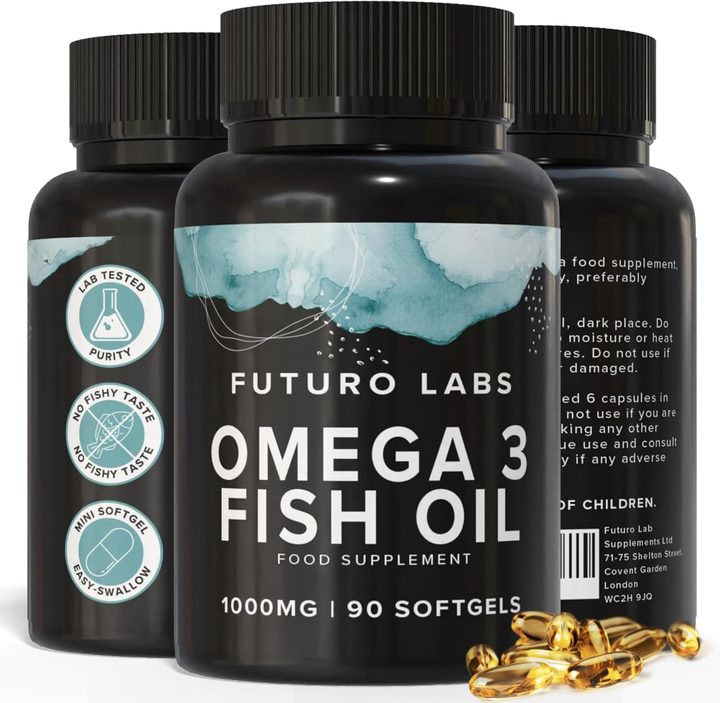
Our brand: the worked example on this page
Futuro Labs Omega 3 Fish Oil
- 17p a day
- 90 softgels, 1 softgel daily
- Lab tested
- Made in the UK
A stated natural triglyceride form, lab-tested, in a 1000mg softgel and a 90-count tub finished in a quarter: Futuro Labs Omega 3 Fish Oil on Amazon UK, 1 softgel mid-meal, 180mg EPA and 120mg DHA, 90 for £14.99 at 17p. Full label breakdown. The one-week behaviour protocol is on the avoid-burps page; the three ingredients of a burp on the stop-burping page.
The checklist's first three lines, the form, the freshness and the size, decided at the checkout
How to avoid fish burps from fish oil is a question the behaviour pages answer with timing, posture and no peppermint, and the honest page answers here with a shopping checklist, because half of burping is decided at the checkout before any softgel is swallowed, and a reader who buys well has less to manage. The first line, the form: fish oil comes as a natural triglyceride, a re-esterified triglyceride or an ethyl ester, the last being the cheap concentrate form whose fatty acids are bound to ethanol rather than glycerol, and many users report that an ethyl ester repeats and refluxes worse than a triglyceride oil at the same dose, the ethyl ester also absorbing poorly without a fatty meal and oxidising faster once opened, the ethyl ester stability literature's findings, so the checklist's first line is a stated triglyceride or re-esterified triglyceride form on the label, with an unstated form on a cheap concentrate read as an ethyl ester until proven otherwise. The second line, freshness: a rancid oil carries the aldehydes of oxidation, which are the painty, fishy smell itself and which repeat on the breath all day whatever the timing, the oxidation literature's account, so the checklist looks for a stated oxidation value, the TOTOX figure some brands print or publish, or failing that a recent manufacture date and a batch test, and buys a tub small enough to finish within two or three months of opening, a 90-count at one a day lasting a quarter and a 365-count opened for a year going rancid before it is finished, with the bite test at home confirming what the label promised. The third line, size: a large bolus of fat arriving at once relaxes the lower oesophageal sphincter more than a small one, so a 500mg or a 1000mg softgel sits better than the 1200mg and 1400mg softgels the high-strength shelf sells, and a reader who wants a gram of EPA and DHA a day takes it as three 1000mg standard softgels across two or three meals rather than as one large concentrate capsule fasted, the smaller-bolus rule of the burp pages.
The last two lines, flavour and the coat, the free line every product needs, the checklist in one product, and the checklist filed
The fourth line, flavour and odour control: even a fresh triglyceride oil in a small softgel taken well will occasionally come up, and what the rare burp carries is decided by the oil's smell, so a lemon-flavoured or a deodorised oil, or a softgel whose shell carries a citrus coating, turns a rare fishy burp into a lemon one, a cosmetic fix that works and that the odour-controlled shelf sells at little premium, with the note that a flavour masks a rancid oil's smell without fixing its aldehydes, so the second line still comes first. The fifth line, the coat: an enteric-coated softgel releases its oil past the stomach and the sphincter, the enteric literature finding fewer burps for most users at a cost premium, and it is the last line on the checklist rather than the first because it costs more, is not needed by the reader the first four lines fix, and is the product answer for the reader whose reflux tendency any fatty food triggers, who has a GP for the reflux and the coat for the softgel. The free line every product needs: the middle of a meal, after several mouthfuls and before the last, upright for two hours after and no peppermint, because no product on the checklist survives being taken fasted, an enteric coat aside, and the best-bought softgel swallowed on an empty stomach floats and burps like any other, the behaviour protocol's first day. The checklist in one product: a stated natural triglyceride form, a lab-tested batch, a 1000mg softgel carrying 300mg of EPA and DHA, a 90-count tub finished in a quarter at one a day, taken mid-meal, which ticks the first three lines and the free line and leaves flavour and the coat for the reader who needs them, at 17p a day. The checklist filed: a stated triglyceride form, freshness by a stated value or a recent date and a small tub, a 500mg or 1000mg softgel, a lemon or odour-controlled oil for the rare burp, an enteric coat only if the rest fails, and mid-meal timing with every product, with the worked example being a stated natural triglyceride form in a 1000mg softgel and a 90-count tub, £14.99 at 17p.
| The line | What to look for | Why |
|---|---|---|
| One: the form | A stated triglyceride or re-esterified triglyceride form | Sits better than an unstated ethyl ester; oxidises more slowly |
| Two: freshness | A stated oxidation value or a recent date; a tub finished within two or three months | A rancid oil burps all day whatever the timing |
| Three: the size | 500mg or 1000mg softgels; not 1200mg or 1400mg | A smaller bolus relaxes the sphincter less |
| Four: the flavour | Lemon-flavoured or odour-controlled | A rare burp carries lemon, not harbour; a mask, not a fix, for rancidity |
| Five: the coat | Enteric-coated, only if one to four fail | Releases past the stomach; a premium; the reflux reader's answer |
| The free line | The middle of a meal, upright after, no peppermint | No product survives being taken fasted |
The verdict, five lines at the checkout and one free line at the table
How to avoid fish burps from fish oil: at the checkout, by a five-line shopping checklist, a stated triglyceride or re-esterified triglyceride form that many users find sits better than an unstated ethyl ester and that oxidises more slowly, freshness by a stated oxidation value or a recent manufacture date and a tub small enough to finish within two or three months of opening since a rancid oil burps all day whatever the timing, a 500mg or 1000mg softgel rather than a 1200mg or 1400mg one since a smaller bolus relaxes the sphincter less, a lemon-flavoured or odour-controlled oil for what the rare burp carries, and an enteric coat only for the reader the first four lines do not fix, and at the table by the free line every product still needs, the middle of a meal, upright after and no peppermint. A stated natural triglyceride form in a 1000mg softgel and a 90-count tub finished in a quarter: Futuro Labs Omega 3 Fish Oil, one mid-meal, 180mg EPA and 120mg DHA, lab-tested purity, 90 for £14.99 at 17p a day.
What to check on the label
- Buy a stated triglyceride form: read an unstated concentrate as an ethyl ester.
- Buy fresh and small: a stated value or a recent date, and a tub you finish in months.
- Buy 500mg or 1000mg softgels: not the 1400mg high-strength ones.
- Buy a lemon or odour-controlled oil if you want: for the rare burp, after the first three lines.
- Buy an enteric coat last: and take every product mid-meal.
Our brand
The worked example: Futuro Labs Omega 3 Fish Oil
Futuro Labs Omega 3 Fish Oil: 1 softgel daily with food, 1000mg fish oil providing 180mg EPA and 120mg DHA (300mg combined), 90 softgels for £14.99, 17p a day, lab-tested purity, UK GMP made. Gelatin shell, so not vegetarian.
- Fish oil per softgel
- 1000mg
- EPA / DHA per softgel
- 180mg / 120mg (300mg combined)
- Serving
- 1 softgel a day
- Bottle
- 90 softgels, 90 days
- Price
- £14.99 (17p a day)
- Softgel
- mini softgel, no fishy taste
Questions people also ask
What type of fish oil does not cause burps?
A stated triglyceride or re-esterified triglyceride form, fresh, in a 500mg or 1000mg softgel, taken in the middle of a meal: the form sits better than an unstated ethyl ester for many users, the freshness avoids the aldehydes that repeat all day, the size relaxes the sphincter less, and the timing keeps the oil mixed into the food, with an enteric coat as the last resort for the reader that does not fix.
Do enteric-coated fish oil capsules stop burps?
For most users, yes, at a premium: an enteric coat releases the oil past the stomach and the sphincter, and the trials find fewer burps, so it is the product answer for the reader whom the form, the freshness, the size and mid-meal timing do not fix, and for a reflux tendency that any fatty food triggers, with a GP for the reflux itself.
Does lemon-flavoured fish oil stop fish burps?
It changes what a rare burp carries rather than stopping the burp: a lemon-flavoured or odour-controlled oil turns a fishy repeat into a lemon one, a cosmetic fix that works, and a flavour masks a rancid oil's smell without fixing its aldehydes, so freshness still comes first on the checklist.
Are bigger fish oil capsules more likely to cause burps?
Yes: a large bolus of fat arriving at once relaxes the lower oesophageal sphincter more than a small one, so 1200mg and 1400mg softgels sit worse than 500mg and 1000mg ones, and a reader who wants a gram of EPA and DHA a day takes it as three standard softgels across two or three meals rather than one large capsule.
How do I know if my fish oil is fresh?
By a stated oxidation value or a recent manufacture date on the label or the brand's published batch test, by a tub small enough to finish within two or three months of opening, and at home by biting a softgel, which should taste mildly of fish and not of paint or old nuts, a failed bite meaning a rancid tub that no timing will fix.
Sources
- The ethyl ester fish oil literature: ethyl ester concentrates are the form of the licensed prescription omega-3 medicines, release only trace ethanol on digestion, absorb markedly better with a fatty meal than fasted, and are somewhat less oxidatively stable than triglyceride oils, so freshness matters more for them, with the polystyrene-cup test demonstrating solvent behaviour rather than any safety difference. PubMed record
- The fish oil oxidation literature: oxidation is measured by peroxide value, anisidine value and their combination as TOTOX, with the industry monograph setting limits of 5, 20 and 26 respectively, and surveys of retail fish oils finding a meaningful share above those limits, freshness being a quality dimension a label rarely shows and a certificate does. PubMed record
- The enteric-coated fish oil literature: an enteric coating delays a softgel's release until it has passed the stomach, reducing fishy reflux for most users, with overall EPA and DHA absorption similar to uncoated oil taken with food and a modest cost premium for the coating. PubMed record
- The omega-3 concentrate literature: standard fish oil is around thirty percent EPA and DHA by weight, concentrates raise that to sixty percent or more by removing other fats, and re-esterified triglyceride concentrates are absorbed better than ethyl ester concentrates, especially without a fatty meal. PubMed record